|
Newsletter Index
RUN FOR YOUR LIFE (04-15-13)
April 15, 2013 - the running of the one hundred and sixteenth Boston Marathon turned deadly when two bombs detonated near the finish line. Three lives taken before their time; one hundred seventy-six others left broken and bloodied; lives forever scarred.
Only when we learn to respect and value all human life as equal and sacred and vow to treat each as such, will we even begin to see an end to these horrific acts of violence that desecrate our loved ones. We cannot be a world at peace until we are first a people of peace.
FREE SPEECH: WE CAN'T AFFORD THE HIGH PRICE TAG (02-18-13)
Free speech isn't as free as some believe. With it comes an expectation of great responsibility and respect for the rights of others and a strong moral code of behavior.
TEN WAYS TO GET ALONG WITH FAMILY MEMBERS YOU DON'T LIKE (01-08-13)
Instead of avoiding family members you don't care for, take the opportunity of being a vehicle for personal growth healing and begin the journey to wholeness.
THE DEATH OF INNOCENCE (12-19-12)
God gave His only Son so that we may have life. Let not the loss of these babies be in vain. Let their lives inspire us to truly learn how to love.
HER WAY OR THE HIGHWAY (11-14-12)
'My way or the highway' doesn't work with animals or humans. Developing a relationship often means putting the needs of others before our own, reaching out and relating in a way that is comfortable for them and slowly building trust.
SEVEN GENERATIONS (10-24-12)
An old Indian philosophy for making decisions: "Think of how it will affect seven generations to come." Consider not only the immediate aspect of doing what makes you happy, but more importantly think of how your choices would affect you and those around you seven generations hence.
I DON'T DO UGLY (10-10-12)
A spirited debate can be stimulating and educational. However, before opening your mouth, make sure your mind, ears, and heart are as well. Otherwise, it can get ugly.
THE NATURE OF NATURE (09-25-12)
Nature does not demand, reprimand or threaten. Man, however, violates this principle.
When we impose demands on one another to be who we want them to be or do what we want when we want, we create misery and suffering for all. (Excerpt from 'THE GREAT TRUTH'.)
THAT'S ALL RIGHT (09-10-12)
In every situation in life, we are given a choice. Always opt to take the moral high ground - do what is right. The rewards are greater.
A SNEAK PEAK Into "THE GREAT TRUTH" (08-28-12)
The critical mistake almost all of us make is we erroneously believe our lives are about our children, spouses, parents, friends, bosses, coworkers, neighbors, strangers or jobs. Some mistakenly decide their lives are primarily about themselves. Read 'THE GREAT TRUTH' to discover what our lives are truly about.
OH, DEER! (08-14-12)
We all have good intentions but how often do we try to force something to happen that perhaps is just not meant to be? It is not always up to us to say how things should be. What is meant to occur will - in its own time and way.
THE HARDEST THING (07-31-12)
The hardest thing we ever have to do is face the truth about ourselves. We are quick to credit ourselves for the right choices. However, we must also acknowledge our faults in order to effect positive change.
HINT, HINT (07-19-12)
When addressing an annoying issue, be open, honest and straightforward instead of giving 'hints'. Carefully craft your choice of words, tone of voice, and body language. Politely and respectfully share your thoughts.
THIS TRUMPS DONALD (07-05-12)
A 2012 valedictorian stated his opinion, "While success and money are nice, they are highly overrated." Be inspired by this young man's message of what is truly important in life.
THE NEW WHISPER (06-15-12)
"Anger Whisperers" are those who chooses to speak with confidence rather than hysteria. They speak clearly and concisely, make requests rather than demands, avoid blame, are respectful of all parties, and actively seek solutions.
WHAT'S IN YOUR BOXES? (06-05-12)
We all have emotional and psychological "stuff" we store in boxes in our heart and mind.
It can be liberating to need to revisit those issues and dispose of those that no longer suit our needs.
THE NAIL IN THE FENCE (05-22-12)
Angry words have the potential to cause a lifetime of suffering. We need to try to put the past behind us by forgiving the ones who so cruelly drove nails into our spirits.
THE SILENT ASSASSIN (05-08-12)
Prejudice, in its many forms, lives like an assassin among us, killing any opportunity for acceptance, appreciation and unity. Learn to move past the anger, hatred and bigotry. Instead, embrace the uniqueness and beauty of those around you.
THAT WAS REALLY AWKWARD! (04-24-12)
Everyone occasionally experiences awkward situations. When that occurs, be true to yourself and never allow another's bad behavior determine who you become.
ONE PART IS THE WHOLE (04-10-12)
We all share in the image we project to the public. We must always be on our best behavior because sometimes, the whole is judged by one part.
I KNOW HOW TO P*SS HIM OFF (03-27-12)
Deliberately pushing another's buttons is a form of bullying. Our personal role should be to always be sensitive to the needs, feelings, desires, beliefs, etc. of those we care about.
SECOND BEST (03-13-12)
A good challenge can drive people to accomplish amazing goals and realize their dreams. However, taking first place does not need to be your goal. Be proud of achieving YOUR personal best.
WHO'S THE BIGGEST LOSER NOW? (02-28-12)
Face the truth about yourself with an open mind. Be open to understanding the criticisms, opinions, and perspective of others. It might just make your life easier and better.
WHAT I LEARNED FROM CROSBY, STILLS AND NASH (02-14-12)
Loss is a necessary part of life; don't grieve at length over what is no longer. Instead, seek those who need or will appreciate your gifts. Bless the world with who you are.
HELD HOSTAGE-The Saga of "Mike" Continues (01-31-12)
When facing an angry, irrational person, it is tempting it is to inform the other of what a despicable person they are. Instead, maintain your integrity; do not allow yourself to become a hostage to their evil.
ONLY FUNNY IN THE SUNDAY'S (01-17-12)
Feelings of unhappiness, frustration, and hopelessness do not condone a person's bad behavior. But, it is important to realize that when someone is hurting, we need to give them our love and support.
A YEAR UNLIKE ANY OTHER (01-03-12)
Make it a personal goal of 2012 to live a life of inner peace. Everything done in anger can be accomplished in peace: conflicts can be resolved calmly; truth can be spoken with words of kindness; relationships can be strengthened by infusing thoughtful behaviors.
NO REASON (12-20-11)
While it is never acceptable to mistreat or disrespect another, there is always a reason why people act badly. We should try to refrain from judgment and respond with compassion.
ALTRUISTIC AMERICANS (12-06-11)
We as individuals cannot fix the economy but we are not without power. There is much Americans can and must do. Let us take action among ourselves and be caretakers of our brothers and sisters.
A MYSTERIOUS DIAGNOSIS (11-22-11)
CAD is a fairly rare condition. Not many are stricken with it; fewer are even aware of its existence; still others claim it is a fabricated condition.
I DON'T DO IT ALL THE TIME (11-08-11)
Every act, no matter how small or insignificant, becomes a part of who you are and impacts the lives of those around you.
MICRO CHIPS (10-18-11)
How insensitively we treat one another, erroneously believing our actions are negligible when in reality each one chips away at a person's self worth. Collectively, every small hurtful act can have devastating consequences.
THREE LETHAL WORDS (10-04-11)
What are the three small (yet powerful) words, spoken by our 'inner voice', that are our deadliest enemy?
BELIEVING IS SEEING (09-20-11)
When we choose to believe in something, we will see it manifested.
THE WORST IS THE BEST (09-06-11)
It never ceases to amaze me how the worst of times inevitably brings out the best in people. Now, if only we can keep that spirit alive in times of prosperity.
A HUMDINGER OF AN EXPERIENCE! (08-23-11)
Blessings often come in small packages, but they are no less meaningful. Do not disregard them for you will miss out on some of life's greatest treasures.
CAT FIGHT CALAMITY (08-09-11)
Assumptions, demands and blame exacerbate any situation while personal responsibility and clear dialogue greatly enhance it.
CHARLIE AND (THE DARK SIDE OF THE) CHOCOLATE FACTORY (07-26-11)
It's noble to put forth an effort to clarify a concern but when it is not well received, know when to walk away.
HE IS SO NOT WORTH IT! (07-12-11)
When troubled by someone's behavior, learn to separate the person from the situation. It will allow you to more effectively address the issue without feeling contempt for the individual.
REFUSE WARRIOR (06-28-11)
We all desire acknowledgment and accolades for the good we do in life yet many times it is not forthcoming. We should never allow the lack of approval from others deter us from performing noble acts. Let the satisfaction of doing good be reward enough.
CANDY APPLE LIFE (06-14-11)
People, like houseplants, need the proper environment and ideal growing conditions to allow them to flourish and reach their designated potential. By discovering our ideal circumstances, our lives can intensify with meaning and joy and blossom in ways unimaginable.
IT'S A LOT HARDER THAN IT LOOKS (05-31-11)
It isn't easy admitting our shortcomings but is absolutely necessary if we want to realize the full potential of who we were created to be. WHICH ONE ARE YOU...REALLY?
A Questionnaire for Enlightened Seekers of Truth
I REALLY BLEW IT! (05-17-11)
Being peaceful, like any other life choice, takes awareness and conscious actions. When you are angry, practice the R/D/C Method: Refuse/Diffuse/Choose.
SHE GOT WHAT SHE DESERVED (05-03-11)
Do people really deserve punishment, shame, hardship, and loss as a result of their behavior?
No. What people deserve is understanding, compassion, and forgiveness so that they may be uplifted and transformed.
NOTHING MAKES ME HAPPY (04-19-11)
Once you understand that no one is liable for your happiness (or misery) except yourself, you can make the conscious choice be joyful within your circumstances and enjoy a happier life.
WHAT WERE THEY THINKING? (04-05-11)
We can never fully measure the amount of pain and suffering we cause based on callous and irresponsible acts. Carefully consider consequences before speaking or acting.
FALLEN STARS (03-22-11)
Examine your response to criticism. Being truly comfortable with opposition demonstrates a healthy sense of self.
THE 120 LB ROTTWEILER (03-08-11)
'Heal' your anger when you encounter any stressful situation. It will help you to maintain your composure for a peaceful outcome.
THE WORLD'S WORST TEACHER (02-22-11)
Your response to a negative situation is a choice. You can respond in kind with rudeness, sarcasm, ignorance or hatred - or you can choose to rise above and respond with truth, integrity, accuracy, kindness and dignity.
ACCIDENTAL ANGELS (02-08-11)
Look at a disastrous event from a positive perspective. You may discover that it is instead filled with unexpected miracles ... all performed by 'accidental angels'.
OUTWITTED (01-25-11)
Our natural inclination is to distance ourselves from difficult or problematic people. However, by reaching out to them with friendship and encouragement, we can help them begin the journey towards wholeness.
HONEY, I SHRUNK THE KITCHEN (01-11-11)
Childhood beliefs about yourself can impact your live as an adult. Uncovering the origin of beliefs and determining the source was valid can help build a stronger foundation for a more positive life.
I'LL NEVER EVER FORGIVE AGAIN (12-27-10)
Understand the great myth of forgiveness. Forgiveness is redundant when one recognizes the necessity of all of life's experiences and turns to God for healing and guidance.
THE FORCE BE WITH YOU...OR NOT? (12-14-10)
Once you understand the importance of letting go and letting things unfold naturally, life becomes effortless and far more enjoyable.
HOW WOULD YOU RESPOND? (11-30-10)
It is easy to respond negatively when someone offends us. Rise above anger, ego, and pride. Respond with kind sincerity; be a teacher-healer.
SHE THREW AWAY THE ENTIRE MAN (11-17-10)
Don't 'throw away' an entire person because of a flaw or disagreement. Instead, forgive mistakes and appreciate the person for their wonderful and unique qualities.
THE ULTIMATE FACE LIFT (11-02-10)
Put your own arrogance aside and allow someone else to save face; you may save a relationship.
HIS MOMENT IN THE SPOTLIGHT (10-19-10)
Take time to make the moment completely about someone else. Your attention and caring will make them feel valued and you will feel pleased and rewarded.
LIGHT MY FIRE (10-05-10)
A flame shares selflessly with the intent of illuminating darkness. People should learn to emulate the flame by sharing kindness, compassion, and understanding, thereby illuminating the lives of others.
THE FAMILY DRAMA DILEMMA (09-21-10)
Treat others as you would like to be treated. Living in God's spirit promotes a peaceful coexistence with one another.
SUCKER PUNCHED (09-07-10)
Emotions are important messengers. Listen to and examine them for the wisdom and knowledge contained within.
SHAKE, RATTLE AND ROLL (08-24-10)
In confrontational situations, maintain your dignity. Never allow anyone to compromise your values and change who you are.
HEALING MY BROKEN NECK (08-10-10)
Forgiveness is the spiritual equivalent of a physical recovery, allowing the emotional wounds to heal.
ALL AND NOTHING PRINCIPLE (07-27-10)
Giving all to everything you do and seeking nothing in return can bring joy and peace - and eliminate disappointment, anger, bitterness and resentment.
MY "PGS" MOMENT (07-13-10)
Personal Growth Spurt: Enrich lives by uncovering strengths and talents in yourself and others around you.
GARDEN OF WEEDIN' (06-30-10)
Pay careful attention to whose dictates you adhere to. Do not allow others to determine for you what has value.
THE HEART OF THE TIGER (06-15-10)
Choose to take the moral high road and respond to unfortunate situations with dignity and integrity.
FAREWELL, BELOVED TOOL SHED (06-01-10)
Periodically in life, we find ourselves being "transplanted". Let go without anguish or resistance.
MY CELEBRITY MOM (05-18-10)
Let 'everyday' people know that they are recognized and appreciated for who they are and what they do.
I DIDN'T ORDER THAT (05-04-10)
Accept life's challenges and embrace opportunities to grow into a person of excellenge.
A MISSED OPPORTUNITY (04-20-10)
Rise above someone else's unfavorable behavior; take the opportunity to be a person of integrity.
THE ARROGANCE OF MICHAEL (04-06-10)
Lessons.. from a Facebook conversation.
ALREADY PERFECT (03-23-10)
"Only when you see yourself through my eyes will you understand the wonder of who you truly are." - God
BUILT TOUGH? (03-09-10)
Are 'tough' people strong, determined, and courageous - or mean-spirited and lacking compassion and sensitivity?
LIVING BY DEFAULT (02-23-10)
Rather than speaking negatively (default), focus on positive statements and generate good feelings.
THE 'HAPPINESS HYPE' OR 'LIFE ON PURPOSE'? (02-11-10)
Instead of pursuing fleeting happiness, take time to discover your true purpose for living.
ACCUSATIONS AND ASSUMPTIONS (01-26-10)
Don't jump to conclusions and accuse. Instead, ask questions and seek the truth.
LIAR, LIAR: THE EXPERIMENT (01-12-10)
Refrain from labeling others as liars. Their belief, observation, recollection or perception of an event or person may just be different than yours.
NOTHING ELSE MATTERS (12-29-09)
Being at peace is a conscious decision and it helps to create a 'Peace Plan'.
NEWS ALERT! THE TRUTH CAN CAUSE HEARING LOSS (12-16-09)
Examine negative events and comments about yourself. Discovering the truth can be an opportunity for self-growth.
I'LL TEACH THEM A LESSON THEY'LL NEVER FORGET (12-01-09)
We all have the opportunity to be teachers. Speak with confidence, respect, and concern to deliver an effective message.
I CAN'T HEAR YOU (11-17-09)
Listen objectively. Consider new ideas. Appreciate other perspectives. Apply ideas that have potential to enrich your life.
A HEARTWARMING & HEAVENLY SURPRISE (11-03-09)
When you have good intentions in your heart and you put forth effort, God makes miracles happen.
THE TWO BIGGEST LITTLE WORDS (10-20-09)
An apology can be the first step towards an emotional and spiritual healing.
CONFESSIONS OF A (FORMER) PEOPLE PLEASER (10-06-09)
Trying to please others is exhausting, confusing and fruitless. Instead, strive to please God.
MISLABELED SOUP CAN (09-22-09)
Rather than labeling someone negatively, understand that their poor behavior may be caused by personal struggles.
BETTER THAN COFFEE (09-08-09)
On awakening, set a positive tone for the day. This can energize you and make life brighter.
LET GO (of) MY EGO (08-25-09)
Acknowledge people for the good they do - regardless of any personal issues.
THE ONLY RACE THAT MATTERS (08-11-09)
Why are human beings segmented into 'compartments' based on skin color or country of origin?
THE TOXIC "ANY" WORDS (07-14-09)
Avoid the use of the toxic "ANY" words: Always, Never and You (except in a compliment.)
"NEVER EVER ASK THIS QUESTION" (06-30-09)
Don't unintentionally offend by asking, "What's YOUR problem?".
"PING-PONG: IT'S ALL IN MY HEAD" (06-17-09)
While money and profit are important, goodwill and generosity far outweigh both.
"WHY ME?" and TOMATOES (06-03-09)
When facing injustice and unfairness in life, shift focus from self-pity to self-discovery.
HUGGY BEAR, A Great Dane Puppy (05-19-09)
An explanation of how a painful experience can negatively impact the behavior of pets and humans.
BOUNDARIES (excerpt from Chapter 9, The Secret Side of Anger) (05-05-09)
My new book, The Secret Side of Anger was JUST released. And I want to give you an excerpt from Chapter 9 ABSOLUTELY FREE.
SWEET (?) REVENGE (04-21-09)
Instead of revenge, resolve your internal anger. Inflicting additional pain on another only perpetuates suffering.
ONE INSIGNIFICANT MOMENT (04-07-09)
A seemingly insignificant moment may have far greater relevance in our lives than we realize...
PROD: A STRATEGY FOR RESOLVING CONFLICTS (03-24-09)
Remaining calm and focused and using assertiveness techniques (PROD) will help resolve conflicts.
M&M's: MOTIVE & METHOD (03-10-09)
Two critical factors that determine the outcome of any situation.
THE KEY TO WORLD PEACE (02-24-09)
"Wars are fought in an effort to bring about peace. Maybe fighting isn't the answer."
A NEW WAY TO LOVE (02-10-09)
"I believe that love is very definitely a feeling, but...also a decision, a behavior, a conscious choice."
HERE'S TO YOUR HEALTH (01-27-09)
Your feelings and beliefs can ultimately determine the course of your health.
LESSON FROM A RED FUR COAT (01-13-09)
Are you meeting with resistance in your relationships? Finding out what works best for the other will make things easier for both of you.
BIGGER IS BETTER (12-30-08)
Being the one to reach out and resolve disputes is a sign of great courage and inner strength.
A SILLY HOLIDAY SONG (12-19-08)
Sing this joyful little ditty next time you feel tense.
GOOGLY EYES AND SNOWFLAKES (12-16-08)
I went to the desert to bring water to those who were thirsty. Yet, I was the one who returned with an ocean.
CONTROL FREAKS (12-02-08)
We all like to be in control of our lives. If someone else is in charge, fear of thr unknown can create anxiety and worry...
A MOST UNUSUAL BLESSING (11-18-08)
Hardship, unfairness, betrayal and loss can strengthen and enriched your life.
MAINTAINING PERSONAL EXCELLENCE (11-04-08)
Don't react to someone's bad behavior with more of the same. Maintain your personal integrity.
THE LESSON OF THE LODGEPOLE PINE (10-21-08)
In life, the process of suffering and loss offers great opportunities for new growth.
OUR LIVING LEGACY (10-07-08)
What will you leave behind once your time on earth is done? What are the memories others will have of you?
PEOPLE ARE NOT PAPER PLATES (09-23-08)
Don't be so eager to trash relationships. Instead, try to repair and maintain them.
WHY, WHAT OR HOW? (09-09-08)
Don't dwell in "why". Focus on how and what you can do to improve your life.
DENIAL - Not a river in Egypt... (08-26-08)
Admitting your inner flaws is an indication of great inner strength.
TELL IT LIKE IT IS
Polite honesty speaks of truth while taking into consideration how the other party might feel or react.
WHAT'S THE DIFFERENCE?
View human diversity as a blessing. Experience joy and appreciation at discovering the unique gifts we can offer one another.
REFRAIN FROM BLAME
Don't hold others accountable for what isn't working in your life. Take ownership for everything you do, have, and are.
WHAT DID YOU EXPECT?
Unmet expectations are a leading cause of anger. Learn to accept that which you cannot change.
SPIRITUAL HEALING
Forgiveness is a conscious decision to be understanding of another's imperfections. It is a path to inner peace.
A REAL "JEWEL"
Anything you do, can be done in kindness. Even the smallest acts can have a profound impact.
SEEKERS OF TRUTH
Truth seekers investigate all of the facts and don't allow personal feelings and issues to interfere with what is fair and right.
NO ONE CAN MAKE YOU ANGRY
Avoid giving others power over your emotional well-being and happiness. Anger, as with all other emotions, is your choice.
THE LOOKING GLASS
Negative comments can provide an opportunity to reach a greater level of self-awareness and personal growth.
I'M RIGHT, YOU'RE WRONG
Try to see the validity in the other party's position and agree to respect their opinion.
ONE LITTLE WORD
By changing that simple word, ("to" to "for") one changes their role in the situation from victim to student.
RESOLVE DISPUTES QUICKLY
Identify problem. Stick to facts Avoid judgments and opinions. Focus on solution.
HOW TO PREVENT PEOPLE FROM PUSHING YOUR BUTTONS
Try to understand motives for other person's behavior and respond with maintain my composure and dignity.
Newsletter: April 15, 2013
RUN FOR YOUR LIFE
by Janet Pfeiffer
April 15, 2013 - the running of the one hundred and sixteenth Boston Marathon. A day for celebrating the tenacity of human nature to push itself beyond all limitations and achieve extraordinary goals turned deadly when two bombs detonated near the finish line. Three lives taken before their time; one hundred seventy-six others left broken and bloodied; lives forever scarred.
Added to the growing list of senseless massacres in this country, Americans from coast to coast are seeking answers, struggling to make sense of such meaningless carnage. No gun control laws could have protected the lives of those commemorating this historic event.
The youngest casualty, Martin Richard, had only eight tender years in this life. Cheering their friends as they crossed the finish line, his mother, Denise, suffered a traumatic brain injury and his six-year old sister lost a leg.
Once considered a rarity, acts of violence in America are becoming more commonplace. But violence is only a symptom of a much deeper rooted problem: our world suffers from an extreme lack of moral integrity. Society has been poisoned by greed, self-righteousness, entitlement, and vengeance. Where decency, compassion and kindness once defined our civilization, we have recreated ourselves as bigoted, arrogant, callous, and hateful. We have turned our backs on God and declared we have a right to live as we please, liberated from any jurisdiction that restricts our freedom. God's Laws to "Love your neighbor as yourself" and "You shall not kill" are obsolete and have been rewritten to justify living selfishly. Revising the word killing by using terms such as "terminating a pregnancy" or "death with dignity" is a clever attempt to conceal murder. "You shall not kill." Period. End of sentence. There is no "with the following exceptions" list. A rose by any other name...
The world continually violates Divine Law and then we're shocked when horrific events such as this occur. Some people are even offended by the mere mention of the Almighty's name. God is not permitted in our schools, ball fields, and government buildings. It is no longer politically correct to wish someone a Merry Christmas, decorate a "Christmas" tree, or assign the Easter egg hunt any religious connotation at all. When you take "Love" (God) out of the equation what remains is apathy towards His children.
We glorify anger, violence, rudeness, and the infliction of pain on others as a form of entertainment. We seek revenge on others who have wronged us and brag to others of how we "got even".
We judge and label those who are different, those who are struggling with personal demons, those who do not live up to our personal standard of excellence. And we are oblivious and indifferent to the suffering we cause others with our hurtful words, labels, exclusions, and intimidations .
We have devalued human life by assigning individual importance to one another rather than viewing each person as they are: a sacred child of God, precious in His eyes and loved beyond measure. Only when we learn to respect and value all human life as equal and sacred and vow to treat each as such, will we even begin to see an end to these horrific acts of violence that desecrate our loved ones.
On the stoop of the Richard's home, someone placed a few bouquets of flowers and a small stuffed bear. One solitary word was written in chalk on the sidewalk: "Peace." The only path to peace is by putting God (Love) back in our hearts and our world.
"We cannot be a world at peace until we are first a people of peace."
Copyright, 2013
www.PfeifferPowerSeminars.com
Newsletter: February 18, 2013
FREE SPEECH: WE CAN'T AFFORD THE HIGH PRICE TAG
by Janet Pfeiffer
America, despite all of her current woes, still remains the greatest country in the world. One of our ultimate freedoms is the right to openly express ourselves without fear of retribution. Journalists, reporters and news broadcasters are all guaranteed protection under the Constitution.
Recently, the Journal News in White Plains, NY, posted the names and addresses of all registered gun owners in Rockland and Westchester Counties. In an overzealous attempt intended to protect communities from a potential repeat of the Newtown CT incident, they inadvertently put tens of thousands of innocent citizens at risk. Those needing to keep their identity hidden, such as judges, law enforcement officials, and women of domestic violence, were now easy targets for anyone with a vendetta against them. Arguing that they only released information that was already on public record, the nationwide outcry of anger took them by surprise.
Free speech isn't as free as some believe. With it comes an expectation of great responsibility and respect for the rights of others and a strong moral code of behavior. Within our own families we often blurt out whatever we want without regard to how the other party may feel upon hearing it. We can be rude, hurtful, mean-spirited, and hateful. "It's a free country. I can say whatever I want and if they can't deal with it, oh well! Too bad! That's not my problem." This arrogant attitude reeks of selfishness and disrespect. The cost of "free speech" can be wounded self-esteem, fractured relationships, alienation, damaged reputations, and in cases such as the Journal, putting others in harm's way.
While I fully support the First Amendment and encourage open and honest expression of one's feelings, I also believe we have a responsibility to take great care in the way we exercise our right. My rights do not supersede the rights of others. So before speaking, consider the following questions:
- Is what I'm about to say or do kind?
- Does it emanate from a place of love for all parties?
- Is it based on truth rather than speculation, lies, jealousies or my own insecurities?
- Does it care for the well-being of all those concerned?
- Does it take into consideration the feelings and needs of the other?
- Is it absolutely the best choice I can make at this time?
- Will it achieve long-lasting and far-reaching benefits for all those concerned? *
In all areas of life we have options as to how we handle ourselves. Let us vow to always make choices that are life-affirming and beneficial to all of humanity.
Copyright, 2013
www.PfeifferPowerSeminars.com
* The Great Truth Read more in Janet's newly released book!
Newsletter: January 8, 2013
TEN WAYS TO GET ALONG WITH FAMILY MEMBERS YOU DON'T LIKE
by Janet Pfeiffer
We all have them: the obnoxious siblings, the drama queen mother, the trouble-maker cousin, the gossip monger, know-it-alls, rude, selfish, and even mean-spirited family members. We try to avoid them yet fate often intervenes and brings us face-to-face with our nemesis. We dread family gatherings and holidays are preceded by weeks of anxiety and fabricated excuses for absenteeism. "I like my friends much better. You can choose them and if they get on your nerves you just cancel your subscription. I don't have to put up with their nonsense. But you're stuck with relatives forever!"
While severing familiar relationships is an option for some and a necessity for others, it is a drastic step not everyone needs to take. There are other alternatives which allow us to maintain a somewhat workable rapport even with those we are not particularly fond of.
Consider the following ten suggestions:
- Remember they are family and you share dna, other relatives, and a history. Each component has value.
- Put everything into perspective. If the issue is minor, excuse it. If it's critical, address it.
- Examine why you allow this person to bother you. What issues are they triggering within you? Examine and heal those first.
- Keep in mind they are probably loved by someone you love. Treat them kindly out of respect for the other party.
- Find something about them you admire, like or respect. (Everyone has something.) Remind yourself before, during, and after your encounter with them. Your thoughts generate how you feel and ultimately how you treat them.
- Remind yourself that everyone has personal issues that are reflected in their behavior. Be understanding and compassionate of them.
- Set boundaries when appropriate. Be firm and fair.
- Keep things neutral. Avoid instigating their bad behavior with inflammatory statements, hot topics or sensitive issues.
- Always try to bring out the best in all whom you encounter, especially those who present your greatest challenges. Be the example of kindness for them to follow.
- Limit the amount of time spent together. Less can prevent a buildup of tension and hostility.
And here's a bonus suggestion from my favorite doctor, Bernie Siegel: "Keep saying 'I love you' for three months. Then stop. They will call you." ("Repeated acts of kindness will eventually affect and reshape a relationship."*)
While many would prefer to simply avoid those family members they don't care for, it is oftentimes not possible. But more importantly, you will miss an opportunity of being a vehicle for personal growth healing. One person, one time, can open anothers eyes, mind or heart which allows them to begin the journey to wholeness.
Copyright, 2013
www.PfeifferPowerSeminars.com
Newsletter: December 19, 2012
THE DEATH OF INNOCENCE
by Janet Pfeiffer
The recent tragedy in Newtown, CT, is one of unspeakable horror. The latest in what appears to be an alarming trend of mass murders in American communities is, in my mind, the most gruesome - due not only to the sheer numbers of lives lost but more significantly because of the tender ages of the smallest victims.
Since the Columbine massacre in April of 1999 when Eric Harris and Dylan Kliebold stormed their high school and murdered fifteen students and teachers and wounded twenty-four more, little has been done to secure the safety of our children. Metal detectors, security cameras, SRO's in the hallways of our schools offer little protection against one determined to commit a heinous act. Neither will gun control, tougher sentencing of the accused or even capital punishment serve as a deterrent to those filled with evil intent. We have put a bandaid on the problem rather than treating the underlying illness behind the carnage of our people.
I was blessed to grow up in the 50's and 60's - a time when a parent's most urgent concern for their children was "Look both ways before crossing the street." Acts of violence in rural America were a rarity, not a common occurrence. But violence is only a symptom of a much deeper rooted problem: for decades our country has been in a state of extreme moral decay.
We have become a nation of self-centered, ego-driven, rude, arrogant, self-righteous people who have lost all regard for our fellow Americans. We care more about getting what we want even at the expense of others. We are a nation where power, greed, and ego take precedent over decency, compassion, and kindness. We have turned away from our religious and spiritual roots and chosen to live life on our own terms. God has become offensive to some and His Commandments obsolete and irrelevant in a modern-day world. "Love your God; love your neighbor as yourself; do not kill." Totally archaic.
We have turned our backs on God and continually violate His Laws. And then we're shocked when horrific events occur. That's akin to exceeding the speed limit and then being surprised when a police officer issues you a citation. Laws are created for a reason and God's Laws are absolute.
We have filled our hearts with hate. We glorify anger and violence, rudeness, and the infliction of pain on others as forms of entertainment then smugly proclaim satisfaction when someone gets what they deserve. We judge and label those who are different, those who are struggling with personal demons, those who do not live up to our personal standard of excellence. We feel justified in seeking revenge on anyone who has offended us and have become oblivious to (and even more shocking) indifferent to the suffering we cause others.
In our arrogance we have sanctimoniously appointed ourselves qualified to assign importance to those we deem worthy and devalue those who do not meet our criteria. A loyal friend is held in higher esteem than one who refuses to repay a loan made to them in good faith. A father who works hard to provide for his family then succumbs to alcohol to cope with stress is lowered on the scale of humanity. An unborn child, unable to sustain themselves independently as of yet, is less significant than the mother carrying her.
Our ego has deceived us into believing that we have a right to live life in whatever manner serves us best. We can do what we want, when we want, however we want. If others don't like it oh well, too bad. That's not our problem. Our rights, feelings, and needs override that of our brothers and sisters. We have a right to be cruel, mean or hateful to those who offend us. People must earn our respect and even then, we choose who we bestow this honor upon. Respect ("to value") is doled out according to our personal evaluation of each individual's merit: some have greater value, some - none at all.
We have devalued human life and therein lies the root of evil in this world. We are all God's sacred children, scarred and struggling, but no less precious in His eyes. Who among us was given authority to redefine another's worth?
The massacre in Columbine, the slaughter of thirty-two at Virginia Tech, the recent mass murders in a movie theater in Aurora and a mall in Oregon haven't been enough to wake this country up. Will the bloodied bodies of twenty precious babies and the heroes who gave their lives to protect them be the pivotal moment that reminds us of the reverence for all human life?
We don't need to fear the end of the world or the so-called "fiscal cliff". We plunged off the "spiritual cliff" decades ago and now must climb back up. It is not our government's responsibility to fix this problem. They are powerless to repair what is broken within each of us. We, as individuals, must make a commitment to return to a life of high moral integrity.
The keys to preventing more bloodshed in this country are a return to the moral and spiritual dictates of God, to live lives filled with compassion, kindness, acceptance, inclusion, generosity, forgiveness, and love; to be a reflection of God's presence in this world and to treat all of His children with the same dignity and tender care that He does. Only when love for all becomes the standard measure of a life well lived will we defeat hatred, destruction, and evil.
We are here to be healers to one another. With the grace and guidance of God, we can achieve this goal. Let THIS be the new American dream. Go back to your houses of worship. Read and live the words of the Bible. Raise your children in the ways of the Lord. Be the example of kindness and love for others to follow.
Rest assured: our precious little angels are resting safely in the arms of our Heavenly Father while we are left to clean up this mess we have made. God help us. Lord knows, we need it.
God gave His only Son so that we may have life. Let not the loss of these babies be in vain. Let their lives inspire us to truly learn how to love.
Copyright, 2012
www.PfeifferPowerSeminars.com
Words of Wisdom:
"We cannot be a world at peace until we are first a people of peace." - Janet Pfeiffer, The Secret Side of Anger
1 Corinthians 16:14 "Let all that you do be done in love."
Ghandi: "I must first be the change I want to see in the world."
Prayer of St. Francis: "Lord, make me an instrument of your peace. Where there is hatred let me sow love."
"When the power of Love becomes more important than the love of power the world will know peace."
The comic strip character, Pogo, once said "We have met the enemy and his is us."
Abraham Lincoln said, "The best way to defeat your enemy is to make him your friend."
Newsletter: October 24, 2012
HER WAY OR THE HIGHWAY
by Janet Pfeiffer
For more than a month I posted her picture on my social media sites. "Please open your heart and adopt 'Odette'. She is a precious yorkie/poodle mix rescued from a puppy mill." Her photo didn't do her justice. She sat huddled in the back of her cage at RBARI shelter in Oakland, her tortured life reflected in her body language. I posted and reposted but to no avail. I inquire if there had been any interest in her. "No", the shelter explained. "Dogs like her are hard to adopt out. They have been severely abused and are terrified of humans. Without being able to assess her personality, few are willing to take a chance on her."
My heart ached. I've adopted abused dogs and with patience and tlc they consistently make great progress and become loving members of our family. But this one was an extreme case. With four adoptees already, could I possibly handle another, and one with such severe issues?
From behind her trimmed "bangs", I saw the extent of the fear and distrust in her large brown eyes. I renamed her Rocky and signed the adoption papers. When the assistant placed her in my arms, her body stiffened as she tried to pull away. "It's ok, Rocky," I said in a whisper. "You're safe now." But she wasn't convinced. At home, she found safety and comfort in the company of my other dogs and I quickly learned that I could not separate her from them under any conditions. Whenever I approached her, I had to have one with me. Even so, she distanced herself as far from me as possible, shaking as I spoke.
"On her terms," I reminded myself. "The only way she'll trust you is if you respect where's she's at and relate to her in ways she's comfortable with." The techniques that proved successful with my other dogs failed miserably with her. She made no attempt to get to know me but I persisted. I learned the best time to approach her was when she was with one of my other dogs. By focusing on them rather than her she felt less threatened and gradually began to come near me to share in the affection I was showing them. Progress was slow.
We can all learn a valuable lesson from working with abused animals. Developing a relationship with them means putting their needs before our own, reaching out and relating in a way that is comfortable for them. This conveys the message that we are sensitive to their fears and care about their well being. Ever-so-slowly, that builds trust.
In our human encounters we often take the opposite approach, disregarding the fear and pain the individual is struggling with. "This is who I am and how I do things. Get over it!" My way or the highway doesn't work with animals nor does it work with humans. Only when we relinquish ego (my way) and respond in spirit (God's way) can we achieve trust and a relationship.
Our little Rocky is making progress. She follows me around the house and is relaxed when I hold her but she still has a long way to go. That's ok. Her way is clearly working and I'll continue to follow her lead. Now, if I could only convince her it's more fun to pee outside.....
Read "Lessons From a Red Fur Coat"
Copyright, 2012
www.PfeifferPowerSeminars.com
Newsletter: October 24, 2012
SEVEN GENERATIONS
by Janet Pfeiffer
So many decisions, so little knowledge. It's a dilemma we all face throughout our lifetimes. With all of our education, intelligence, and resources we often make poor choices that exacerbate a situation. I know I've done my share. Thinking I was making the best choice possible, I often regretted the decision I made. In hindsight I would have chosen to do things differently.
Countless choices are relatively insignificant: should I paint the living room beige or blue (many of you are familiar with my "9 coats of paint" story from The Great Truth*), buy the Nikes or Reeboks, vacation on the Jersey shore or visit San Diego? There are some benefits and ramifications for each but for the most part they are relatively minor.
In college, I had a professor of philosophy who engaged his classes in provocative debates. Dividing us into equal teams of two, he chose a controversial subject and had each side research and present their best argument. The purpose of these discussions was not to have one side emerge victorious and the other defeated. It was to encourage us to look at all possible aspects of an issue plus the myriad outcomes of each choice. In this way, before engaging in life choices, we could be relatively confident we had given sufficient thought to the subject and were making intelligent decisions.
Many years ago I discovered a simple way to increase the odds of sound decision-making. It was based on an old Indian philosophy: "Before making any decision, think of how it will affect seven generations to come." It stressed the critical aspect of not only living in the moment and doing what felt right, made us happy, or was advantageous for us at that moment but more importantly to think of how our choices would affect us and those around us today, tomorrow, a year from now, and seven generations hence.
Here are some questions to consider before making an important decision:
- Is this the best possible choice I can make?
- Will it serve me well now and in the future?
- How will it impact those around me: family, friends, community, globally?
- What are the long-term and far-reaching consequences associated with this choice?
- What are my other options?
- Will they serve me and the entire planet well now and in the distant future?
Once a decision is made, if it is irresponsible, can cause irreparable damage. I am my brother's keeper and need to take into consideration not only my own best interests but others as well. It can be done. It simply requires some extra thought.
Copyright, 2012
www.PfeifferPowerSeminars.com
*For greater wisdom in making right choices read
The Great Truth: Shattering Life's Most Insidious Lies That Sabotage Your Happiness Along With the Revelation of Life's Sole Purpose. I reveal a profound four-word question guaranteed to give the infallible answer 100% of the time.
Newsletter: October 10, 2012
I DON'T DO UGLY
by Janet Pfeiffer
She's strikingly beautiful: tall, large oval-shaped eyes, full lips, dark flowing hair. Her exotic look could land her on the cover of any fashion magazine. Her personality perfectly suits her ample frame. She's outgoing and bubbly, intense and opinionated and I've enjoyed the two years she's spend in my anger management group. She is well-known for her strong opinions and feelings. Last week was no exception.
That evening she noticed voter application forms on the table in the front of the room and strongly urged the others to register to vote in the upcoming presidential election. "We can't let that other guy get into office," she exclaimed. "He's a liar!"
There are two topics I never discuss in public: religion and politics. People are fiercely passionate about both and can easily cross the line from debate to defamation. It's disheartening enough to see our political leaders vilify each other. I do not need to engage in similar communications. I don't do ugly.
But this discussion was already in progress. I encouraged the women present to learn as much as they could about each candidate and vote wisely in Nov. "Don't simply watch one channel or read one newspaper. Research every source of information. Weigh the reliability of each source. Then choose who you feel would best serve our country." Pretty fair and objective advice, I thought.
The woman continued: "Don't vote for Romney. He can't be trusted! He's against women and will take away our rights!" I inquired as to specifically what she was referring to and where she got her information from. She refused to respond but simply repeated her accusations with more fervor, adding additional allegations. I disputed several of her claims and sited my trusted sources. Her voice rose as she refused to allow me to complete a sentence.
As much as I requested she show me respect and refrain from interrupting, the situation only escalated. When I suggested that her information (matters of public record, not simply my opinion) was incorrect, she blew me off, at times laughing in my face. "That's ridiculous!" she screamed. "You don't know what you're talking about!"
I reminded her, in vain, of my original point - to educate ourselves on the issues, research all sources, and vote intelligently. I purposefully did not endorse either candidate at this time, respecting each woman's right to decide for herself. However, she continued her diatribe for the next hour.
There were significant mistakes each of us made that accounted for the debacle of our discussion. First, having initially stated my position it would have been wiser for me to let it go. Instead, I repeated myself several times to someone who clearly was not interested in what I had to say. Second, I failed to set and enforce boundaries. At the first sign of disrespect, I should have changed the course of the discussion. I failed to do so.
On her part, she entered this dialog with a closed mind. Unwilling to listen to an opposing position, she let her ego rule her behavior. Those who interrupt are fearful of being exposed to new ideas which may challenge their current beliefs. Her sarcastic laughter was incredibly disrespectful and meant to intimidate and humiliate me (it did neither). Next, she made statements she was unable to support with examples or documentation, a clear indication she had no real knowledge of the subject. This made her appear ignorant and desperate.
Clearly, we both made our share of mistakes. A spirited debate can be stimulating and educational. This failed on all accounts. My advice? Before opening your mouth, make sure your mind, ears, and heart are as well. Otherwise, it can get ugly.
Copyright, 2012
www.PfeifferPowerSeminars.com
Newsletter: September 25, 2012
THE NATURE OF NATURE
by Janet Pfeiffer
I have two acres of beautifully landscaped property with colorful gardens. In each, I've planted a wide array of flora: roses, tulips, chrysanthemums, geraniums, daisies, sweet Williams, peonies, and others whose names elude me. One day, while preparing dinner in the kitchen, I heard voices outside. I wasn't expecting company or the UPS guy so I ventured outside to see who was there. No one was visible yet the voices continued. I followed them around to the front of my house. Still, no one. I stood for a moment wondering if perhaps I needed medication for those voices in my head when I realized the sounds were emanating from below. I looked down - they were coming from my garden.
"What the heck is wrong with you? Are you lazy or just stupid? Here it is June and I'm already in full bloom and you've barely stuck your head out of the ground. Loser!" I couldn't believe what was happening! My garden was at war with itself! I stood in disbelief as the roses and geraniums argued, criticizing one another and calling each other vile names. I was horrified!
"What in the world is going on here?" I questioned. What was supposed to be a diverse assortment of vibrant plant life turned into a battle ground of floral egos. "Rose" explained that while she was in full bloom, her lazy cohorts were dilly-dallying and not taking this whole garden thing seriously. "The growing season doesn't last forever, you know," she remarked to them sarcastically.
"Hold on a minute", I said. "It's not up to you to determine how and when each flower should grow. The growing conditions must be ideal for each of you and everyone has a unique set of criteria. You, my friend, do not get to dictate the growth patterns of Daisy, William or any of the others. Your role is to be the best you and leave the rest up to Nature. One does not demand flowers bloom. They must be nurtured, supported, and appreciated at each stage of their growth."
Ok, I must confess. This didn't actually happen and no, I don't hear voices (at least not from my garden). But I wanted to illustrate an important point. Wouldn't it be completely absurd if, in fact, nature behaved in such a childish and arrogant manner? We all know that everything in nature has a time and place and one cannot and must not force her to conform to our expectations.
Nature expects nothing. It does not demand, reprimand or threaten. Man, considered the highest form of life on the planet is the only one who violates this principle. When we impose demands on one another to be who we want them to be or do what we want when we want, we create misery and suffering for all.
Imagine, for a moment, what life would look like if we replaced our limited mindset with a more "natural" one and allowed one other to just be?
Copyright, 2012
www.PfeifferPowerSeminars.com
This newsletter is an excerpt from The Great Truth:
Shattering Life's Most Insidious Lies That Sabotage Your Happiness Along With the Revelation of Life's Sole Purpose. Available for sale early Oct. 2012. Book can be
preordered at Products.
Newsletter: September 10, 2012
THAT'S ALL RIGHT
by Janet Pfeiffer
She was only nineteen, a college sophomore, when she started her own sorority. Disillusioned with the superficial behaviors/attitudes of those already on campus, she wanted one that was all-inclusive of every interested female and one devoted to serving the community. Together with a hand-select group of friends, she chartered a unique service-oriented group of sisters. Girls from every corner of this prestigious university arrived to pledge. When two friends applied together, she was eager to welcome both. However, her cofounders had other ideas. The first girl was welcomed with open arms. Her friend, a bubbly, intelligent but severely overweight young woman was denied. The founder was enraged! She reminded her sisters that this was not the premise under which this sorority had been founded. But her voice went unheard. Heartbroken, the bubbly friend retreated into obscurity.
The following year, "Founder" took the position of president of the sisterhood with one objective in mind. She searched for "Bubbly" and begged her to re pledge. But "B" was adamant: "I can't. I was totally humiliated and embarrassed. I never want to see any of those girls again." Founder begged and apologized. Not one to take "no" for an answer, she persisted until "B" acquiesced. Once onboard, it didn't take the others long to warm up to "B". She proved herself to be one of the hardest working and most loved members of the chapter. End of sweet college story.
Years passed and Founder, out with some friends one evening, was approached by an attractive woman. "Hi, Founder", she said. A look of uncertainty revealed that "F" did not recognize the woman. "It's me, Bubbly", she explained. "Oh, my God," "F" proclaimed! "I'm so sorry. I didn't recognize you." "That's probably because I've lost over a hundred pounds. I wanted you know that you totally changed my life. I will never forget your kindness. It's because of you, I went on to have a wonderful career, married a fantastic man, and have two beautiful children." They hugged each other tightly as tears rolled down their cheeks. After a few minutes, each continued their respective activities. End of heartwarming young adult story.
Fast forward fifteen years. Founder, now a mother with children of her own, moves to a new location. It's always unsettling to change doctors and find qualified medical care for your children but it is absolutely imperative to find someone you can trust implicitly. Needing a physical for her oldest before he could play football, she made an appointment at a local pediatricians office. As the doctor opened the door to the examination room and looked up from her child's chart, both mom and doctor gasped as they realized who would be caring for the medical well-being of her child - Bubbly. Serendipitous ending to a mid-life story of Divine providence.
In every situation in life, we are given the opportunity to do what others want us to do or to do what is right. Always opt to take the moral high ground - do what is right. The rewards are greater.
I can validate the authenticity of this story. "Founder" is my daughter.
Epilogue
This event only recently occurred. The night before my daughter called to share this story with me, I had a dream. I was standing on a street corner as a crowd of people began walking towards me. Suddenly, an ominous feeling filled the air. "A young boy fell down a sewer! " someone shouted. With great urgency, we collectively began running in the direction of the underground drainage system. I called out to the leader, "Put me down there! I'm small and I can fit." As we approached the opening, the metal grating became visible. Suddenly, I stopped dead in my tracks - the menacing feeling had dissipated. "Don't worry," I advised everyone." He's fine. My daughter's got him." As we peered into the underground cavern, I could see my daughter and the young boy. There, on a brick floor in a large well-lit room, she stood, holding the child's hand. Both were smiling. All was well.
As I stood up from my knees, I thought to myself, Yup, that's my daughter. That's just what she does - rescue people. It's no big deal to her.
That is my daughter - a woman of great moral integrity. I couldn't be more proud.
Copyright, 2012
www.PfeifferPowerSeminars.com
Newsletter: August 28, 2012
A SNEAK PEAK Into "THE GREAT TRUTH"
by Janet Pfeiffer
The critical mistake almost all of us make is we erroneously believe our lives are about our children, spouses, parents, friends, bosses, coworkers, neighbors, strangers or jobs. Some mistakenly decide their lives are primarily about themselves. You know who I'm speaking about - those who believe the world revolves around them or those with a sense of entitlement - the world owes me attitude. (Sound like anyone you know? Be honest.) Life has absolutely not a single thing to do with any of that. It doesn't even have anything to do with me, per se. It is not about Janet the wife or mother or daughter, or Janet the author and inspirational speaker, or Janet the successful entrepreneur. It is not about needing to look a certain way or acquire degrees or recognition nor is it who Janet wants in her life or where she wants to live.
In today's world, there is a competitive methodology to the way most of us live. It's an us vs. them mentality. Some compete on a material or financial level. But for others there is the need to be right, to look younger, to be thinner, to have the higher level of education or more prestigious job or to date or marry someone hot. There's a need to be the favorite parent (or child), to gain recognition for our accomplishments and blame others for what went wrong, to seek justice for those who have offended us or committed a crime, or to have what we want and get what we deserve. It's a dog-eat-dog world and I'm wearing a Milkbone pantsuit. Come on - admit it. We have all lived our lives in this manner to some extent. I know I certainly have at times. Even those who are generous very often live ego-centered lives. We do what feels good or gets us what we're seeking.
We compete against coworkers to win the coveted promotion and corner office with the view. Athletes vie for the gold medal and product endorsements that precede a celebrity lifestyle. Divorcing spouses squander their life savings fighting over who gains custody of the eight-year- old microwave. Friends argue over whose fault it is that they were late for the movie premier. Parents brag about their protoge child performing on Broadway. And drivers battle it out on our highways at sixty-five miles per hour determined to prevent the other from cutting in front of them. Really, folks? The Hatfield's vs. McCoy's mentality is so counter-productive. Who even cares about this stuff? (Obviously someone cares or they wouldn't engage in such competitive, nonsensical, and adolescent behaviors.)
Remember when you were seven? You're little brother spilled grape juice all over his bed. Mom was furious! She came into the bedroom you both shared and began screaming, "For cryin' out loud! How many times have I told you not to drink juice in bed! Look at the mess you've made - your bed is ruined!" As your sibling burst into tears, you innocently looked up at your mother with the biggest brown eyes you could muster and sweetly declared, "I drank my juice in the kitchen like you said, Mom," head nodding affirmatively while seeking to remind her who her good child was. There wasn't even the slightest consideration of how your little brother was feeling as you extolled your own virtues. But he was six and you were seven - time to grow up and stop fighting to be right or to be loved more or to be better than.
Copyright, 2012
www.PfeifferPowerSeminars.com
Newsletter: August 14, 2012
OH, DEER!
by Janet Pfeiffer
I was ecstatic when we moved into our home fifteen years ago. Leaving behind a congested suburb for a more rural area abundant with wildlife was a dream-come-true for me. I've always felt a special connection with nature and to be living among her finest was heaven! Herds of deer, magnificent black bears, red foxes - all were regular visitors to my backyard. And for an amateur photographer, what could be more convenient that to have my subjects come to me?
A few short months after settling in, I was out for my daily power walk early one warm Saturday morning. About two miles from my house is a gorgeous golf course with a large open field of tall grass at the southern end. From the road , I noticed something moving. Upon closer investigation, I say two huge brown eyes and giant ears peering up from the grass. It was a brand new baby deer! I glanced around for the mother - she was nowhere in sight. I felt a rush of anxiety as I feared for the fawn's life. I ran home and , together with my husband, grabbed some blankets, jumped into the car, and raced back to the field. I scooped the little guy up in my arms and brought him home. My neighbor, Joe, had a petting zoo so I contacted him for advice. "You should have left him alone. His mother was nearby keeping a watchful eye over him. That's what deer do. Hurry and put him back."
I felt sick to my stomach. Did I just sentence this little guy to death? Was him mama gone by now? What have I done, I asked myself? I carefully placed him back in the exact spot where I found him and glanced around for his mama but she was nowhere to be found. By now, he was strong enough to stand and immediately ran off into the wooded area.
We all have good intentions but how often do we try to force something to happen that perhaps is just not meant to be? Many years ago, I put myself in the middle of a family dispute that did not involve me. A rift between loved ones caused me great distress as I watched them argue over a trivial misunderstanding. A well-intentioned intervention on my part only made matters worse. I felt horrible! I only wanted to help. I sheepishly admitted to my misguided efforts in an attempt to right an even bigger wrong but it was too late. An apology was unable to undo the damage I had just caused. I had to let it go. In time, the affected parties worked things out in their own way. They were fully capable and certainly didn't need any help from me.
Misguided intentions usually arise from fear and/or ego. I don't trust that the situation at hand will work itself out or that those involved are qualified to resolve the issue on their own. Ego tells me I am the more competent party needed to solve this problem. My own anxiety over the current circumstances outweighs the needs of those involved to perhaps allow things to remain status quo. I need to have faith that what is meant to happen will but only when all necessary conditions are in place.
Sometimes intervention is necessary and sometimes not. It is not always up to me to say how things should be. Allow things to unfold naturally. What is meant to occur will - in its own time and way.
Copyright, 2012
www.PfeifferPowerSeminars.com
Newsletter: July 31, 2012
THE HARDEST THING
by Janet Pfeiffer
My anger management group is no place for the weak. While I am very compassionate and respectful, I have zero tolerance for denial, blame, self-pity and the like. Monday night was no exception.
"Sharon" sat down on the large blue sofa along with the other women. As always, I asked the ladies how they were doing since our last meeting a week ago. "I'm having a problem with some of the women here," Sharon said. (She was referring to those at the battered women's shelter where our meetings are held.) "Last night I told my roommate to turn the light off so I could go to sleep and she got nasty with me. Then, when I got up the next morning to go to my appointment, no one told me the van was leaving so I missed my ride. Later, I was using the pay phone and moved the garbage can into the hall because it was in my way. A staff member yelled at me and told me I had to put it back. I told her it's a free country and I can do what I want. She got nasty with me so I got nasty back. I'm tired of these b*tches pushing me around!"
She proceeded to congratulate herself for not hitting anyone. "I've been to anger management before. I don't need this group. I didn't hit anyone like I used to."
I, too, applauded her for the progress she had made. This was impressive for someone who grew up where violence is an acceptable way of life. But I needed to take her beyond where the other group left off. "Let's take a look at the role you played in each of these situations so you can do things differently in the future and avoid further problems. In the first, did you ask your roommate politely or were you rude?" "I was rude but she didn't have to get nasty with me so I cursed her out!" "Could you have asked politely?" I inquired. "Yes but even so, she didn't have to be a 'b'!"
I proceeded: "You do know that the van leaves precisely at 6 am every morning, don't you?" I asked. "Yes", she replied. "What could you have done differently to ensure you were on time?" "I could have gotten up earlier." I could see she was becoming agitated that I was focusing on her role in each of the arduous situations. "This is a shelter and they have rules everyone is expected to abide by. To move a garbage can into the hallway presents a fire hazard and is in violation of the town's fire code. Staff was only doing their job." "That's ridiculous!" she shouted. "It's a stupid garbage can, for God's sake! I could move it if I want to!" I was not surprised when she left the group.
The hardest thing we ever have to do in life is face the truth about ourselves. We are quick to credit ourselves for the right choices we make while failing to acknowledge our defects. Finding fault with others is effortless as it requires no self-examination and effort on our part to change. But only when we are willing to acknowledge our role in what isn't working in our lives do we have the power to effect positive change.
Live in truth, no matter how (temporarily) painful: it is where your true personal power lies to prosper.
Copyright, 2012
www.PfeifferPowerSeminars.com
Newsletter: July 19, 2012
HINT, HINT
by Janet Pfeiffer
"The worker in the cubicle next to me is so annoying!" my client stated. "Whether it's personal or business related, her phone calls are audible to everyone within a thirty-foot radius. It's very distracting for all of us. I can't concentrate on my work when I hear her discussing with her daughter whether or not she can go to the mall after school with her friends. When I'm on the phone with a customer, they've actually commented about being able to hear her. Not only is it unprofessional, it's also embarrassing!"
She went on to say that this issue had become the hot "water-cooler" topic. The general consensus was that something needed to be done. "We've all tried hinting to her but she just doesn't get it!" I asked her what had been said. "You know," she continued, "stuff like 'this company ought to enforce a strict phone policy so employees can't use their phones for personal matters.' Someone even mentioned in front of her that it's rude when people don't consider those around them. But she just can't take the hint! Short of going to HR, what else can we do?"
It's not uncommon for people to be oblivious when others are referring to their inappropriate behaviors. As easy as it is to find fault with others, it is equally as difficult to see our own flaws. To recognize what is offensive in ourselves creates what I call an "ouch moment" - it hurts. Unless one is truly comfortable with themselves, the observations and comments from others can be embarrassing, hurtful and threatening to one's already low self-esteem. If I do not agree with the opinion of the other party, I am unable to identify it in myself. And if, in fact, I am in agreement ("Yes, I'm sometimes inconsiderate of others."), I am quick to offer excuses to justify my behavior.
For the "hint-throwers", it is important to identify what is preventing you from approaching the individual honestly. Many are concerned with offending the wrongdoer and the fear of causing them pain prohibits them from taking action. Other times, the person is concerned with the possible repercussions of their actions. Seeking to avoid a confrontation, they relinquish assertiveness for passive-aggressive behavior.
If the issue is insignificant, can you simply let it be? If it truly needs to be addressed, forget the hints. Be open, honest and straightforward. Formulate in your mind exactly what you want to say, carefully crafting your choice of words, tone of voice, and body language. Then rehearse, and rehearse, and rehearse until you have perfected your speech. Begin by asking questions and ascertaining if the other party realizes what they are doing and if so, why. (This allows you to better understand their reasons.) Then, politely and respectfully share how you feel and how it is impacting your life. Ask for their cooperation in finding a resolution that both can agree upon. And don't forget that all-important "thank-you for taking the time" statement to conclude your meeting.
A direct approach consistently works better than intimation. Short, sweet and to the point - then put the issue behind you.
Copyright, 2012
www.PfeifferPowerSeminars.com
Newsletter: July 5, 2012
THIS TRUMPS DONALD
by Janet Pfeiffer
He was only eighteen, one of several valedictorians at Wayne Valley High School. Yet his message contained the wisdom of one generations older.
The heat was unbearable, just topping three digits. I sat in the bleachers watching my grandson's class of over 360 young men and women bid farewell to thirteen years of formal education. Preparing to transition into the world of adulthood and self-sustainability, the blue and white cap and gowns painted an encouraging picture on the football field on the evening of June 20th.
As the first of several speakers approached the podium, I took a much-needed sip of water from my water bottle preparing to keep myself well hydrated throughout the many anticipated long-winded speeches. Farhaad Naim cleared his throat and began. A few light-hearted jokes brought laughter from those sitting in the hot metal stands. "Many will tell you to go out into the world, get a great job with a fantastic salary, be successful, buy a nice car and house, fulfill your dreams, and never give up. But not me. While success and money are nice, they are highly overrated."
Hmm, I thought. That's interesting. I wonder where he is going with this. I leaned forward, anxiously awaiting his inspiring message.
"The most important thing in life is to be a good person. In whatever way possible, whether in small ways or large, do good things for others. Treat one another with kindness."
Like fans at the Superbowl, the audience went wild with applause. I wanted to run over and hug him but I knew my grandson would die of embarrassment. "Be a good person. Do good to others." More profound words have never been spoken. This, by far, was the most meaningful commencement address I'd ever heard. We all strive for success and nice things but I couldn't agree more with Farhaad. The most important and rewarding aspect of life is achieved when we share a kindness with another.
Years ago, Donald Trump was asked to give a commencement address at a large university. His message for those in business was "If someone cheats you, get even." I was appalled! Not only was his message one of vengeance, but the college paid him $250,000 to give it! Farhaad's message was ever so more worthy and cost the township not a penny. It trumps the Donald's by a mile. It just goes to show you - money can't buy everything, especially wisdom. "Be a good person. Do good to others." Priceless. Too bad Mr. Trump wasn't there.
Copyright, 2012
www.PfeifferPowerSeminars.com
Newsletter: June 19, 2012
THE NEW WHISPER
by Janet Pfeiffer
First it was Dan "Buck" Brannaman, the horse whisperer; then Cesar Millan who whispered to dogs. A Google search revealed there are whisperers for cats, babies, donkeys, skunks, reptiles and (no joke) one for serial killers. In this week's edition of the Daily Record, a unique category emerged when a gentleman named Jim Conroy referred to himself as the "tree whisperer." He believes that trees and plants respond to touch, bioenergy and alternative forms of healing. While those of the animal kingdom use their special abilities to train difficult members of their designated species, Mr. Conroy uses his gift to heal and balance plant life, specifically trees. The serial killer whisperer, well, you can Google that one yourself.
Never being one who kept up with current trends (a quick glance at my wardrobe will attest to that), I've decided to jump on the bandwagon of this one. Henceforth, from this moment on, I want to be identified as the "Anger Whisperer". Cool moniker, isn't it? I hereby claim exclusive rights to it (if that's even possible).
What does it mean to be an Anger Whisperer? Too often, when people become upset with another individual or in a particular situation, they become aggressive and loud. Yelling, screaming, cursing or threatening becomes a method of expressing their discontent. Many believe that situations ("I can't get the stupid lid off this jar!") respond best to loud noises. We can all attest to the fact that lids react favorably to an increase in vocal volume. And certainly, we've all witnessed the positive impact on others when we scream at them. I know I have. I suddenly develop a fervent desire to comply with the other party when they raise their voice at me.
An "anger whisperer" is one who chooses to speak with confidence rather than hysteria. (The above behaviors are hysterical - and not in the comedic sense.) Secure in their position, they speak clearly and concisely, make requests rather than demands, avoid blame like the plague, are respectful of all parties, and actively seek solutions. Being an "aw" conserves energy, too. It takes far less exertion to speak calmly as opposed to harshly. Additionally, you avoid alienating or offending those around you or damaging the task you are working on. And no one needs to "clean up your mess" when your rant is complete.
I invite each one of you to become an "anger whisperer" disciple. When confronting another person:
~ Speak your words softly but firmly (as my above "whispering" colleagues do);
~ Build trust;
~ Gain the cooperation and respect of those around you;
~ Work towards finding a solution that benefits all concerned;
~ Be a voice of peace and healing;
Whispering works. Try it. Just don't steal my handle. : >)
Copyright, 2012
www.PfeifferPowerSeminars.com
Newsletter: June 5, 2012
WHAT'S IN YOUR BOXES?
by Janet Pfeiffer
At the time of his passing, one of Hollywood's most successful and revered TV producers, Aaron Spelling, left an massive estate to his wife of more than forty years. The 57,000 square foot mansion included 123 rooms, 12 bedrooms, twenty-seven bathrooms, 3 kitchens, 4 bars, a doll museum, 3 gift-wrapping rooms, a wine cellar, bowling alley, swimming pool, gymnasium, tennis court, spa, screening room, eight 2-car garages, a greenhouse, 12 fountains, a water fall, and an entire wing for Mrs. Spelling's wardrobe. In a recent TV interview, Candy took a crew on a tour of her warehouse which held thousands of boxes of fine collectibles. Downsizing meant ridding herself of numerous (that's an understatement!) possessions no longer suitable for her new living quarters.
While most of us will never have to dispense quite so many belongings, we can relate on some level to Mrs. Spelling's plight. As my children outgrew clothes and toys, I'd periodically have garage sales to get rid of what we no longer needed nor had room to store. When they grew up and moved into their own apartments, a house with five vacant rooms was far too large for me. Moving to smaller quarters meant disposing of the remaining items that no longer suited my needs. While there was some resistance to parting with certain pieces, I basically found the experience to be quite liberating. To no longer be burdened with "stuff" was very freeing.
Most of us have much more than we actually need. Holding on to "things" requires a great deal of our time, energy and money. Repairing, replacing, cleaning and maintaining each item is time consuming and can be emotionally and financially draining. Conversely, donating such possessions as clothing that no longer fits or that have long since been considered stylish, makes room in our wardrobe for more fashionable attire. Releasing articles which no longer serve us allows us to welcome new, more suitable, ones into our lives.
Like the cartons in Candy Spelling's warehouse, we all have emotional and psychological "stuff" we store in boxes in our heart and mind. Old beliefs from past experiences ("I'm no good."), anger ("I'll never forgive him for what he did to me!"), fear ("What if I fail?"), jealousy ("I can't let her win!"), bitterness ("I should have gotten that promotion, not her."), regrets ("I should have finished college.") and others consume much of our time and energy. They become arduous weights we carry from relationship to relationship; from location to location; from job to job. Many we've warehoused for so long we no longer even remember what they are. We simply know we're burdened with baggage that is interfering with our enjoyment of life.
Periodically, we need to revisit those issues and dispose of those that no longer suit our needs. Overcome the fear through self-confidence; heal the anger with forgiveness; replace resentment with gratitude. The experience will prove quite liberating.
So what's in your boxes? Maybe it's time to unpack.
Copyright, 2012
www.PfeifferPowerSeminars.com
Newsletter: May 22, 2012
THE NAIL IN THE FENCE
by Janet Pfeiffer
"The sharpest sword is a word spoken in wrath." (The Buddha).
A little boy, prone to anger, was told by his father, "Every time you're angry, drive a nail in that wooden fence. When you've learned to control your anger, start removing them." Six months later, the boy had removed every nail he had driven. Triumphant, he showed the fence to his father. The father sadly pointed out, "See the holes? The fence will never be the same."
I first heard this story several years ago and thought it a perfect analogy to the potential damage anger can have on another person.
All emotions have purpose and value. None are inherently bad, even anger. It's how we choose to express them and what we do with them that determines if they become a positive or negative force.
Here's the problem with anger: we become upset with someone for whatever reason and lash out in fury. "You idiot! I told you not to do that!" "I never should have married you! My parents warned me!" Ouch! Hurtful words hurt...over and over. We may say something once yet the person on the receiving end of our rage replays those words again and again, each time gaining momentum and power. For the offender, the incidence occurs once and is forgotten. For the target, they relive it ten, twenty, one hundred times. Angry words have the potential to cause a lifetime of suffering.
When I was young, I distinctly remember an adult telling me in a nasty way I'd never amount to anything in life. Clearly they were angry although I never understood why. I hadn't done anything to warrant it at that time. (I had plenty of other times though.) Those words stayed with me for decades.
I attended college (with no aspirations) simply because my mother insisted. (Thank you, mom.) Eleven days after graduation I married my high school sweetheart and soon thereafter started a family. Staying home raising children was safe and at times became a convenient excuse for not venturing outside of the home. After all, what else could I possibly do? I reminded myself I'd never amount to anything so why even try?
It wasn't until I was in my forties that I was able to revisit those hurtful words and re evaluate their meaning. What had caused me great anguish for nearly thirty years, in reality, had no value. That adult's words were not truth. They were spoken in anger. Now as an adult, I was finally able to put the past behind me by forgiving the one who so cruelly drove a nail into my spirit.
Hurtful words hurt - over and over. They can leave holes in the very fiber of one's being. Choose your words wisely. Choose kindness.
Copyright, 2012
www.PfeifferPowerSeminars.com
Newsletter: May 8, 2012
THE SILENT ASSASSIN
by Janet Pfeiffer
I read advice columns. I sometimes find valuable information that benefits me or I can pass along to others. At times I shake my head in awe at the nonsensical issues people seek advice about, like the biggest debate ever in Dear Abby's history: which is the correct way to hang a roll of toilet paper - paper across the top or underneath? Really? This is what people are concerned with?
Other times, the stories are tragic and my heart aches for those struggling. Then I read stuff that baffles my mind: people complaining over the most inane issues and fabricating problems where none needed to exist. Consider the following: a "military mom", whose sons and husband served in the Marines, is livid her daughter is seriously dating a physician with no military background. She complains to that although he is nice and respectful to all and her daughter is very happy with him, they refuse to accept him into the family based solely on that one condition.
"Why should this young man get to go to school until his late 20s, get a job right away, and live a totally comfortable and entitled life while other young men leave their families and never come home?" The hair on the back of my neck stood up. (Let me mention here: one of her sons made the ultimate sacrifice for his country.) She accuses the boyfriend of "throwing our family's sacrifice in our face by living in the lap of luxury" and cannot imagine having him as her son-in-law.
Clearly this mom has not healed from the tragic loss of her child and seeing the boyfriend may be triggering her pain. However, she exacerbates matters by making outrageous assumptions and accusations against him: he "lives a totally comfortable and entitled life" while "living in the lap of luxury". These statements are arrogant and judgmental. Anyone less than a member of the military is considered unsuitable as a future family member. Her closed mind and heart prohibit her from recognizing his attributes and valuable contributions he's making to society. Her expectations that he conform to her idealisms are disrespectful and hateful and are responsible for her anger and bitterness.
While many fail to see themselves as bigots, their behavior suggests otherwise. Prejudice comes in all sizes and shapes much less recognizable than the more obvious ones such as skin color, sexual orientation and nationality. Any form of bigotry creates a breakdown in families and society, leading to anger, resentment, hatred and bitterness. It robs us of fully appreciating the uniqueness and beauty of those in our company. Until we recognized and addressed each, prejudice lives like an assassin among us, killing any opportunity for acceptance, appreciation and unity and putting each of us at risk. Where are the hidden assassins in your heart? Ferret them out so all may be embraced in your life.
Copyright, 2012
www.PfeifferPowerSeminars.com
Newsletter: April 24, 2012
THAT WAS REALLY AWKWARD!
by Janet Pfeiffer
Last week I spoke to a group of employees at a manufacturing company. The topic was "Dealing With Really B~A~D People". (Bullies~Aggressive~Difficult) No one is immune to these "challenging" individuals. They appear in our place of employment, our communities, our churches and most unfortunately our families. I'm no exception.
The group was mid-sized, about fifty or so in attendance. As I glanced around the room, I noticed a familiar face: the next door neighbor and close friend of my "B~A~D" family member. Oh, sugar-plum-fairies! Now what? I always reference my own personal experiences when lecturing. While respecting the identity of the parties I am referring to, I share intimate details of my life and the challenges, mistakes, injustices and triumphs I've encountered. I do so as a way of authenticating the lessons I am teaching. Speaking from my heart allows my audience to better relate to what I'm saying and find validity in it. It also gives them the opportunity to witness first hand how to apply my techniques to their particular situations.
Regardless of how some family members have treated me, I know they are very private and would not want their personal agendas revealed in public. I thought about abandoning the idea of transparency before this group and speaking strictly from my head. But it would be unfair to those present to omit any aspect of my program simply to protect the identity of the offenders. I made the decision to give my all. There would be, however, a fine line which I must take great care not to cross.
I began the lecture, making very broad references to my family experiences. Disguising the offending parties as different members and genders permitted me to speak candidly without revealing any identifying characteristics. And then the mother of all surprises happened: the neighbor/friend raised his hand. He shared a current family situation that hit really close to home. Wow, this is awkward, I thought. I could have responded "I know exactly what you mean. I'm going through the same thing in my own family." But I didn't. Instead, I maintained my integrity and presented a generic response. "I'm so sorry you're in this situation," I responded. "Whether it's someone spreading rumors about us, speaking in a mean or hurtful way, ignoring us or showing favoritism, it's important to address your concerns with the other party in an attempt to rectify the situation. Here are some steps I used with my family member."
I provided tips on boundaries, communication and conflict resolution. I was comfortable with the way I navigated my way through a very precarious moment, confident I protected the true identity of my offender.
When I returned home that evening, my sister called me for an unrelated matter. I shared with her my delicate experience. "I don't know why you bothered to protect _____. They already told the neighbor years ago they can't stand you." Really, I thought? I had taken great care to shield the other when clearly their behavior was not reciprocal. "Doesn't matter", I told my sister. "I need to live my beliefs and be true to myself. I'm not a hateful person and refuse under any circumstances to behave as such." If I don't admire certain traits in another, why would I ever emulate them? Don't I become exactly what I don't like?
Be authentic. Live your values, regardless. Never allow anothers bad behavior determine who you become.
Copyright, 2012
www.PfeifferPowerSeminars.com
Newsletter: April 10, 2012
ONE PART IS THE WHOLE
by Janet Pfeiffer
I have been busy with the media discussing the recent killing of seventeen year old Trayvon Martin in Sanford, Florida. A volunteer with a local neighborhood watch committee observed Martin walking alone wearing a "hoodie" sweatshirt draped over his head. The volunteer, George Zimmerman, called the local police to report a suspicious male who "looks like he's up to no good or on drugs or something." The dispatcher inquired as to whether he was black, white or Hispanic. Zimmerman replied, "He looks black." Against the advice of the dispatcher, Zimmerman approached Martin, a scuffle allegedly ensued and Martin was shot and killed.
The American public is outraged, demanding justice for Trayvon. An innocent child profiled by a racist is the subject of protests and marches across the country. Though yet to be determined whether this was an act of self defense under Florida's Stand Your Ground law or a racially induced homicide, popular opinion leans towards Trayvon. An investigation and trial will determine who was responsible for his untimely death.
I don't need a trial. I already know unequivocally who the guilty party is: the American people. All of us: the media, the bigots, the gang members, the haters - we've all played a role. The media for certain: they report news that sells and the more sensational the better. They will often report unfavorably about one group of people more so than others which can instill prejudice in the mind of their readers. And we are gullible enough to buy into it.
Yet it is not solely their responsibility. Those who behave badly cast a shadow on their kind. Young men of all skin colors get drunk and disorderly at local bars and give well behaved young men a bad rap. Law enforcement officials caught taking bribes cast a shadow on those who are dedicated to serving the public. Clergy behaving inappropriately with young men cause suspicion even for those of high moral character.
When Pepsi sends their sales reps out into the field, they are expected to demonstrate the integrity of the company. Poor hygiene, bad manners, rude behavior casts an unfavorable light on the company as a whole. To big business, this translates into lost revenue as potential customer's experience a decline in trust in the honor of the company.
Likewise, when I am out in public, I represent not only myself but on some level my family, my religious association, my cultural heritage and my country as well. If my behavior is offense it can easily reflect on any or all of those affiliations. As a tourist visiting a foreign country, don't I have some responsibility to accurately exemplify the American people as a whole? One bad experience with me can have a negative impact for future Americans.
If we want our group to be accurately portrayed, we must all share in the image we project to the public. We must always be on our best behavior because sometimes, the whole is judged by one part. Take seriously your responsibility to truthfully represent your kind. Be a reflection of the honorable attributes of those with whom you are a part of. It will help alleviate prejudices and potential tragedies such as Trayvon Martin.
Copyright, 2012
www.PfeifferPowerSeminars.com
Newsletter: March 27, 2012
I KNOW HOW TO P*SS HIM OFF
by Janet Pfeiffer
I know just how to push my husband's buttons and really p*ss him off. After sixteen years together, I know his weaknesses, the issues he's sensitive about and exactly what hot topics are off limits with him.
Being able to get a rise out of someone gives us a tremendous sense of power and control. Like pushing a button on my TV remote or pulling the trigger of a semi-automatic handgun - a fractional amount of energy can evoke an enormous response. With one smart remark, one off color comment, one snide criticism, I can send a former Navy seaman, fire fighter and plumber into a frenzy. (OK, that last example may not sound quite as impressive as the others but anyone who can unclog a toilet is no whimp!)
We all seek a sense of authority and jurisdiction in our lives. After all, no one wants to be pushed around or controlled by others but how we exert that power is critical. Deliberately pushing another's buttons is a form of bullying. In recent years, bullying has become one of the hottest topics in the news. Schools across the nation are mandating anti bullying programs into their curriculum; citizens are fighting for laws to protect our children, making it a crime in some instances. Yet how can we expect our children to be kind and sensitive to others when within our own families we bully and intimidate the very people we claim to love? If I cannot treat my own husband, siblings, parents or grandparents with dignity and respect, why would I treat total strangers or people I don't even like as such?
My role within my marriage is to always be sensitive to my husband: his needs, feelings, desires, beliefs, etc. My role is to always bring out the best, not the beast, in him. I truly care about his well-being and want what is best for him. He, as with all of us, deserves it. It takes minimal effort on my part of accomplish this.
My real power lies in my ability to resist the temptation of exerting my authority over another regardless of how tempting it may be. Even though one may feel justified in some instances ("he does it to me all the time!"), we must forgo arrogance (ego) and respond in spirit (kindness).
Let me, in each of my encounters, bring out the best in the other party - even and especially within my own family. Only then can I expect the issue of bullying to be resolved in society. Remember the words of Ghandi: "I must first be the change I want to see in others."
Copyright, 2012
www.PfeifferPowerSeminars.com
Newsletter: March 13, 2012
SECOND BEST
by Janet Pfeiffer
I'm not a competitive person. While I've competed in 5 & 10K races and half and full marathons, the order in which I crossed the finish line was immaterial to me. I cared only about completing the race. I know others are far more accomplished and serious race walkers than I am. I only wanted to prove to myself I could do it.
I've never felt the need to be better than anyone else but I have always felt the need to be better than myself. I believe if I am not growing and improving each day, I am not fully alive; I'm cheating myself. I need to be conscious of always being my personal best. (For the record, I'm not always.)
I have nothing against those who like competition. A good challenge can drive people to accomplish amazing goals: to push themselves beyond their current abilities, overcome enormous obstacles and realize their dreams. For some, however, the need to be the best is rooted in self esteem. To "settle" for second best is a reflection of their worth, rather than ability. I remember many years ago watching the Olympics. Figure skating was one of my favorite sports and upon completion of the competition, a reporter interviewed the young American who captured second place. "Are you disappointed you didn't win the gold?" he asked. "Are you kidding!" she exclaimed. "I'm thrilled to have won the silver medal!" I loved her attitude: she was truly proud of her accomplishment even if there was someone who achieved more.
As American Idol enters its 11th season as one of the top rated TV shows on the air, many of us would be hard pressed to recite all 10 previous winners of the coveted title. So many have fallen from the public eye shortly after reaching idol status. However, some who ranked lower went on to achieve even greater success: Jennifer Hudson, Katherine McPhee (star of "Smash"), Chris Daughtry (hit after hit). Sometimes, being number one is not as prestigious as it appears.
Does it feel great to be acknowledged as the best of the best? Of course. I've won first place in several writing competitions for my children's books and blue ribbons for my nature photography. I've even won gold medals in race walking. But the trophy was never the reason I entered those contests. It was to push myself to face new challenges and to be more.
When I place second I am reminded of Ticonderoga pencils. At the beginning of each school year, our teachers would send home a list of supplies each student needed: composition notebook, ruler, and three Ticonderoga #2 pencils - number 2, never #1. Sometimes being second is better.
If my personal best is worthy only of silver, I'm ok with that. I've earned it. Remember, one man's silver can be worth its weight in gold.
Copyright, 2012
www.PfeifferPowerSeminars.com
Newsletter: February 28, 2012
WHO'S THE BIGGEST LOSER NOW?
by Janet Pfeiffer
I like reality TV shows. Well, not all of them. I like the shows where people compete in meaningful challenges: America's Got Talent, Dancing With the Stars, and one of very my favorites - The Biggest Loser. Maybe because I'm such a health and fitness nut I love watching people reclaim their health the good old fashioned way. Making a commitment to a lifestyle change in eating and exercising habits benefits not only the contestants but their families as well. I celebrate each victory with them and am in awe of their physical and emotional transformations. What I don't enjoy is the game playing that sometimes occurs. This week's episode contained some of the most disturbing thus far.
Daphne and her brother, Adrian, were original members of BL team but were eliminated early on. Two months into the competition, they were brought back to the ranch. Their attitude upon returning was somewhat off-putting and the strong alliances already in place were not overly welcoming of them.
Adrian was sent home again shortly thereafter. This did not fare well with Daphne who took personal offense with those responsible. Her attitude became fairly hostile while outwardly remaining aloof. Rather than ally with her team mates, she quickly assumed the roll of outsider as she planned her revenge. However, in a strange twist of events she ended up being voted off. As is the format, she was interviewed before leaving the ranch to return home. "I came here to loose weight. People get caught up in game playing. I don't need all the drama. They didn't give us a chance. I have no regrets. I'm happy I'm going home." (I've paraphrased.)
As an objective observer, it was clear she was a game player as well. Her offensive attitude, lack of personal responsibility (excuses and blame became her M.O.), and pre formed judgments of her housemates coupled with her ruthlessness all led to her demise. Like other cast members as well, she was unable to see her contribution to the friction in the house and therefore unable to alter her fate.
I have always said the hardest thing anyone has to do in life is face the truth about themselves. Doing so without a mind open to other's criticisms and opinions lends itself to a life of denial and blame. It renders us life-long prisoners of our weaknesses and personal issues and impedes our ability to live authentically. Life is meant to be experienced in all its glory and only when one chooses to live in Truth can this be achieved. Listen to others. Consider their perspective. It might just make your life easier and better.
Copyright, 2012
www.PfeifferPowerSeminars.com
Read: "It's a Lot Harder Than It Looks"
Newsletter: February 14, 2012
WHAT I LEARNED FROM CROSBY, STILLS AND NASH
by Janet Pfeiffer
I'm a sixties girl. I grew up with the music of the Beatles, the Dave Clark Five, Petula Clark and the legendary Crosby, Stills, Nash and (at one time) Young. Hit after hit kept us dancing all night long. One of my favorites was CSN's "Love the One You're With". Little did I realize then how those lyrics would impact my life decades later.
Fast forward to 1982, the dissolution of my thirteen year marriage. Hallmark doesn't waste any time reminding us of Cupid's imminent arrival and a mere five months after our separation, I faced every "dumpee's" worst holiday: Valentine's Day. Just what I needed: a reminder I was alone, that someone who professed to love me "till death" determined I was unlovable. Regardless of his opinion, I still had a lot of love inside me to give but what was I supposed to do with all this pent up affection?
Somehow the lyrics of CSN's song revisited my memory: "Don't be angry, don't be sad, Don't sit cryin' over good times you had. If you can't be with the one you love, honey, love the one you're with." (do, do, do, do, do, do da do!)" If you can't be with the one you love, love the one you're with. Perfect, I thought! Where is it written Valentine's Day has to be limited to romantic love? There are so many people in my life I am deeply fond of, why not express my love to them?
First in line were the obvious: my children and parents. But that wasn't enough for me. I needed to let those who least expected it know how I felt about them. The staff at my church, I thought. They are wonderful people and it's been a joy being a part of a loving community. From the priests to the secretaries and maintenance men, each held a special place in my heart. This was the perfect time to let them know. So I baked a tray of heart-shaped cookies and brought it to the front office. Tied to the big red bow was a note stating "You are all a blessing in my life." I felt great!
The following year, I took a box of chocolates to the elderly woman up the street who I had become friends with. It had been a long time since anyone showed her they cared. For years to come she reminded me of how special she felt that day. Each year, I celebrated Valentine's Day by surprising yet another unsuspecting someone.
Each of us holds within an enormous capacity to love. Yet some close their hearts when a trust is broken or a relationship dies. Fear of being hurt or disappointed leads us to retreat into a cavern of self-protection swearing never to love or trust again. We deprive ourselves and the world of the love now lying dormant in our hearts.
But I also learned another important lesson. "Don't sit cryin' over good times you had": not to grieve at length over what is no longer. Loss (in every form) is a necessary part of life. We all have gifts that need to be expressed and the world is filled with those who need and will appreciate them. Seek them out. Share. Bless the world with who you are.
Copyright, 2012
www.PfeifferPowerSeminars.com
Read: All and Nothing Principle
Newsletter: January 31, 2012
HELD HOSTAGE - The Saga of "Mike" Continues
by Janet Pfeiffer
Yesterday, I faced my "Mike". * It was far worse than expected. I am very experienced in dealing with hostile, nasty people. It's what I do for a living. I can remain emotionally detached, composed and focused which allows me to calm them down and gain their cooperation in getting the issues resolved.
Mike is bullying the family. Feeling as though he has never been heard and understood, he resorted to drastic measures by inflicting extreme psychological distress upon another family member. (It doesn't make sense to me either.) Our family gathered for an intervention. Concerned only with himself, Mike verbally assaulted various members there to help, made outrageous and unsubstantiated accusations against innocent people, and laid down a list of demands. Dominating the conversation, his was the only voice to be heard. Others' attempts were silenced. There was no reasoning with him. He was virtually holding the family hostage.
Then he shifted his attention to me. Eyes burning with hatred, face twisted with rage, he raised his voice and spewed venomous allegations against me, holding me accountable for things I had no involvement in. As I sat in disbelief I felt an eerie chill course through my bones. "I am looking into the eyes of Satan," I thought. Nothing in all my life terrified me as this did.
How tempting it is to return venom with venom; how gratifying to inform the other of what a despicable person they are. I refuse to succumb to the lure of evil. Never will I allow anyone to poison the goodness within me; to convert my kindness into hatred; to harden my heart with vengeance.
This is presenting itself to be one of the greatest challenges of my life. I am struggling not to hate nor lash back with facts. But arrogance hides from truth so any efforts would be fruitless. More importantly, it contradicts who I am. A hostage negotiator knows not to allow ego to interfere with rational judgment. They know when to comply with the demands of the terrorist in order to preserve the safety of the innocent. They make choices in the best interest of the one in danger.
I can walk away and disconnect from Mike. But for the one being abused, it is a more complicated decision and not mine to make. I am powerless to protect my loved one from harm. I must work within the confines of the current situation until such time as those circumstances change. And I must continually monitor my heart making sure it does not become infected with evil.
While Mike may feel he has "won the battle", any semblance to victory is an illusion. He is destroying himself with bitterness and hatred and has lost the respect of all who know him. It is genuinely tragic.
I cannot make this situation right but I can make myself right within this situation. I can and must maintain my integrity and authenticity and repudiate the lure of malevolence. I can not allow myself to become his hostage.
Mike's birthday is today. His card is in the mail. My gift? Prayer for his healing. God sometimes still performs miracles on Tuesdays.
Copyright, 2012
www.PfeifferPowerSeminars.com
* The difficult family member I wrote about in my last newsletter. Read 'Only Funny in the Sunday's' directly below this article.
Newsletter: January 17, 2012
ONLY FUNNY IN THE SUNDAY'S
by Janet Pfeiffer
I love reading the Sunday funnies. One of my favorites is For Better or Worse by Lynn Johnston. In a recent comic, the young child, Mike, was having a bad day. Trying to construct a building out of Lego-type pieces, gravity was working against him as the entire structure collapsed. In a fit of frustration, he kicked the remaining pieces while simultaneously letting out a few choice juvenile words accompanied by a blood-curdling "Aagh!!!" Mom promptly grabbed him by the arm and directed him to go to bed. As she turned to leave, he whispered a tearful request, "Mom, aren't you going to kiss me goodnight?" "Mike", she replied, "when you act like that, I just don't feel like kissing you at all!" He hung his head in shame as he murmured, "But Mom, that's when I need it the most."
Mike is just a kid and apparently hadn't learned how to manage his feelings appropriately. Like most children when upset, rather than verbally express how he felt, he lashed out physically in defeat. A loving parent would take the time to explain to their child the proper way to deal with life's challenges in a less aggressive and destructive way. Patience, repetition, understanding and gentle guidance would ensure the child learns the necessary lessons while feeling loved and valued at the same time. Typical behavior expected of a child, most adults are sympathetic to their plight and patient as they learn and grow.
But at some unspecified age, adults become non tolerant of such outrageous behavior. There is an unspoken expectation that adults should know how to behave properly when upset. Witnessing an adult throwing a hissy fit typically does not evoke compassion in those observing the shocking behavior. Even less obvious behaviors leave the average individual feeling annoyed, upset, angry and repulsed. Like Mike's mom, they respond by pulling away rather than moving towards. "Get over it!" and "Deal with it!" only add to the others distress as they experience feelings of abandonment, rejection and insignificance.
I will be facing my "Mike" in a few short days. I would be grateful if their bad behavior was limited to kicking over a few wooden blocks but sadly theirs takes hissy fits to a whole new level. I understand this individual is deeply unhappy and may feel hopeless in their current situation as well. Does that condone their bad behavior? Not at all. But when people are hurting, they need understanding; when they are frightened, reassurance; lonely - companionship. The way to neutralize a negative (feeling or behavior) is with the opposite: a positive. At the times they most push us away, we need to move even closer.
I am by nature and choice a compassionate and patient person. But in all honesty, it will take every ounce of my strength and empathy to give this person the love and understanding they so crave, and so rightfully deserve. To walk away in their time of pain only escalates their suffering. I wouldn't abandon someone who was injured and bleeding. I would address their wound the best I could. Neither can I abandon my injured "Mike". It's now he needs my love and support the most. Keep me in your prayers.
If you like this, you will also like: How Would You Respond?
Copyright, 2012
www.PfeifferPowerSeminars.com
Newsletter: January 3, 2012
A YEAR UNLIKE ANY OTHER
by Janet Pfeiffer
I'm not much for New Year's resolutions; I don't make them at all. People have good intentions and initially put forth a valiant effort. But we all know as January progresses enthusiasm wanes and efforts diminish. By February, most are chastising themselves for being failures and vowing to be more persistent next year.
I do believe there is value in setting and accomplishing goals: getting into shape, getting out of debt, spending more time with family, returning to school to further one's education. All can enrich lives, improve health and strengthen relationships. But all are meaningless...unless we first pursue the single most important objective: to create and live in peace and harmony with one another.
I can hear some of you saying, "That would be nice, Janet, but it's totally unrealistic in today's world."
Well, my friend, I respectfully disagree. While I may not be able to facilitate world peace, I certainly have the ability to create it within myself and to be an instrument of peace to all whom I encounter. Everything done in anger can be accomplished in peace: conflicts can be resolved calmly; truth can be spoken with words of kindness; relationships can be strengthened by infusing thoughtful behaviors. The Way of Peace requires far less effort and has zero harmful consequences.
However there are things one must do in order to accomplish this:
- Relinquish the need to control others and what is occurring around us (admit it - we all do it - we want things our way).
- Reduce expectations placed on others, ourselves and the world. Unfulfilled expectations lead to disappointment and anger. Accept that which we have no ability or right to dominate.
- Eliminate the need to be right at the expense of another's "wrongness". Accept that there are differences and each person's needs or perceptions are valid.
- Be more accepting of who people are. Allow each to journey through life in their own time and way. Appreciate them with all their imperfections. Treat them with compassion, patience and concern.
- Know that everything that happens in life is a necessary part of one's journey and absolutely essential for their personal and spiritual growth. This removes resentment, anger, bitterness and jealousy.
While you are contemplating what New Year's resolutions you will embark upon in 2012, consider first that which is most significant: resolve to be a living example of peace.
Some say when you have your health you have everything but I know healthy people who are miserable. I believe when you have inner peace you have all you'll ever need. It is possible. I've done it. So can you.
"We cannot be a world at peace until we are first a people of peace." - Janet Pfeiffer
If you like this, you will also like: The Key to World Peace.
Copyright, 2012
www.PfeifferPowerSeminars.com
Newsletter: December 20, 2011
NO REASON
by Janet Pfeiffer
Ten years ago, my Uncle John passed away. Although in his eighty's, it was hard on his son, Johnny. Three months later, Johnny's only child, his beautiful fourteen year old daughter, was in a car that plunged into an icy Ohio River where she tragically drowned. Her mother, Johnny's wife of more than twenty years, died from grief a mere eighteen months later. An overwhelming series of tragedies pushed my cousin into a deep depression. There was a noticeable change in his attitude and behavior. As difficult as he could be at times (angry outbursts, sullenness, isolation from family and friends) everyone understood and offered compassion and support. No one judged him. After all, he had every reason to be distraught and angry. It took years for Johnny to sort things out and be himself again.
Many years ago at the shelter, a ten year old boy named "Tim", was a participant in the children's group I facilitated each week. One day, I summoned the children into the resource room for our meeting. Tim defiantly refused to come. I playfully approached him, as I had done many times in the past, coaxing him to join us. He threw himself on the floor shouting "I don't want to go!" Jokingly, I leaned over him and extended my hands to his. With a clenched fist, Tim swung as hard as he could and delivered a punch to my knee that would have made Joe Frasier proud. I dropped to the floor in agony as a coworker offered assistance. "What's wrong with you?" she screamed at Tim. "There was no reason for you to hit Miss Janet! You're in big trouble!"
Although Tim was not always the best behaved child, I knew something was wrong. With a little investigating, I discovered he had been sexually molested at the age of three. Lying prone on the floor with an adult hovering over him most likely triggered a frightening recollection of those horrific events. His reaction most likely was one of self-protection.
We often criticize people for their bad behavior claiming there was "no reason" for them to act in such a manner. Yet behind all behavior is a motive, a reason why we do the things we do. Most often, we are not privy to that information. I may not know why the store clerk was curt with me. Is she going through a personal crisis such as a divorce and dealing with fear and anxiety? While it is never acceptable to mistreat or disrespect another, there is always a reason why people act badly.
Being sympathetic to Johnny was easy: people understood the reasons behind his outbursts and sullenness. They shared in his grief and cared about him. We all have issues that originate someplace. I may not be privy to that information nor do I need to. Then again, I may know their reasons yet feel they are not valid. But that is not for me to determine.
We need to apply Johnny's example in our response to others by refraining from judgment and responding with compassion and resolve. Remember, there is always a reason.
If you like this you will also like: Maintaining Personal Excellence.
Copyright, 2011
www.PfeifferPowerSeminars.com
Newsletter: December 6, 2011
ALTRUISTIC AMERICANS
by Janet Pfeiffer
By now, many Americans have lost faith in their government to restore the economy and prevent further financial devastation. Feeling powerless and hopeless is causing many Americans a sense of deep despair. We as individuals cannot fix the economy but we are not without power. There is much Americans can and must do.
The generosity of the American people is rivaled by no other nation. We have been called the most generous people in the world and for valid reason. First to respond to disasters around the globe, we have poured billions of dollars and immeasurable hours of man power into relieving the devastation and suffering of those in foreign lands. But have we neglected our own? The time is long overdue for us to reach out to one another and help our neighbors.
The holidays bring out the best in the American people. Churches collect Christmas presents for their "giving trees" helping local families in need; the post office collects non perishable food items to be distributed to local food banks; civic organizations hold coat drives to warm the poor during bitter winter months; even animals in shelters benefit from generous pet lovers. And who can even count the number of turkeys donated to homeless shelters for Thanksgiving? Those who extend love within their communities know the giver is doubly blessed.
But what happens after the holidays pass? Are family's financial woes erased with the start of a new year? January 1 brings no relief to those struggling through December.
We all know of families losing their homes in foreclosure; the elderly who will endure another bitter winter without heat; the single mom who must choose between getting medication for her arthritis or put food on the table for her young children. Knowing is insufficient. Awareness must lead to action.
"To those who have been given much, much is expected."
Let the benevolent hearts of the American people prove to be a greater force than our government in helping those in need. If you are so inclined and have the means:
Find a family in your neighborhood who is struggling financially.* Make a 6 month or 1 year commitment to help that family financially. Offer to pay their electric bills for one year; provide them with gift cards to their local supermarket each week; shovel their snow or mow their lawns (or pay someone to do it) to save them the expense; prepare a meal each week and deliver it to your local senior center or elderly neighbor. If you know someone currently unemployed, hire them to do odds jobs around the house for you. Would you be willing to forgo buying that 56" flat screen TV to help one less fortunate; or postpone your vacation to the Bahamas to bring a stranger up to date on their mortgage payments, thus avoiding foreclosure?
So while we pray for our political leaders to restore our great country to financial stability, let us sit by idly no longer but rather take action among ourselves and be caretakers of our brothers and sisters.
No small deed goes unrewarded. What may seem insignificant to you could make a world of difference for the recipient.
PLEASE FORWARD THIS TO EVERYONE YOU KNOW. MY GOAL IS TO REACH 1,000,000 AMERICANS. IMAGINE THE COLLECTIVE IMPACT WE CAN HAVE ON OUR COUNTRY.
*Families can be located anonymously through local churches, outreach centers, health departments, schools, senior centers, etc.
Copyright, 2011
www.PfeifferPowerSeminars.com
Newsletter: November 22, 2011
A MYSTERIOUS DIAGNOSIS
by Janet Pfeiffer
A few years ago I was diagnosed with a serious disorder. At first, I didn't pay much attention to it. It seemed rather benign. Anyway, I'm pretty skeptical about conditions being classified "disorders". I think it's a ploy fabricated by certain industries to prescribe more medication or therapy. Or perhaps, it's for those who like to be fashionable and latch on to the latest trend. Whatever the case, as time progressed I could see how much it was impacting my life.
People had been commenting for quite some time that I was acting "different". I must admit, I had begun to notice subtle changes but I brushed them off as a fluke. However, when they began to occur on a more regular basis and then daily, I could no longer deny it. I was forced to take action. I sought professional help.
While there have been suspicions for awhile that this disorder is real, I do believe mine has been the first officially documented case. I was diagnosed with CAD: Chronic Appreciation Disorder. Initially, I was in a state of denial. It was a lot to process. After all, the world is not accepting of those Pollyanna's who find good in everything. There are opponents anxious to burst your happiness bubble. They are suspicious and uncomfortable with anyone feeling good all the time and will aggressively question your authenticity. And they have been known at times to berate you for your enthusiasm.
It doesn't take much to trigger an attack of CAD although for me it is more prevalent in the early morning hours. Perhaps it has something to do with nature. I know people who have allergies to pollen and claim being outdoors triggers an attack of runny noses, watery eyes and sneezing. Nature definitely affects my condition as well. Being exposed for even a few moments to the most insignificant blessings triggers an attack of gratefulness. I'll spontaneously begin thanking God for the gift of a deer. I'll shout praises for the glow of the moon. Subtle breezes have been known to make me break out in a huge grin.
CAD is a fairly rare condition. Not many are stricken with it; fewer are even aware of its existence; still others claim it is a fabricated condition. But I can assure you it is very real.
How do you know if you're affected with CAD? There are six warning signs:
Chronic gratitude ~ excessive joy ~ uncontrollable outbursts of smiling ~ spontaneous verbal expressions of thanks ~ daily sense of contentment ~ general overall happiness.
If you have any or all of these symptoms, seek a professional for a proper diagnosis. (I am certified in CAD identification. Call me.) Early detection is critical. It will enable you to thoroughly enjoy life.
There hasn't been enough research done yet to determine if it is contagious but I hope it is. Imagine if the entire world were afflicted?
There is no cure for CAD. I am told I will die grateful.
Lucky me.
Copyright, 2011
www.PfeifferPowerSeminars.com
Newsletter: November 8, 2011
I DON'T DO IT ALL THE TIME
by Janet Pfeiffer
"Mommy, can I please have this dog?" Joey shouted. He pointed to the small brown terrier in the rusted cage at the local shelter. "Let me ask the attendant", she said. "This dog is not suitable for young children," the woman stated. "He sometimes bites." "But he doesn't do it all the time, does he?" the mother inquired. "Well, no but..." "We'll take him," the mother declared.
The husband helped his wife up off the floor, wiping the tears from her face. He applied pressure to the open gash connecting her hairline to her eye. "Leave me alone" she sobbed. "I'm tired of you hitting me. I want a divorce!" "But I'm a good husband", he stated. "We have fun times together. I don't do this all of the time." "You're right," she said. "It only happens when you're angry. You can stay."
She stood before the judge in a packed courtroom. "The charges against you are serious. What do you have to say for yourself?" "Your Honor, I know I had too much to drink and lost control of my car. But it's not like I do it all the time." The judge glanced over at the family of the 14 year old boy who was struck and killed by her vehicle. "As long as this is not a regular occurrence it's ok," the mother stated. "Alright," declared the judge. "Since you're basically a good driver you're free to go."
"Sharon" sat down in my office. Her annual company review was approaching. It was not looking good for her. In her desk was an envelope of complaints filed against her by customers. She could be rude, nasty and disrespectful. Outraged at the prospect of being terminated, she complained vehemently about the unfair and prejudice treatment she received. "They don't like me because of the color of my skin," she complained. "You don't think it has anything to do with the rude way you treat people?" I inquired. "No!" she shouted. "I'm basically a nice person. I only treat customers bad when they act like idiots and piss me off. It's not like I do it all the time."
Given the choice, would you hire an attorney who doesn't lose cases all the time or one who wins cases consistently; a neurosurgeon who doesn't cause permanent brain damage in his patients all the time or one who has a 100% success rate? It's a no brainer.
It's easy to make excuses for our own bad behavior claiming as long as we don't commit an offense all the time it can be overlooked. Every act, no matter how small or insignificant, becomes a part of who you are and impacts the lives of those around you. None can be frivolously dismissed.
I informed Sharon that while I like certain qualities about her, I would never employ her in my company nor would I ever invite her to become a close personal friend. In order to fill those positions, her behavior needed to be consistent.
People of integrity do not make lame excuses. They closely monitor their behavior making certain it is in harmony with their high moral standards. Being honorable is something they do all the time.
Copyright, 2011
www.PfeifferPowerSeminars.com
Newsletter: October 18, 2011
MICRO CHIPS
by Janet Pfeiffer
Sharon arose each morning before sunrise to get her children to school on time. "Why do you give me fruit for breakfast?" complained 9 year old John. "I want Pop Tarts!" "Fruit is healthier for you," Sharon explained. "I wish Mrs. Roberts was my mom", he mumbled. "She gives her kids Pop Tarts."
Chip.
The first to arrive at the office each morning, Sharon straightened out her desk in preparation for the day's upcoming tasks. Her coworkers arrived, criticizing her choice of bagels for the upcoming meeting. "Why aren't there aren't any Danish?" someone complained. It's not even my responsibility to pick up breakfast, she thought. They never appreciate my efforts.
Chip.
At lunchtime, she called her elderly father to see how he was feeling. "Are you coming by to see me today?" he asked. "I have to work, Dad. I'll be there on the weekend." "A good daughter would stop by every day," he whined.
Chip.
Later that day, a coworker confided in her that her husband was having an affair. "You are a strong woman," Sharon reassured her. "I know you'll get through this and be fine." "Why do you always have to be so positive?" the co worker snapped. "Not everything has a happy ending, you know!" She stormed out of Sharon's office.
Chip.
On her way home from work, she stopped by the salon for a quick haircut. A substitute hairdresser, filling in for her regular stylist, commented on her choice of style. "You shouldn't wear your hair in a ponytail. It's outdated. You should let me cut it short and perm it. It would make you look much younger," she declared. Sharon liked her ponytail.
Chip.
As she pulled in her driveway, she was happy to be home. Eager to see her husband, she began fixing dinner. The front door opened. As she approached him for a kiss, he turned away. "Did you pick up my blue suit from the cleaners like I asked?" They were closed by the time Sharon left work. "I'll get it tomorrow. You don't need your suit until the weekend." "I told you I wanted it today! I knew you wouldn't get it right!" he snapped.
Chip.
Sharon stood quietly for a moment, then silently went into the spare bedroom and closed the door behind her. No one ever saw her again.
MicroChips: each one seemingly trivial; each insignificant to the one expressing it; yet collectively, of great relevance to the one hearing them. How insensitively we treat one another, erroneously believing our actions are negligible when in reality each one chips away at a person's self worth. Collectively, every small hurtful act can have devastating consequences. Sensitivity for the feelings of others prevents MicroChips.
Copyright, 2011
www.PfeifferPowerSeminars.com
Newsletter: October 4, 2011
THREE LETHAL WORDS
by Janet Pfeiffer
Words have power. Not the words others say to us - we actually have the ability to filter out anything off-putting or hurtful and prevent them from having a negative impact on us. Even those positive expressions others convey to us can have little or no effect. One may receive a compliment only to dismiss it. "You look wonderful!" "No I don't. I look awful!" We write off the other party as insincere.
More importantly than what others say to us is what we say to ourselves: our internal voice; that little noise in our heads that never shuts up. All day, all night - it talks incessantly. Sometimes it's helpful and tells us things that benefit us such as "you can do this" or "today is going to be awesome." At times, our internal voice prevents us from getting into trouble: "you know you're not supposed to do that. You'll ruin everything." There are incidences when it can actually rectify a bad situation we've crafted: "tell her you're sorry you were rude and insensitive. She deserves better than that."
Our IV can be our best friend or worst enemy, helping us move our lives forward, become better people and achieve great accomplishments. Or it can hinder our success and happiness by filling our heads with thoughts of pessimism, fear, hate or selfishness. The blessing or curse of our IV is that whatever we say to ourselves actually generates how we feel. And our feelings are what propel us to make decisions in life. "I am excited about going back to school and getting my degree!" "I love taking care of my elderly dad. I feel good knowing he's getting the best care possible."
We all have a combination of both positive and negative voices in our head which is healthy. As long as the positive outweigh the negative we are generally fine.
However, there are three small (yet powerful) words that are our deadliest enemy. Responsible for more devastation, suffering, ruin and failure, these words can destroy even the most commanding. They are "I don't care."
"I don't care" is responsible for hurt feelings ("I don't care what he thinks. I'm going to put him in his place once and for all."), health problems ("I don't care if smoking is unhealthy. I enjoy it."), damaged relationships ("I don't care if she likes it or not. She deserves what's coming to her!"), depression "(I don't care about finding a job. I've tried everything and nothing's working."), suicide ("I don't care about myself. I have no value and no one loves me anyway."), violence ("I don't care if someone gets killed") . And so much more.
"I don't care": three little words that lead to apathy - lack of feeling, without emotion, without motivation or reason. Apathy is our worst enemy for when one looses feeling and interest there is no effort made. Without effort progress is not forthcoming and we remain stuck in an unhealthy place of self-pity and despair. Feelings monitor our behavior and keep us on the path of rightfulness.
The antidote to apathy is concern - concern for our own well-being and the feelings and well-being of others. Only when our internal voice engenders caring thoughts that direct our behavior will we find ourselves on the path to a life of abundance.
Read more about the power of words: The Two Biggest Little Words
Copyright, 2011
www.PfeifferPowerSeminars.com
Newsletter: September 20, 2011
BELIEVING IS SEEING
by Janet Pfeiffer
Most of us are familiar with the adage "seeing is believing": when I see it I'll know it is real. For many, it is difficult to believe in something without visual proof of its existence. When I was a child, I was fascinated with obscure creatures of lore whose existence was vehemently debated by many: the Loch Ness monster, Sasquatch (Big Foot) and the Abominable Snowman, to name a few. So called "actual photos" and expert testimony were proof enough for me that these elusive creatures did indeed roam the earth and inhabit our waters. I wanted to believe in something so intriguing and fascinating that any miniscule evidence of its being satisfied my need for the bizarre.
We all travel through life believing in that which we have no actual proof of. I believe in Abraham Lincoln though I have never personally met him nor have I ever known anyone who has. Jupiter, icebergs, single cell amoebas and the human mind are all on my list of unseen beliefs. For some there are photographs that offer sufficient proof (however, we now have the magic of Photoshop so some photos are now under scrutiny). For others, it is putting our faith in those we trust who have first hand knowledge. We "see" through the eyes of others and so it is possible for us to deem certain beliefs factual.
Then there are those entities we see but choose not to believe: a five legged sheep ("it must be a fake"); a spouse caught in an affair; a termination notice from our place of employment; a diagnosis of a life threatening illness. Even when something is blatantly put before us, we may still have difficulty accepting the truth.
If I do not believe something exists I will not seek to find it. And if perchance it appears before me, I will dismiss it as irrelevant so as to support my existing truth. A vision of one who has crossed over into the next realm may be considered a dream for those who do not believe in communication in the afterlife. For one who does not believe in altruism, they will maintain skeptic of every good deed and seek the ulterior motive.
And for others, there is yet another option: when we choose to believe, we see. When I believe in the corruptness of government, it shows up consistently on the front page of the newspaper. When I believe prejudice exists, it appears before me in a variety of circumstances. When I believe in hateful people I encounter them on every street corner.
And when I believe in the goodness of humanity, I recognize it in the simplest acts of total strangers. If I believe in fairness I give credit to those who treat me with equality. When I believe in integrity, I identify it in the honesty of my mechanic who only performs the necessary repairs on my car. If I believe in love, I can identify it in a glance or smile from my spouse. If I believe in God, I see Him in every facet of creation: every breeze, every flower, every raindrop, every person. If I believe in my own worth, I acknowledge the wonders of who I am and give myself credit for all my accomplishments.
What you believe in you will see for either way, it exists before you. Believe what you wish - it will be manifest in your life.
Copyright, 2011
www.PfeifferPowerSeminars.com
Newsletter: September 6, 2011
THE WORST IS THE BEST
by Janet Pfeiffer
Hurricane Irene barreled up the eastern seaboard from the Bahamas, hitting NJ on Aug. 27, 2011. Ranked as one of the top five worst storms in history, it left 5 million people without power and caused millions of others to evacuate. In total, 2011 proved to be the most expensive year of economic damages due to natural disasters. In just the first eight months of this year, ten tornadoes, floods, drought and wildfires, blizzards (and now Irene) have cost Americans in excess of $35 billion and counting. Collectively, thousands of lives were lost and billions in cherished possessions gone forever.
Prior to this weekend's disaster, we are reminded of the devastating Hurricane Katrina, which struck New Orleans nearly six years ago to the date (Aug. 29, 2005). Vivid images of mile-long lines of families fleeing the impending storm via crowded highways, thousands huddled together in temporary shelters, family pets stranded on rooftops are permanently emblazoned in our minds. And after ten years, not one among us will ever forget the worst tragedy in American history - the attack on the World Trade Center on Sept. 11, 2001.
Yet amidst the painful memories of loss and desolation from these disasters, there remain contrasting memories as well: Americans joining together to send needed supplies to ravaged areas; school children raising money for those affected; men and women leaving their families behind to journey thousands of miles to clean up the debris, comfort those in shock and rebuild homes. Long before Irene hit, victims of Katrina were forming crews to travel to NJ to offer assistance.
And who can ever forget the images of the heroes of 9/11, like Fr. Mychal Judge, who without hesitation gave their lives to save total strangers? Hurricane Irene produced two such heroes, each giving his life to save another. Within my own community, those with generators provided power to those without; spontaneous barbeques between neighbors sprang up in adjacent driveways; strangers formed "bucket brigades" to bail water out of flooded basements. My husband is re wiring a house for a family whose home was desolated by flood waters.
As the anniversary of 9/11 approaches, let us all remember the solidarity and benevolence that so effortlessly flows from the hearts and hands of our American brothers and sisters. Whether in our own great country or abroad, Americans are at their personal best when faced with the worst possible situations.
It never ceases to amaze me how the worst of times inevitably brings out the best in people. Now, if only we can keep that spirit alive in times of prosperity.
Copyright, 2011
www.PfeifferPowerSeminars.com
Newsletter: August 23, 2011
A HUMDINGER OF AN EXPERIENCE!
by Janet Pfeiffer
The buzzing was unmistakable. The chirping sounded odd. At first glance, it appeared to be a cicada smashing against the unopened window seven feet above the concrete floor in a desperate attempt to escape from the garage. But cicadas don't chirp. At closer glance, my husband realized it was not an insect at all but rather a delicate humming bird. "Grab your camera!" he shouted. I quickly retrieved my Canon Sureshot and set the shutter for "speed of light fast". Try as I could, I was unable to capture this flighty creature on film.
Normally, we would simply leave the door open knowing a bird would eventually find its way out. However, this little guy was struggling. He could not maneuver himself low enough to clear the overhead doors and find his way to freedom. We watched helplessly and soon realized he was in trouble and needed our assistance.
For several months, this humming bird has been visiting the bright red flowers gracing the deck outside my office.* Each morning he appears for a split second, never resting long enough for me to snap his picture. In the blink of an eye he appears then quickly vanishes, leaving me feeling both elated and disappointed.
But today was different. He desperately needed our help. I ran to the deck and grabbed the plant. Resting it atop my head (I felt as ridiculous as I looked), I stood near the window hoping it would attract him and I could gently guide him to safety. My husband tried capturing him in the underside of an umbrella. Next, I climbed atop a 6 foot ladder coaxing him with a feather duster (made perfect sense). Nothing worked. With each flutter of his wings, his strength diminished; the humming decreased; the chirping ceased altogether.
Suddenly, he disappeared behind some paint cans on the workbench. Without hesitation, my husband gently scooped him up and took him outside where I had placed the houseplant. He sat motionless; we feared the worst. Then he opened his eyes and looked around. Not eager to leave the hand that saved him, he took refuge there for at least two minutes while I snapped frame after frame. Then he took flight to the oak tree above. We were elated!
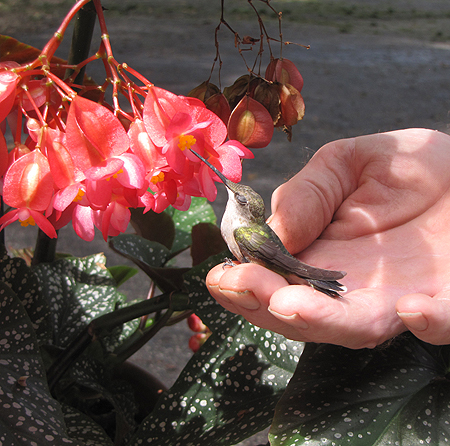
But the story doesn't end there. Two days later, while in my office, who reappears but our little friend. This time he was not scurrying to leave. He checked out the red flowers as usual but then the most amazing thing happened - he flew straight towards me, hovering inches from the glass doors separating us. As if there to thank me for what we had done, he returned to the flowers, then back to me again, repeating this pattern several times. We were eye level, a mere 24 inches dividing us. But there was an undeniable message in his glance - one of deep gratitude for a simple act of kindness. He has since returned in the same pattern on several more occasions.
How easy it would be for me to dismiss this event as meaningless. But I believe no good deed goes unrewarded by the Universe. Blessings often come in small packages, some as diminutive as our humming bird. But they are no less meaningful. Do not disregard them for you will miss out on some of life's greatest treasures. Kindness + Gratitude= Joy.
Copyright, 2011
www.PfeifferPowerSeminars.com
* Read CANDY APPLE
Newsletter: August 9, 2011
CAT FIGHT CALAMITY
by Janet Pfeiffer
At last night's meeting of my anger management group, one of the participants shared a recent incident between him and his wife. She had to leave town for a few days on business. He was in charge of caring for their two cats (actually her cats; he's not a fan of felines). One of her beloved kitties has health issues that were being managed effectively with medication. Before leaving, she handed him a list of instructions along with the vet's name and phone number.
"Call me if you have any questions", his persnickety wife affirmed as she walked out the door. No big deal, he muttered to himself. It's only a cat. But as fate would have it, shortly after she left, one kitty became ill. The following morning brought no significant improvement so he phoned the vet only to be informed the doctor himself was out sick. He promptly located another clinic and made an appointment for later that day. Without knowing the cat's history, the doctor made an educated diagnosis, prescribed medication and sent them on their way.
Upon her return, the husband carefully relayed the incidences of kitty's medical escapade. By now, the cat was on the road to recovery. He was pleased. She went ballistic and lambasted him for not bringing the cat's records with him to insure the vet made an exact diagnosis and prescribed an optimum treatment plan. He countered with "The cat's fine! At least I didn't kill him!"
Needless to say, an argument ensued as to who was right and who was wrong in this situation. "You should have handled it better!" "But you know I'm not good with cats!" Assumptions, accusations and defenses continued for hours.
So who was right? In any given situation, each party has certain responsibilities. The wife, fully aware of her husband's lack of knowledge and enthusiasm for her furry felines, could have given him the option of watching them rather than simply handing him the responsibility. If he agreed, she needed to have all medical records readily available to him with the name and phone number of a covering vet. The wife also could have requested that during any subsequent examinations, he was to call her so she could speak directly to the doctor to make any decisions concerning treatment.
He, on the other hand, knowing how particular his wife is, could have declined caring for her pets, explaining that this is not his forte. And for the sake of the animal, she might feel more comfortable hiring someone more qualified during her absence. If he chose to be caregiver, he needed to treat the cat with the same attention his wife does. To do any less would be disrespectful to her.
Both parties could have handled things better. Each had a responsibility to communicate their feelings and needs clearly and in great detail to the other and come to an agreement each felt comfortable with. Assumptions, demands and blame exacerbate any situation while personal responsibility and clear dialogue greatly enhance it. Take ownership, avoid blame, seek positive solutions.
Copyright, 2011
www.PfeifferPowerSeminars.com
Newsletter: July 26, 2011
CHARLIE AND (THE DARK SIDE OF THE) CHOCOLATE FACTORY
by Janet Pfeiffer
I belong to the online community Linkedin, a website for business people seeking to connect with one another to grow their businesses. Within this community are discussion groups like-minded members can join. Members post questions and spark interesting dialogues. One in particular caught my eye: "If you knew this was your last day on Earth, what would your legacy be?" I immediately posted my sentiments: " to be a reflection of God's love, kindness, compassion and peace in this world; that others will see God in me and be drawn to know Him on a deeper level."
Others followed: "do one thing for somebody else each day"; "stand strong and keep faith in the mist of the storm". We're off to a great start, I thought. But alas, I spoke too soon. One contributor, "Charlie", thought differently and made some derogatory remarks. "While it's very 'nice' to speak kind words or be a good Christian, your idea of legacy is very thin". She proceeded to "challenge us to make a difference based on real actions" and not "some trite words about God".
Another responder cautioned her to be careful of criticizing others and stated she raised over $650,000 for charity. Charlie quickly dismissed this as not conforming to the definition of legacy and proceeded to clarify by referencing the dictionary. To that she added "I also raised thousands for charities." (Meow!) Responder noted she (responder) needed to purchase a copy of Janet Pfeiffer's The Secret Side of Anger. Charlie viewed this as a sarcastic dig. This is where me and my big mouth stepped in.
Giving her the benefit of the doubt, I stated that while I did not believe she meant to be offensive, some of her words could have been taken as such. I followed some blah, blah, blah with "Thank you for living your life with passion and purpose. I admit that." But by now, Charlie was clearly on the defensive and lashed out at everyone who tried to explain the nature of the group and/or smooth things over. She accused the host of "only generating this discussion to gather a congregation", accused others of bullying her and threw a jab at me for "self-promoting" by mentioning my book. She threatened to withdraw.
Once again, my fingers hit the keypad as I tried in vain to smooth things over by requesting we all respect one anothers beliefs and not make this a battleground of bruised egos, false accusations and digs. To that, she accused me to deliberately trying to provoke anger in others in order to sell more books. (Sigh!) One final suggestion from me, that perhaps this particular discussion was not a good fit for her, only fueled her fire. (Time to let it go, Janet.)
But Charlie had other ideas and continued to antagonize the group. I followed the discussion but chose not to engage further. Her final post (I'm never really sure) was riddled with sarcasm "Based on previous experience of you (meaning me) I'm sure you will feel the need to respond so go ahead".
It was apparent from the get go Charlie was not a happy camper. Defensive, offensive and aggressive, she was actually the bully she accused others of being. (Very sad.) It's hard for all of us to see the "dark" side of who we are: our problems, issues and offensive behaviors. Being the victim and blaming others is much easier than taking personal responsibility. Observers often feel the need to point out the other's flaws and errors (but only because we care, right?). However, with their defenses firmly in place, this only exacerbates the situation and further supports their belief that they are being unfairly targeted.
While I believe my motives for intervening were honorable, (but can I really be 100% sure?), I violated one of my own cardinal rules: never argue with a Mr./ Ms Right. They always have to "win". (Remember Charlie Sheen - WINNING!! Maybe it's a "Charlie" thing.)
It's noble to put forth an effort to clarify a concern but when it is not well received, know when to walk away (not easy if we're functioning in ego - is that where I was??).
By now this discussion, for me, had long overrun its course. Time to move on to more constructive matters and be at peace.
PS: Charlie immediately started her own discussion within this same group addressing the poor treatment she recently endured from "another group". Apparently she needed validation that she truly was a victim. What she doesn't realize is that she is victimizing herself through her own insecurities. Say a prayer for her if you can.
Copyright, 2011
www.PfeifferPowerSeminars.com
Newsletter: July 12, 2011
HE IS SO NOT WORTH IT!
by Janet Pfeiffer
Steven stormed into my office and threw himself down in the chair. "I can't stand it anymore!" he moaned. "The guy is driving me crazy!" "And that would be..." I inquired? "Andre. He's this new kid they just hired and they stuck him with me to train." "What is it about Andre that bothers you," I asked. "Everything!" "Could you be just a bit more specific?" I requested. "He's so darn arrogant. He thinks he knows everything. I've been assigned to teach him the ropes and help him learn how this company does business. But no matter what I suggest, he thinks he knows more than me. I can't stand it anymore!"
"Why do you allow him to bother you?" "How can I not?" he continued. "This guy could drive Mother Theresa up a wall." He was determined to convince me that his reaction was perfectly normal and Andre was an idiot. "You know," I explained, "no one really has the ability to make you frustrated or angry. You choose to react that way. You are causing yourself a great deal of unnecessary stress."
He considered what I said. "You're right. I'm the one suffering. My blood pressure goes through the roof every time I even think of him." "Is it really worth it," I asked? "No it's not. He is so not worth it! " Steven declared.
"Wait a minute," I said. "I didn't say he wasn't worth it. I was talking about the situation." "Yeah," he continued, "but he's not worth it either. The guy's an obnoxious jerk!" I took a deep breath before proceeding. Grasshopper needs enlightenment.
"When we declare a person is 'not worth it', we devalue the individual. That is a judgment statement that diminishes a person's significance. We do not have the right to decide that. The situation, the attitude of superiority, is not important enough to get upset about. But the situation or behavior is not the individual. They are two separate and unique entities. We must clarify those distinctions and not confuse them. 'He's not worth it' is, in itself, an arrogant statement. So inadvertently you are mimicking the behavior in him that you loathe."
He paused for a moment. And then it happened - the "AH, now I get it" moment I'd been waiting for. "Wow," he exclaimed. "I never looked at it that way."
Most people don't. We confuse a person's behavior with their intrinsic value. Behavior merely reflects what the individual is experiencing internally. It's a window, of sorts, into a person's deepest self. Keep the two (person and situation) separate. It allows you to more effectively address the issue without feeling contempt for the individual. He is definitely worth it; the situation not so much.
Copyright, 2011
www.PfeifferPowerSeminars.com
Newsletter: June 28, 2011
REFUSE WARRIOR
by Janet Pfeiffer
I didn't know his name. I had no idea who he was, where he came from or what he did for a living. I didn't know his nationality or if he had family. We never spoke a word. Yet he inspired me to be a better person.
Shortly after moving to Jefferson, I began noticing a tall, lean, rugged looking gentleman walking along the roadside. Laden with plastic grocery bags from the local supermarket, he walked for miles on end picking up trash alongside the thoroughfare. I never knew quite where or when I would stumble upon him but for years he was as much a local fixture as the pine trees that shaded his expedition.
There were no "adopt a roadway" signs bearing his name, revealing the identity* of the man responsible for maintaining much of the pristine beauty of our community. I admired him from a distance for his selfless and humble commitment to keeping our town clean. Recognition for his efforts was clearly not motive for his altruistic actions. He did it because it mattered to him.
Roadside trash really bothers me and I secretly wished I had the time to follow his lead. But I'm much too busy running a business that consumes me. And, there is far too much trash along the roads I travel. Where would I possibly begin? (And, may I add, none of it is even mine!).
But, I reminded myself, it doesn't matter whose mess it is. It matters (to me) that someone clean it up. And I don't need to save my entire town. I can care for one manageable portion. Each day upon my return home, I am greeted by a stretch of undeveloped land approximately 1/2 mile in length. Plastic water bottles, food wrappers and Styrofoam containers migrate to the wooded greenery that greets the pavement. The displaced refuse diminishes the innate beauty that enticed me to buy a home on this street. This, I decided would be my task. So I adopted this small parcel of earth. In the early morning hours, I surreptitiously maintain the flawless perfection of one half tract because it matters to me.
We all desire acknowledgment and accolades for the good we do in life yet many times it is not forthcoming. Oftentimes, we consider holding back. "Why should I work so hard at work? No one even says thank you." "I sacrifice for my family and it's not appreciated. I'm not doing it anymore."
Never allow the lack of approval from others deter us from performing noble acts.
Whether at work, within the family unit or on a community level, follow the footsteps of Jefferson's Refuse Warrior: let the satisfaction of doing good be reward enough. Remember, it only needs to matter to you to make it worth the effort.
*Recently I learned the identity of Jefferson's Refuse Warrior. His name is Allan Spears and he passed away last month. But I promise to keep the legacy of Mr. Spears's alive in me because it matters, to both of us.
Copyright, 2011
www.PfeifferPowerSeminars.com
Newsletter: June 14, 2011
CANDY APPLE LIFE
by Janet Pfeiffer
For years, I've had a gorgeous houseplant that produces delicate clusters of soft pink blossoms throughout the year. Given to me by one of my best friends, it requires good light, weekly watering and an occasional dose of Miracle Grow. Clippings root easily in water and subsequently one plant has propagated to three. Broad green leaves sprinkled with white flecks adorn the lanky stems.
Occasionally, I move my houseplants to the deck outside my office for the summer. I savor their beauty through the transparency of my sliding glass doors. This year was the first time this variety of begonias prospered from the fresh outdoor air.
Within a short period of time I noticed a remarkable transformation: the leaves had naturally grown deeper in color (no surprise). But the clusters of flowers had unexpectedly undergone a remarkable change as well. No longer bubble gum pink, their color now rivaled that of the finest Halloween candy apple. Upon further investigation, I discovered the underside of the leaves, normally a pale greenish/gray, were bright crimson. This once lovely plant was now a stunning specimen!
It puzzled me that I was taken aback by such dramatic changes. Houseplants are not really house plants. All plants were designed by nature to grow in their native environment - outdoors. Once placed in the proper location, the ideal growing conditions allow them to flourish and reach their designated potential.
I am always in awe of nature and the unlimited lessons we learn from her. I contemplated the similarities between my begonias and fellow human beings: don't each of us need the proper environment in which to fully grow and develop? So many of us are stuck "indoors" - in places or with people that prohibit our natural evolutionary path. We commute to work environments that stifle our natural abilities and talents; we have families that pressure us to conform to what they deem acceptable; we associate with negative friends who suffocate our aspirations and joy; our jealous spouses monitor our every move, limiting our social activity; society dictates our lifestyle and career choices based on current trends. Sadly, we sometimes unintentionally accept the pale hue of our existence, not realizing that under more conducive circumstances our lives can intensify with meaning and joy and blossom in ways unimaginable.
Moving outdoors definitely has its challenges: I must water more frequently, protect the fragile stems from high winds and keep the deer from feasting on my flora. But it is well worth the effort for each day I am in awe of the brilliant colors and overwhelming splendor once thwarted by an unsupportive environment.
Moving and/or removing that which (or those who) limit us are necessary measures to personal fulfillment and the crimson life we were designed to have. I invite you to move beyond your bubble gum existence into your candy apple life.
Copyright, 2011
www.PfeifferPowerSeminars.com
Newsletter: May 31, 2011
IT'S A LOT HARDER THAN IT LOOKS
by Janet Pfeiffer
We all live in personal denial* to a certain extent. It's far easier to recognize the imperfections in others than to take inventory of ourselves. That's understandable. To acknowledge one's own faults requires a strong sense of self. Low self esteem and insecurities prevent us from being completely candid.
Facing the truth means making a decision. Either we fabricate excuses and remain stuck in our deficiencies or we embark on the sometimes arduous task of personal growth and self improvement. Facilitating change takes time and energy. It isn't easy admitting our shortcomings but is absolutely necessary if we want to realize the full potential of who we were created to be.
I challenge you to answer the following questions. Carefully consider your answers. Examine your heart. Be brutally honest for it is only in truth that one is liberated.
WHICH ONE ARE YOU...REALLY?
A Questionnaire for Enlightened Seekers of Truth
There are people in this world who cause problems...
And there are those who work at finding solutions.
Which one are you?
There are people who cause pain and suffering wherever they go...
And there are those who bring compassion and healing to those in need.
Which one are you?
There are people who seek revenge o those who have hurt or cheated them...
And there are those who choose to forgive.
Which one are you?
There are those who criticize and belittle the shortcomings of others...
And some who encourage and support their strengths.
Which one are you?
There are those who offer the world negativity and anger...
And others who bring hope and laughter.
Which one are you?
There are people of prejudice who divide and separate us because of our differences...
And people of love who unite and appreciate us because of those same differences.
Which one are you?
There are people in this world who search for every excuse to hate...
And others who embrace every opportunity to LOVE.
Which one are you?
And in the end, when they are gone,
There are some who will have left behind them trail of suffering and destruction.
And others who leave for the world a legacy of love and kindness.
WHICH ONE ARE YOU...REALLY?
If your answers consistently fell in the latter category, I challenge you to reconsider. Thinking of how those around you might respond if asked to share their observations of you will give you deeper insight. Remember: denial of truth imprisons. Be brutally honest first, gentle on yourself second (remember, life is a continuous journey towards personal excellence). Then honor the beauty of who you are.
What I know for sure is that if you are reading this newsletter you are already a courageous seeker of truth and well on your way to greatness! Let's celebrate together when we get there.
*Read about Denial
Copyright, 2011
www.PfeifferPowerSeminars.com
Newsletter: May 17, 2011
I REALLY BLEW IT!
by Janet Pfeiffer
Let me introduce myself to those of you who may not know me. My name is Janet Pfeiffer. I am the anger management lady, the one who promotes peaceful living, cooperation and harmony; the one who is eternally happy, always polite and respectful; the Mary Poppins of NJ. I am sickening sweet and nauseatingly positive. Sometimes I project an image of being flawlessly perfectly. Let me reassure you - I am far from it. Last week, I really blew it, literally. I blew up - BIG time.
Saturday morning, my normally mild-mannered husband and "Miss Peacelover", had a fight. Not a disagreement, as we typically have, but a yelling screaming, door-slamming fight. And as is the case with most of us, it was over something really insignificant. He had work to do, I needed to cut the lawn. He assured me the mower was working but within 5 minutes I began having problems. He had to stop what he was doing and fix it yet again...for the gazillionth time. "This @!#*@#! mower is 40 years old for crying out loud!" he shouted. "I'm sick and tired of fixing it!!!" (More @!#*@`! expletives.)
Normally, I would simply turn away and let him be upset. But no, I had to open my big mouth and insert my even bigger foot. I violated my own Number One rule when dealing with an angry person: I took his behavior personally. After all, it's my lawn mower that I purchased long before we met. And it has long outlasted its life expectancy. For years, he's complained that we need a new one. I'm the one who's procrastinating.
Feeling attacked, I continued being stupid and violated rule #2: I shouted an inflammatory question. "I suppose this is all MY FAULT?" I screamed. (Yeah, screamed, she sheepishly admitted.) Not waiting for a reply, I slammed the door, causing 3 of my newly-framed photos to shatter on the tile floor.
After I calmed down, I felt horrible. I was so disappointed in myself. I really blew it. But, I rationalized, since there was no cursing, name calling or physical violence it wasn't all that bad. And besides, it's only the 4th fight we've had in nearly 16 years (that averages out to one every 4 years - way below the norm.) And, since we apologized immediately, everything's fine.
But no amount of rationalization on my part could excuse my bad behavior. I never want to hurt my husband or disrespect him in any way. And I did. There is no justification in that. Being peaceful, like any other life choice, takes awareness and conscious actions. I let myself down and I feel ashamed. I must vow to never repeat such an offense again.
Next time I encounter an angry person, I'll practice what I teach others:
The R/D/C Method: Refuse/Diffuse/Choose.
- Refuse to get caught up in their anger. Maintain your composure.
- Diffuse the situation by walking away or making a calming statement such as, "I know you're upset. What can I do to make this easier for you?"
- Choose a smarter way of dealing with the situation. You know what doesn't work (slamming doors, accusations, screaming). Opt for an alternative: humor, understanding, helpful suggestions, etc.
Remember: it's ok to be angry but hurting someone is not - ever.
Copyright, 2011
www.PfeifferPowerSeminars.com
Newsletter: May 03, 2011
SHE GOT WHAT SHE DESERVED
by Janet Pfeiffer
She was dating the nicest guy: thoughtful, kind, funny. Her friends envied her but she never appreciated him. Demanding and arrogant, she'd often hurt his feelings with her razor sharp tongue. Begging her to stop was futile. Finally, he'd had enough and left.
She came to my office shortly after the breakup. Tears moistened her cheek as she reached for a tissue. "I really messed up. He was the best thing that ever happened to me and I blew it. Do you think I can win him back?" I sat quietly as she continued. "My best friend is so angry she won't even talk to me. She warned me that if I didn't treat him better he'd leave. She said I got exactly what I deserved." "What do you think?" I asked. "She's right" she replied. "There was no reason for me to treat him that way. I had it coming."
We often gloat when hearing of someone whose bad behavior finally catches up with them: a coworker guilty of taking long lunches and exiting early at day's end gets fired; an unemployed adult child freeloading off his parents finds himself living in his car; a drug addict, busted, lands in jail. We feel a smug sense of justice when consequences finally catch up with an offender. "They got exactly what they deserve!"
But do people really deserve punishment, shame, hardship, loss? Granted, lessons are often learned most effectively under adverse conditions. But punishment focuses on inflicting additional pain and suffering (albeit sometimes in the hopes of reforming the wrongdoer). But negative begets negative and anger, guilt, embarrassment and diminished self worth are often the unfortunate byproduct.
As you've often heard me say, behavior is an outward expression of an internal issue. People act out what they feel, sometimes inappropriately. One who experiences trauma (bullying, incest, abandonment) may reach for a substance to ease the pain. In the case of my client, she notoriously chose controlling men. As much as she wanted a relationship, her fear of being dominated yet again caused her to be offensive and push him away rather than embrace him. Contrary to her belief that there was no reason she treated him badly, there was. There is always a reason for everything we do whether we recognize it or not.
Each of us is hurting enough based on our poor choices. None of us needs more suffering. What people deserve is understanding, compassion and forgiveness so that they may be uplifted and transformed.
Imagine a world where people overcame their fears - there would be no more threatening or manipulating; where they healed their anger - no more abuse or fighting; where their insecurities were resolved - no jealousy or gossip. Relationships would be infinitely easier and life far more enjoyable for everyone. For it is in healing, not punishment, that we are able to live in abundant prosperity and harmony with all.
Copyright, 2011
www.PfeifferPowerSeminars.com
Newsletter: April 19, 2011
NOTHING MAKES ME HAPPY
by Janet Pfeiffer
Yesterday in Dear Abby, a young man asked if he should marry his long time girlfriend. "She's everything I could ever ask for, nearly perfect, but I don't know if she'll make me happy." In a recent interview, Ashley Judd said she didn't feel compelled to have children. "I'm not sure they would make me happy," she stated. A woman I've been coaching for several weeks recently admitted her job no longer makes her happy.
I remember the many years I struggled with despair - nothing I did or had made me happy. Husband, kids, holidays, friends, possessions - joy was nowhere to be found in my life. It seemed normal to be miserable. Periodically, there would be moments of pleasure but they were fleeting at best. Life was dark and gloomy with only occasional glimpses of light. Try as I did to find someone or something that would bring me joy, I remained depressed and discontented.
My life was a dismal existence of day-to-day responsibilities and problems. I guess I'm not one of the lucky ones, I thought. I guess my life is meant to be glum. Sadly, I resigned myself to my fate.
But at some point, I realized I didn't want to continue this way. I began to search for answers. That search led me inward, where all answers lie. Gradually I determined that no one could make me happy. Actually, no one is liable for my happiness (or misery) except me. Nothing I owned or possessed had the power to make me happy. While I enjoy the things I have, take pleasure in what I am doing, have fun with the one I'm with, happy is an inside job. It's a choice, one that I make every moment of every day.
Children instinctively know this. One only needs to spend a few moments observing them. They posses the natural ability to be happy...period. Watch as they play in the mud after a rainstorm; or dance in their room, spinning in circles. Listen as they sing nonsensical songs out of tune or delight in a bug crawling across the ground. There's no one around, no toys, no computers - just the child and their attitude and imagination. They carry joy in their hearts and freely express it at any given moment.
Somewhere in the journey to adulthood, we lost the natural ability to be happy. We erroneously assigned that task to others or to life in general. And when they shirk their duty, we succumb to anger and misery. Regardless of who you're with, where you are, or what you're doing, you can actually be happy.
So I decided to be happy and joyful within my circumstances, not because of them; to be happy regardless of who I'm with, rather than relative to. Happy is an attitude and I choose my attitude the same way I choose my wardrobe or my breakfast.
I discovered how to be happy...period, with NOTHING. I need ABSOLUTELY NOTHING to be happy. Just that simple revelation alone makes me happy! I feel like a kid again. Wanna play in the mud?
Copyright, 2011
www.PfeifferPowerSeminars.com
Newsletter: April 5, 2011
WHAT WERE THEY THINKING?
by Janet Pfeiffer
In the wake of the recent tsunami in Japan, the entire world felt the after shock of the unprecedented devastation this country endured. A record 9.0 earthquake followed by enormous tidal waves left entire cities in ruin and more than 27,000 dead.
Tsunamis are not preventable. Nuclear disasters are. In a country that experiences high levels of seismic activity, (not to mention being one of the world's most densely populated areas) it defies logic - my logic, at least - that anyone would even consider building nuclear power plants within their borders. To build near or on a fault line is, in my opinion, a complete disregard for human safety.
The reactors continue to face the possibility of a meltdown. Dangerous levels of radiation and plutonium have been detected. Cleanup could last five years, allowing for radioactivity to diminish. Those who braved entering the reactors in an effort to save millions of lives face an almost certain premature and painful death, leaving behind loved ones to grieve their senseless loss. Like Chernobyl in 1984, the full effects of this disaster will not be understood or felt for generations to come.
Failure to choose a safer location and/or energy source that could have minimized global annihilation of such astronomical proportions is, in my mind, callous, negligent and irresponsible.
And yet, as individuals, aren't we all guilty of such indiscretions on smaller, yet no less damaging, levels? We disregard anothers feelings when criticizing them and blurt out whatever's on our mind. A moment of insensitivity can cause years of heartache. A teacher tells a young student they'll never amount to anything, leading to a lifetime of poor career choices. A father abandons his child, the message being they are not worth loving. The child, feeling unworthy, struggles with personal relationships. A night of reckless partying culminates in the loss of a life, destroying entire families.
We can never fully measure the amount of pain and suffering we cause another over the course of their lifetime based on our callous and irresponsible acts. When we fail to consider the long term and far reaching consequences of our actions we are behaving with utter disregard for the well-being of the other. A simple remedy is to consider every alternative option to guarantee the best possible results for all parties while yielding minimal, if any, negative consequences.
So, before making any decisions, ask yourself the following:If I say or do _____, what may happen? What are the possible long term and far reaching consequences of my choice? Are they in the best interest of all parties concerned? If not, what must I do differently to ensure the optimum outcome for all now and in the future? One moment of thoughtfulness can prevent a lifetime of suffering.
Had these power plants been constructed with that objective in mind, perhaps the world and future generations would not be facing the horrors of a possible nuclear disaster.
Seek always to avoid inflicting possible suffering on others. Instead, choose alternative methods that engender positive benefits for all.
Copyright, 2011
www.PfeifferPowerSeminars.com
Newsletter: Mar. 22, 2011
FALLEN STARS
by Janet Pfeiffer
This season, I've taken to watching Celebrity Apprentice. Although not a fan of "the Donald" nor the celebrities on board, I do enjoy the creative aspect of watching people bring concepts to fruition. But last week's episode was painful to watch. Each week the two competing teams choose a project manager. This week was Lisa Rinna's turn.
Things got off to a rough start and progressively worsened. Not particularly fond of Lisa's, Star Jones and Dionne Warwick vowed to speak openly with her should any disparities arise and work together as a team. It wasn't long before they broke their own promise and allowed their insecurities to create division among them.
Discourteous remarks began circulating, culminating in a confrontation between the three. Lisa, initially requesting an open dialogue, countered defensively. Star (a former prosecutor) resorted to court-room tactics, using legal jargon, bullying, threats and intimidation.
Diva-like Dionne was manipulative and condescending dismissing Lisa time and again. A successful alliance initially formed to oust Lisa from the show succeeded when, in the board room, Trump uttered those ill-fated words, "YOU"RE FIRED!"
Then, just when it seemed the drama had concluded, the bell sounded for round two. Rather than accept her fate with dignity and grace, Lisa posted unflattering remarks about Star on Twitter. The former prosecutor retaliated with an imminent lawsuit.
While these women struggled to win the battle, clearly none could, for each made a fundamental mistake: they thought they could handle criticism. Lisa's need to defend herself when faced with contradictory remarks indicated a lack of self confidence. An unwillingness to consider the validity of another's perspective or suggestions by dismissing them revealed a need to control (fear based).
Star's need to bully and threaten (arrogance and hostility) indicated her own fears and insecurity. ("When I threaten people back down and comply with my demands.") And Dionne's grandiose image of herself surfaced in her unwillingness to face her weaknesses and flaws.
Denial of (self) truth is a clear indication of poor self image. Lisa's counter attack ("Revenge By Twitter") only perpetuated her fear in a struggle to regain control and status.
While many profess to appreciate those who are honest and up front, few can graciously handle criticism or opposition. The need to defend, protect and prove is all based on insecurity and self-doubt. In an effort to prove themselves, these women actually revealed serious character imperfections. Rather than be exemplary women of confidence and courage, they exposed and allowed their own insecurities to hinder their chances of completing their mission: to raise funds for their favorite charity.
Take a moment and examine your response to criticism. Being truly comfortable with opposition demonstrates a healthy sense of self. The opposite presents a challenge to strengthen one's self esteem.
Sadly, that night, all three Stars failed to shine.
Copyright, 2011
www.PfeifferPowerSeminars.com
Newsletter: Mar. 8, 2011
THE 120 LB ROTTWEILER
by Janet Pfeiffer
The Rottweiler weighed in at 120 lbs.; the man walking him about 180. Yet the dog clearly had the advantage. The man struggled as the Rottie pulled and dragged him down the street. As I rounded the corner with my 3 furry companions, I moved to the opposite side of the road and instructed my dogs to stay by my side. With both hands firmly gripping the leash, the man braced himself with as his dog lunged at mine, barking loudly and with heavy breath.
"Don't worry!" he shouted as his knees hit the pavement. "He's friendly." (Really, I thought? Could've fooled me.) The four dogs spent a few moments "saying hello" without incident. (Thank God. Had his dog been vicious, the consequences could have been devastating!) Although visibly excited, mine remained by my side and relatively well behaved. Clearly outweighed twice over by my girls, I was at no time in jeopardy of relinquishing my authority over them. They were well trained.
He and I exchanged a few pleasantries when he asked me how I did it - kept my dogs under such strict control. "I don't", I replied. "There is no control. I taught them to heal, to walk by my side without pulling. When they do, it's effortless for us to walk together because they remain calm under even under stressful conditions." I continued. "They were taught not to be distracted by outside stimuli and when they behave properly they are rewarded for their good conduct."
He asked if I could help with his dog so I gave him a few points: pay attention to what is going on around you at all times; at the first sign your dog is becoming excited, intercept his line of sight (what he is looking at) and change his focus from what is exciting him to what is calming him down (you); be firm and repeat the word "heal" as you keep him close by your side. A stern, composed voice repeating a single command retrains his brain.This newly conditioned response replaces prior negative behavior and becomes his habituated reaction to future situations of a similar nature. He is, in affect, healed of his bad behavior. Walking him now in public is not only easier but far less dangerous."
For many, this story is symbolic of our anger: we try desperately to control it and prevent it from dragging us to our knees. Yet anger is an incredibly powerful force and it takes an enormous amount of energy and diligence to accomplish that. I have always encouraged people to heal their anger. Once healed, you can encounter any stressful situation and maintain you composure. The others behavior no longer dictates your reaction. You remain calm and serene, your response diffuses the situation, and all involved leave unscathed. A perfect ending to a threatening situation.
If you or someone you know needs help healing their anger, contact me. It's what I do.
Copyright, 2011
www.PfeifferPowerSeminars.com
Newsletter: Feb. 8, 2011
THE WORLD'S WORST TEACHER
by Janet Pfeiffer
She taught high school for a long time. No one understood why her students never scored high on their exams and few went on to college. I sat in on her class as part of my research in child development. My observations were alarming.
Her students were typical adolescents. Some were lazy, some class clowns, a few were classified "slow learners". Her method of teaching was highly unorthodox.
As I assumed my position in the back of the classroom,she began her lesson plan of the day. "Who read last night's geography assignment? Hands raised in the air. "What's the capital of Montana?" she queried. "Butte," one student replied. Her glare penetrated the room. She repeated the question.
Each time a student responded incorrectly she became increasingly agitated. "If you're going to be stupid then so will I: you give dumb answers, I'll give dumb answers. It's Los Angeles!" She quickly moved on to the next subject.
I waited in vain for her to provide the correct answer. Is she kidding? She's a teacher, for God's sake! How can these children learn anything if she gives them incorrect information? The end of the day arrived when I finally approached her. "Why did you give your students wrong answers?" I asked. "I hate it when they act stupid so I give it right back to them. Two can play that game," she sneered. "But how does that help them? How does it make the situation better for anyone?" "It doesn't," she snapped. "Then why do it?" "Because I can't stand ignorant!" I stood speechless as my brain fumbled hopelessly for a retort.
Ok, this is where I tell you that this story is completely fabricated. I admit - I made it up to make a point. As preposterous as this scenario is, haven't we all played this "game" periodically in our lives? A driver cuts you off and you give them the finger; you match the sales clerk's rudeness with a powerful dose of your own; a coworker criticizes you so you criticize back. "An eye for an eye" philosophy dictates the behavior of many. But the question remains the same: how does responding in kind benefit anyone? Does it improve the situation or enrich the life of either party? "It doesn't" is a clear indication that the response is neither intelligent nor beneficial.
In life, we are continuously faced with choices: to be part of the problem or part of the solution. If rudeness, sarcasm, ignorance or hatred is the issue do I really want to ally myself with that type of behavior and contribute further to the problem? Or, do I choose to rise above and be solution by responding with truth, integrity, accuracy, kindness and dignity? By choosing solution, all parties benefit.
Copyright, 2011
www.PfeifferPowerSeminars.com
Newsletter: Feb. 8, 2011
ACCIDENTAL ANGELS
by Janet Pfeiffer
I started early, allowing extra time for traffic. The drive should only take ninety minutes but in N.J. you never know. Half way there I found myself stuck in rush hour traffic on the Garden State Parkway. I breathed a sigh of relief. (Thank God I left early.) I was confident I'd arrive on schedule for my lecture at St. Bartholomew's Church.
I made my way to the exit ramp and reached for my directions (I know - I'm not a fan of GPS). Left at the light, 3 miles, right on Summit. Well, that didn't work. I pulled into a parking lot to turn around. Suddenly, my car didn't respond to pressure on the gas pedal. Instinctively, I knew it was the transmission. I called my husband. "Let it sit for a few minutes, then try again." (Thank God I have a husband who knows cars.) It didn't respond. I called the church. "Sit tight. We'll pick you up." (How nice of them!) My husband left home to come get my car. (He's a good man.)
I arrived 45 minutes late to an animated round of applause. After a quick set up, I began my talk on the healing power of forgiveness. Upon completion, I received a standing ovation and book sales surpassed the norm. (I was grateful for their warmth and generosity.)
My husband drove my car as far as a gas station where it died again. We were told we could leave it overnight but would have to pay a large fee. It was passed 10 pm when my husband called his son. "I can get my friend's flatbed and be there in an hour," he said. (What a nice stepson I have.) I went to get my husband coffee and spilled it all over myself (luckily for me my dress was machine washable).
Kris secured my car to the truck and hauled it to his house where the following day he would transport it to a nearby mechanic. We arrived home at 1:30 am, exhausted and sweaty. "What a great evening!" I exclaimed. "What?" my husband replied. "Everything went wrong tonight. And this repair is going to be expensive!" "No", I replied. "Everything went exactly right. Whatever obstacle arose, God sent an angel to help: you, the church driver, Kris. All night, I've been surrounded by angels. It was perfect."
The following morning, I called the mechanic. My transmission needed to be completely rebuilt. "Since you're Kris's stepmother, I'm taking $300 off the bill." (Yet another angel!) My husband pointed out that the bill was still high. "It's ok. What I earned in book sales last night covers the cost of the repair. How great is that?" "But that means you didn't make any money!" "No, that means I earned exactly what I needed to fix my car. It would have broken down whether I gave this talk or not. Now I don't have to take money out of my savings account."
I truly felt blessed. What would appear to some to have been a disastrous evening was for me filled with unexpected miracles ... all performed by accidental angels.
Copyright, 2011
www.PfeifferPowerSeminars.com
Newsletter: Jan. 25, 2011
OUTWITTED
by Janet Pfeiffer
Last evening, I spoke before a sold out audience in Hillsdale, N.J. The crowd was enthusiastic and engaging and, as usual, filled with questions long after my lecture ended. Although my talk was not on anger, many of the subsequent queries were. One such inquiry was posed by a high school teacher who expressed her frustration over a student. "He's rude and disrespectful - a bully. I want him out of my classroom and I don't care where they send him!" A look of shame came over her face. "That's not very nice, is it?" she asked. "I understand," I replied. "We've all had people in our lives we wish would go away. But how does this help the child?" Her eyes fell to the floor. "It doesn't," she admitted.
I asked a few questions, hoping to learn more and offer some viable suggestions. The boy's parents rarely engaged in his life. As a child, they trained him well in the ways of bullying by conceding to his tantrums and demands. The older and more difficult he became, the greater distance they put between them. Additionally, the teacher explained, this student excelled academically in class - he was bored.
"It sounds like he craves attention and validation," I commented. "Bullies are insecure and feel unimportant and sometimes invisible. The fact that he's gifted academically and not being challenged adds to his frustration." She listened sympathetically. "Repositioning him to another school only reinforces his worthlessness. He becomes someone else's 'problem' and continues his troubled path. This child needs reinforcement and confirmation." She solicited my help. "Can he assist you in teaching some lessons in class? Feeling needed and appreciated could help alleviate some negative behavior." She enthusiastically agreed to try.
One of my favorite poems from childhood is "Outwitted" by Edward Markham: "He drew a circle that shut me out - heretic, rebel, a thing to flout. But love and I had the wit to win: we drew a circle that took him in." Feeling unloved, unwanted, or unappreciated is deeply painful. And pain is often expressed in the form of anger, bullying or rage. While our natural inclination is to get as far away from difficult or problematic people as possible, it only reinforces their beliefs and adds to their suffering. Reaching out, taking time to encourage, befriend and compliment can help validates one's existence and begin the journey towards wholeness.
Would you help someone who slipped on ice and suffered an injury; rescue an abused or abandoned dog from a shelter; take a sick parent to the doctor? Of course you would and why? Because most people are compassionate and care about the well-being of others. A bully is equally as deserving of respect and healing as those I mentioned. And yet, many will banish them to obscurity. But their pain doesn't heal on its own. Child bullies grow to be adult bullies and inflict misery on others and the cycle of suffering perpetuates. No one deserves to hurt.
We all want and need to feel a part of one another. Draw a circle. Be inclusive. Invite them in - even and especially the difficult ones. That way, all will win.
Copyright, 2011
www.PfeifferPowerSeminars.com
Newsletter: Jan. 11,2011
HONEY, I SHRUNK THE KITCHEN
by Janet Pfeiffer
As a child, I remember visiting my Aunt Mary's house in New Milford, N.J. Her sprawling ranch style home was nestled on park-like property. My last recollection of being there was around the age of 12. More than 20 years would pass before I'd return.
An invitation from my cousin brought me back to 67 Lacey Dr. We entered through the back door and directly into the kitchen. As I stood in the breakfast nook (I know - I'm dating myself) I blurted out, "Oh my gosh - your kitchen shrunk!" We burst out laughing at how ridiculous I sounded. Of course, her kitchen hadn't shrunk. I'd gotten bigger and was now seeing it from a more accurate perspective.
Our recollections of things past are sometimes distorted. Yet those beliefs impact our lives as adults, shaping who we become and directing the path we take.
Gary Zukav, acclaimed author of Seat of the Soul, says that the most important thing we have are our beliefs. They are the foundation upon which we build our lives. If our beliefs are accurate and valid, our foundation will be sound. If, however, our beliefs are flawed, our base will be weak and unsteady.
For example, if I was told as a child I am worthless and unlovable, that becomes my guiding truth. Every decision I make stems from that belief. I avoid or sabotage loving relationships, feeling unworthy. I neglect or abuse myself, feeling contemptible. I settle for less knowing I am undeserving.
Uncovering the origin of my beliefs and determining if its source was valid can help me re evaluate my position. Was it a jealous classmate telling me I was stupid and ugly that impacted my view of myself? Clearly, the source was erroneous and I can amend my opinion.
What are my beliefs about myself, others and the world in general? Do I ascribe to the notion that people are inherently evil or good? Was I taught that God punishes or that He is a loving and compassionate Being? What about disease? Do I believe there are some for which there is no cure? If I was raised to believe I am privileged, have I developed an attitude of arrogance and entitlement causing difficulty in my interpersonal relationships? Each belief, whether valid or not, directs the course of my life: how I feel, my attitude, the choices I make.
Here are some common beliefs that may need revisiting: As you age, you slow down/gain weight/can't do what you used to/develop medical problems ~ certain people deserver more respect than others ~ I shouldn't have to put up with this ~ Nothing ever works out for me ~ I can't _____. And the list goes on.
Periodically, it's important to revisit your "Aunt Mary house" for any erroneous beliefs. Perhaps, the start of this New Year is the ideal time to make sure your foundation is solid.
Remember: A house built on a faulty foundation will crumble. A life built on untruths will fail.
Copyright, 2011
www.PfeifferPowerSeminars.com
Newsletter: Dec. 27, 2010
I'LL NEVER EVER FORGIVE AGAIN
by Janet Pfeiffer
Several months ago I appeared on an internationally acclaimed TV show hosted by a husband/wife team. For more than a quarter of a century, this couple shared their personal lives and God's Word with millions of loyal followers. I was deeply saddened when they recently appeared on national TV revealing their dark secret of infidelity.
He spoke with great remorse for having committed such an egregious offense against his wife, family, friends and God. She lovingly shared her decision to forgive and preserve their marriage. I knew all-to-well the importance of forgiveness and how it benefited me in past similar experiences. But I have since outgrown forgiveness: I will never again forgive anyone for any offense.
The betrayals of my past have taught me much: first, that everything that happens in my life is a very necessary part of my journey. Each experience is absolutely essential for me to become the person God created me to be and to fulfill His Divine Plan. Much as an athlete must endure painful hours in the gym with demanding coaches and aching muscles in order to break world records, so must I face devastating hardships to achieve personal greatness.
The same applies to family and friends: each must realize their own mistakes and suffer the consequences of their imperfections in order that they, too, may find their appointed path in life. It is not for me to say what decisions they must make nor lessons they must learn in order to fulfill their destiny. This is between them and God and I must remove myself from their equation.
My life is my relationship between me and God. I am here to live my life in ways that please Him. I share my life with others but my life is not about them. When I err, I have failed against God and He is saddened by my poor judgment. My struggles and indiscretions are between Him and me exclusively.
I have also discovered that everything that comes into my life is here to teach and benefit me. Infidelity, blackmail, abuse all have the potential to make me a better person. Each can enrich my life should I allow it. Those who bring these experiences to me are merely messengers in my script of life. I have since learned to welcome them for they bring gifts of immeasurable value for me to unwrap and apply.
Pain has allowed me to come to know God on a deeper more intimate level that a life of ease could never provide. When I hurt, I instinctively turn to Him for healing and He never disappoints. When I feel abandoned, He comforts. When I'm confused, He offers clarity and guidance. Where is there room for anger or hurt towards anyone who has paved the way for me to profoundly know God? There isn't.
Do I need to forgive my boss for requiring me to put in long exhausting hours to earn the title of VP of sales? No. I understand the sacrifices required for success.
And now I understand this great myth of forgiveness: it is redundant when one recognizes the necessity of all experiences. My life is a spiritual journey of knowing God. I am grateful to all who provide me the opportunity to experience His Love. And while the events they bring may not be pleasant, the rewards are immeasurable. For me, there is no longer the need to ever forgive anyone for each has blessed me in ways unimaginable. Thanks to them, my life is exactly as it should be.
Copyright, 2010
www.PfeifferPowerSeminars.com
Newsletter: Dec. 14, 2010
THE FORCE BE WITH YOU...OR NOT?
by Janet Pfeiffer
One of my favorite author/speakers is Dr. Wayne Dyer. Several years ago, my daughter gave me a box of gift cards written by him. While most have been given away to family and friends for various occasions, I have selfishly chosen to keep two for myself. I found both to be especially profound and meaningful.
One in particular has a beautiful photo of water rushing over moss covered rocks. Superimposed over the image are the words "Everything in the universe flows. You don't get ahold of water by clutching it. Let your hand relax...then you can experience it." A childhood image immediately came to mind. One of my chores was watering my dad's vegetable garden. How much fun it was to place my hand in front of the nozzle as the water flowed out of the hose! The strong current tickled my palm as it rushed between each finger.
Allowing the water to flow naturally over my hands was an effortless pleasure (and...the plants got watered in the process). But in choosing to close my hand, the water only became more determined to continue its intended journey.
In my early years, I lived in scarcity, fearful of "loosing" things, people, opportunities, money. I held on tightly to everything and everyone. Possessions were carefully tucked away in their proper place, secured from would-be thieves by camouflage or door locks. Money was hidden in secret places even mom wasn't privy to. I worked diligently at being kind and thoughtful in relationships to ensure people would like me and never leave. And God forbid one did, I'd scurry frantically to restore the connection.
Professionally, I became obsessive about work. Fifteen hour days began before sunrise. I had to do it all and suffered from frustration and exhaustion. "Let your hand relax... experience it": words that transformed my life.
Many of us work so hard at making things happen: I have to loose 10 pounds by the weekend; my wedding must be perfect. We force, rather than allow. Life, like water, will flow as intended whether we agree with it or not. One can neither stop it nor hold onto it. I cannot force a robin's egg to hatch before it's ordained by nature any easier than I can make someone love me. Once I fully understand the importance of letting go and letting things unfold naturally, life becomes effortless and far more enjoyable.
I still begin each morning at 4:45, work out, meditate, eat a hearty breakfast and put in long hours in my office. But what has dramatically changed is that I now allow my life to flow rather than force it to be what I want. I cling to no one and nothing. I enjoy what passes through my life, knowing that when it's gone something or someone else will appear.
Whether a relationship, career or financial situation, let go. Let things flow, effortlessly, the way they are intended, just as water over your hand. Relax and savor each moment.
Copyright, 2010
www.PfeifferPowerSeminars.com
Newsletter: Nov. 30, 2010
HOW WOULD YOU RESPOND?
by Janet Pfeiffer
Periodically, I update my email address book by sending out an announcement of some sort. This allows me to weed out invalid addresses and delete those who no longer wish to hear from me. Recently, I invited everyone to sign up for my free online newsletter while taking advantage of an unprecedented 50% discount offer. (I assured them they could unsubscribe at any time.) Many took advantage, a few opted out, some did not respond at all. One, however, had a few choice words for me.
Claiming I deceitfully obtained her contact information, she proceeded to admonish me, calling my offer a scam. She concluded by demanding I immediately remove her name from my contact list and added "I wouldn't buy ANYTHING from you EVER!!!!!" (I sensed she was upset.)
I could have allowed ego to respond in a defensive manner or completely ignored her. After all, she offended me by accusing me of unethical behavior. I highlighted her address and was prepared to hit "delete" when spirit whispered to my heart: "Reach out. Let her know there are honest people in this world. She is skeptical. Show her the way to trust. Restore her faith."
In every offensive or provoking situation, we have the opportunity to be teacher-healers. Many of you would probably have supported me had I chosen to respond with sarcasm or anger. However, I would have taught her nothing. I would simply have reinforced her belief in the corruptness of humanity. I was being given the chance to reinstate her faith in the goodness of humankind but I could only do that by allowing spirit to respond with understanding and compassion.
I acquiesced to spirit: "You might not remember me as I seldom contact everyone in my address book. I assure you that at some point we met, perhaps through networking or mutual friends. I will certainly honor your request and remove you from my contact list. However, if you are receptive, I would like to send you a free copy of my latest book, The Secret Side of Anger." (I hoped this would restore her confidence but due to the nature of the book I was concerned she might think I was being sarcastic.)So I added, "We all deal with angry people. This book can give you some great insights and skills to make your life easier. Hope you enjoy it. Peace and joy, Janet."
I hoped she would recognize my sincerity and reply favorably but sadly there was no response. That, however, is not matter for my concern. I presented an opportunity for her to learn and grow. Perhaps it was not the right time for her or I was not the teacher she needed. In any event, I chose the way of spirit for it aligns with Divine teaching and is the path to all healing. Perhaps one day our paths will cross again and she will be open to my sincerity.
How easy it is to respond with arrogance when someone offends us. But to do so keeps us both stuck in the mire of anger, ego and pride. Rise above. Respond in spirit. Be a teacher-healer.
Copyright, 2010
www.PfeifferPowerSeminars.com
Newsletter: Nov. 17, 2010
SHE THREW AWAY THE ENTIRE MAN
by Janet Pfeiffer
She went through an ugly divorce. After 20 years of marriage he left her for another woman. Custody battles and division of assets left her angry and bitter. She came to my office several years later preparing to return to court for the next round.
"He ruined my life", she stated. Her face, twisted with resentment, obscured her natural beauty. "I'm making sure he pays for the rest of his life!"
"How can I help you?" I inquired. "I'm not an attorney."
"I need to do something about my anger. It's destroying me." Forgiveness, a powerful tool for healing anger, was not an option for her. "He doesn't deserve it."
"What first attracted you to him?" I asked.
She looked confused. "He's a worthless jerk!" she stated. I asked her to humor me and repeated the question. Clearly agitated, she reluctantly searched for something to satisfy me.
"Everyone likes him." "Why?" I asked. "He's outgoing and friendly." "And...?" She threw me a look of contempt and rolled her eyes. "He's very generous." "Does he still possess those qualities?" "Yeah, I guess so." Her muffled reply was barely audible. I continued.
"Is he a good father?" She admitted he was. I reminded her how fortunate her children were. She nodded in agreement. "You loved him for a lot of years because of the goodness in him. Then he made a decision that really hurt you. Have you ever behaved badly and offended him?" Her eyes fell to the floor. That was response enough. "Does that negate everything wonderful about you?" "No." "Then it's unfair to diminish his worth for what he did. Focusing on his good qualities will help alleviate some of your anger."
Many of us are guilty of making this same mistake: we throw away an entire person because of a flaw, disagreement or something they did that hurt us. We demote them to "sub" status and eradicate all their value. Each of us deserves to be forgiven for our mistakes and acknowledged for what is wonderful and unique about us.
I made a promise the day my husband ended our marriage that I would continue to respect and honor him for the remainder of my life. (That is not to say I never got angry with him. I did.) But what I loved about him for 18 years still existed. True, I saw a less attractive side of him after our divorce but that did not give me license to erase everything good about him.
My client reported back with me a few months later. She was much more at peace with her circumstance and her new-found attitude towards her ex was reflected in an improvement in their relationship. She learned to appreciate him in small ways and her situation became easier to manage.
Copyright, 2010
www.PfeifferPowerSeminars.com
Newsletter: Nov. 02, 2010
TH ULTIMATE FACE LIFT
by Janet Pfeiffer
Recently I asked a friend if she could pick up an 11x14 picture frame for me the next time she stopped at the craft store nearby. "I have a gorgeous 8x10 photo of a black bear eating pears from the tree in my yard. I already have a mat that will be perfect. All I need is a dark frame and it will look awesome."
It wasn't long before she came by with frame in hand. I eagerly pulled it from the bag. The look on my face revealed my disappointment. "What's wrong?" she queried." "I thought I asked for an 11x14." "No", she stated adamantly. "I distinctly remember you saying '8x10'". She appeared uncomfortable at the thought of making a mistake. It was apparent that when I stated the picture size she thought I was referring to the frame. I had to act quickly. Her feelings were my number one concern at that moment.
I remember as a child hearing the term "save face". Even then, I knew it meant never causing another to feel embarrassed or humiliated; that in the event of a misunderstanding or disagreement, each party has a right to retain their dignity and honor. This meant putting ego aside and responding in spirit (in this case, putting her feelings above my own).
I could easily have proven she was wrong but for what purpose - my own need to be right? In doing so, I ran the risk of her feeling offended, embarrassed, or humiliated. Is feeding my ego at her expense ever fair, acceptable, honorable, justified? Not in my mind it isn't.
The question here is not who's at fault. The bigger question is: how do we resolve this? And, secondly, what steps are necessary to insure future miscommunications are avoided?
"You know," I stated, "I remember mentioning the 8x10 photo and picturing it matted in a larger frame. I probably wasn't clear. I'm sorry." "Oh no, maybe I got it wrong" she immediately replied. "No big deal," I stated. "I can always exchange it."I sensed relief on her part as she relaxed her posture. An uncomfortable situation and possible confrontation was easily averted.
Maya Angelou says people may forget what you say or do but they will never forget how they felt around you.
Whether dealing with a co worker who insists she was never told she couldn't use the copy machine for personal reasons, a spouse who is certain you promised to help rake leaves on the weekend, a waiter who took your order for steak when you clearly ordered fish, remember that with everything important in life, this incident is rather trivial. Put the others feelings and honor above your own arrogance. Allow the other to maintain their dignity and self-respect by offering them the ultimate face-lift.
Remember, a little compassion goes a long way. By allowing the other to save face, you may save a relationship as well.
Copyright, 2010
www.PfeifferPowerSeminars.com
Newsletter: October 19, 2010
HIS MOMENT IN THE SPOTLIGHT
by Janet Pfeiffer
4:45 am arrives quickly. The limo pulled into my driveway, prepared to take me to NY for an appearance on CNN. As we began our 60 mile journey, the driver commented on the beautiful area where I live. I spoke briefly about the wildlife that shares my backyard and my favorite, the black bears.
After a few moments of small talk, I turned my focus to "Bill" and inquired about his life. He spoke openly about his love for his wife of forty years, their children and grandchildren. His image in the rear view mirror reflected his devotion for the family he cherished so deeply. It was obvious he derived much pleasure speaking about them.
"You are blessed," I commented. His eyes sparkled in agreement. As the conversation continued, I sensed a change in his demeanor. "My son", he said, "isn't going to college. He got a job instead. He's wasting his life. I never had the opportunity to continue my education. I want a better life for him."
"Is he a good kid?" I asked."Does he stay out of trouble, support himself?" He responded affirmatively. "Tell me, what are his best qualities?" "He loves his mother. She has health issues and because I work long hours she's home alone a lot. He comes by every day to help her." As he continued speaking fondly of his son, the joy returned to his face.
"That's really what matters most, isn't it?" I asked. "He'll find his way. Don't worry about him." He seemed somewhat relieved. The remained of our dialog revolved around his family and his life.
This was quite a switch from the norm: typically, drivers inquire as to why I'm being interviewed and what I do for a living. I could talk forever about my passion for motivational speaking and writing. But today, I decided to make Bill the center of my attention and hopefully make him feel special. Our discussion continued.
It wasn't long before we arrived in front of the Time Warner building on Columbus Circle. As Bill opened the door for me, I thanked him for a lovely drive. "No", he replied, "thank you. I really enjoyed our time together." His beaming face reflected his sincerity. He wished me a wonderful day.
It was 6:10 am as the sun appeared over the East River and already my day was perfect. For one brief hour and a half, the only thing that mattered to me was Bill. There was no competition for "air space", no need for me to interrupt with a story of my own, diverting the attention away from him. 100% of the spotlight was his. He knew it and felt important and grateful.
Whether seeing endless photos of my neighbor's grandchild, listening to my teller brag about her son's scholarship or offering comfort to the man on the plane whose wife was diagnosed with cancer, when I make the moment completely about the other party, they feel valued and I am pleased. My small gift to them comes with huge blessings for me.
Copyright, 2010
www.PfeifferPowerSeminars.com
Newsletter: October 5, 2010
LIGHT MY FIRE
by Janet Pfeiffer
I love candles. Well, actually I love fire - not the kind that causes pain and destruction. I love flames, the way they dance and move effortlessly with the flow of the air around them. But what I love most is their generous nature. (You didn't know they were unselfish, did you?)
Recently, we had a storm and suffered a power-outage. We have a backup generator but chose not to use it. Instead, I took out dozens of candles from my linen closet. Encased in glass jars, I placed them in the rooms we intended to use. I lit a match and put it to the wick of the first candle. Immediately, the flame engaged the fiber and light infused the room. From that one flame I continued to light the others. Each time I took from the original, the flame never diminished in size or intensity. It maintained its original strength and brilliance in spite of sharing its glow with others.
The light produced from subsequent flames intensified and permeated each room, illuminating shadowy corners and eliminating obscurity. As I sat in the soft glow of candlelight, I began to reflect upon how life can be mirrored by the flame.
Flame does not concern itself with how frequently others draw from its radiance. It cares not who benefits from its energy. It does not complain nor worry that it may suffer depletion. It is the nature of flame to share, selflessly giving whatever is requested of it, with the intent of illuminating darkness.
We all have the ability to emulate flame. If I share my knowledge with others, does it deplete my own intelligence? Of course not. Rather, it adds to the astuteness of mankind and all of humanity benefits. If I share kindness, understanding, love, compassion, thoughtfulness, possessions, does it not have the potential to brighten someone's life and potentially spread throughout the entire world? One small candle, one insignificant flame can light an entire room and beyond. One small act, one insignificant deed can radiate ad infinitum.
How many candles can one light from a single flame? The number is beyond measure. How many lives can one impact from a single act of unselfishness? The number? Incalculable.
The way to generosity is like that of flame: giving unselfishly and unconditionally, without hesitation, condition or fear. Be a source of light in the darkness. Let your unselfishness permeate the planet.
Copyright, 2010
www.PfeifferPowerSeminars.com
Newsletter: September 21, 2010
THE FAMILY DRAMA DILEMMA
by Janet Pfeiffer
Last evening in our anger management group, one of our members faced a dilemma. A family betrayal years earlier left her estranged from several members. Hurt feelings led to unresolved anger and she was no longer speaking with several siblings. She was apprehensive and uncomfortable about an upcoming fiftieth anniversary party.
"I don't want to see any of them again and have considered not going. But I didn't want to hurt my aunt and uncle. So I'm planning on staying as far away from them as I can," she stated.
"Will you enjoy yourself if you do?" I asked.
"No", she admitted. "But I'm afraid someone might say hello to me. I wouldn't know how to respond. I don't want to get into anything about what happened years ago. I just want to ignore them."
I made the following suggested: "If a sibling approaches and says hello, reply with the same, adding, 'how are you?'. Chances are they'll counter with the standard response. Then, immediately redirect the conversation to a neutral topic. 'Aunt Betty looks beautiful, doesn't she?' Keep the conversation short and simple. Chat briefly about what a lovely event it is. Then politely excuse yourself. 'I need to make a phone call to check on the babysitter. I was nice seeing you.' This allows you to end the encounter on a positive note."
I went further and suggested she take the initiative and reach out. "Why should I be nice to them? I was wronged and it's their responsibility to fix it."
I explained that she's living in ego. Her feelings were hurt, her pride wounded, her rights violated. Like many of us, she assumed the position that one is right, the other wrong; they're the perpetrators, she's the victim. Living in ego suffocates us in pride, stubbornness and a need for justice. Living in spirit, aligning with God's Law, frees us to live effortlessly in peaceful coexistence with one another.
It is easy to be polite to those who have treated us fairly. It is difficult to be kind to those who have wronged us. My life is not about my relationship with the other person. My life is about my relationship with God. Every situation I experience, every encounter I share with another is a test between me and God. I ask myself, "Am I living in accordance with Divine Law? Am I living in a way that pleases my Creator?" I do not concern myself with who is right (ego); I concern myself only with doing what's right (spirit). Divine Law requires that I treat others as I would like to be treated, not as I think they "deserve". When I choose the path of spirit, I live with honor and integrity and am blessed accordingly.
Copyright, 2010
www.PfeifferPowerSeminars.com
Newsletter: September 7, 2010
SUCKER PUNCHED
by Janet Pfeiffer
I thought I was fine. But the moment I turned my back I got sucker punched. That's not supposed to happen to me. After all, I'm a master at what I teacher and practice, aren't I? I'm the one others come to for answers. But this time I messed up. I lost focus and got hurt.
I knew what she was like yet I expected her to be different this time. I asked for a favor knowing full well she would turn me down as she's done in the past. She stayed true to character.
Yet when she denied my request, I felt hurt. "She is who she," I chastised myself. "She's not going to change for you.You are responsible for your own pain. You set yourself up to be hurt."
I knew that. I expected something from her that was unrealistic based on her feelings towards me. I wanted her to treat me as she does others and that's not going to happen. She has a problem with me and I honestly thought I had come to terms with that. Clearly, I hadn't.
Hurt, like all emotions, is a messenger. It allows us insight to what is going on within us. I needed to pay attention to this courier and seek the significance of my self-imposed suffering.
At the very moment she declined my request with a transparent excuse, I felt devalued. I allowed her opinion of me to overshadow that of my own. But her opinion is only an opinion. For years, I have not measured myself on how others judge me. My only gauge is God's opinion. If He is pleased with who I am then I am as well. (That is not to say that He's always happy with me, by the way.) If someone else is having a problem with me it's just that - their problem.
I gave up my happiness, joy and peace simply because she failed to feel about me that way I wanted her to. Who am I to impose my expectations and demands on anyone? She has her own issues, dislikes and preferences as I do and the same God-given right to express them without judgment or resentment from me. And while others opinions have value, they do not define who I am.
I reinstated my love of self yet struggled with some residual anger (resentment). This, too, was unlike me as I easily let go of insignificant issues such as this. I decided to listen to the message of my pain. I discovered my concern was that others, who highly respect her, would lessen their view of me as a result of her influence. I reminded myself that I have no control over that, and that which I cannot control I can accept should it manifest. I restored my peace.
Emotions are important messengers. Do not deny their presence in your life. Each has value. Spend time with them. Listen to and examine them for the wisdom and knowledge contained within. Once deciphered, let go of those which are limiting and harmful. Move onto those which are life-affirming. Respect each feeling as the blessed gift it is.
Copyright, 2010
www.PfeifferPowerSeminars.com
Newsletter: August 24, 2010
SHAKE, RATTLE AND ROLL
by Janet Pfeiffer
With all the anger in the news lately, I've been interviewed more than 50 times on radio and TV stations across the country. For the most part, the hosts have been engaging and gracious. A recent interview was quite the contrary.
This live radio show welcomed call-ins, the first beginning with "Hi, Toots. Are you hot?" Not sure who he was referring to, I hesitated and then inquired, "Are you speaking to me?" "Yeah," he replied. I asked to be referred to by my name and stated that it was hot here in NJ. "Do you have a question about anger?" He repeated, "Hey, Toots, are you hot?" I reiterated my initial response. No reply.
The second questioned my political views. I asked if he had a question concerning anger. "I don't want that Mosque built near ground zero! How do you feel about it?" I redirected my response. "If you feel strongly about it, do what you can to prevent it from happening but do so within the guidelines of the law. Channel your anger into something constructive." Though inappropriate, neither caller could shake my confidence.
I wondered where this interview was taking me. "What's your bra size?" the next caller blurted out. "I'm not going to answer that question", I politely replied. "Do you have a question about anger?" Like a carbonated beverage, he repeated himself. Not missing a beat, so did I.
The final caller: "Nobody could be that nice all the time! You sound like a classic witch with a capital 'B'!" (Really??) Even this guy's arrogance couldn't rattle my nerves. "I'm not sure why you would say that but I actually am this happy. Do you have an anger question?" Silence. In the back round, I overheard someone say, "She's the real deal."
With only a few moments left, one host asked if I was polite just for the show. "No. I'm always polite." I thanked them for being great hosts and said I enjoyed being on their show. "You're just saying that." I assured them of my sincerity.
How often do we allow another's bad behavior to change who we are? Would anybody have blamed me had I replied with sarcasm or a cutting remark? After all, the callers were rude and disrespectful and by some standards that gives me license to be the same. But that's not who I am. I dislike that kind of behavior and refuse to mimic it. I consider myself a woman of integrity, dignity, kindness, and respect.
Be authentic. Never allow anyone to compromise your values and change who you are.
Try as they might, none were able to shake me up or rattle my nerves. I know how to roll with the punches.
Copyright, 2010
www.PfeifferPowerSeminars.com
Newsletter: August 10, 2010
HEALING MY BROKEN NECK
by Janet Pfeiffer
Twenty some years ago I took a bad fall while hiking. My face was greeted by a large rock while my right arm twisted beneath the weight of my falling body. Within moments, two hikers came to my rescue, gently restoring me to a somewhat embarrassing yet upright position. Though broken and bleeding, I completed the strenuous 9 mile hike and arrived at the emergency room around 7:00 that evening. By then, my arm was throbbing in pain and I had lost the use of my hand.
A vertical fracture of the radial neck bone was the diagnosis. "Worst kind," the doctor said. Somewhat puzzled, I timidly corrected him. "I broke my arm, not my neck". "That is your arm", he explained, "more specifically your elbow." (Oops!)
As I recall this story many years later, I remember in great detail the events leading up to the accident: I was stepping over a fallen tree when my foot caught a protruding branch, pummeling me forward like a javelin tossed by an Olympic shot putter. And of course, the excruciating pain. But 6 weeks later when my body fully recovered there was no discomfort of any kind.
Clients frequently come to me in extreme emotional pain, the result of being treated badly by someone they know and trusted. Getting beyond their anger and hurt presents a challenge for many. When I suggest forgiving their offender, they often balk. "I can't forgive them. Why should I? They don't deserve it!" Arrogantly, they are determined to remain imprisoned in the injustice.
Some are genuinely afraid of forgiving. They believe that by doing so, it diminishes the seriousness of the offense or puts them at risk for the offender repeating the behavior. Neither is true. Forgiveness is a gift one gives to one's self. It is a conscious choice to allow the wound to heal and live free of anger, pain, bitterness and resentment. In essence it is the spiritual and emotional equivalent of a physical recovery (like that of my "neck" bone).
Forgiveness allows for human imperfections without holding the offender hostage to their faults; hostage, not accountable. One must face the consequences of their actions and make amends whenever possible. But it is cruel to insist they suffer the guilt and shame of wearing the proverbial scarlet letter for all eternity. Remember, we have all hurt someone at some time in our lives.
As I am able to recall the vivid details of that accident, one can remember what transpired that precipitated their pain. But just as my elbow completely mended and I now live pain free, forgiveness allows the emotional wounds to heal so that one may live in the fullness of peace and joy.
Aug. 8 is International Forgiveness Day. Forgive someone who has offended you. Release the anger. Heal your pain. Live in abandoned joy.
Copyright, 2010
www.PfeifferPowerSeminars.com
Newsletter: July 27, 2010
ALL AND NOTHING PRINCIPLE
by Janet Pfeiffer
We often hear that relationships must be 50/50 in order to work: each party giving half in order to achieve a whole. In marriage, couples need to split household chores evenly and put similar efforts in to make the union healthy. In business, each team member must carry their weight - working equal numbers of hours, balancing the workload with evenly assigned tasks. Friendships thrive on a similar give-and-take principle.
In an effort to create equality, some may even resort to bribery: "If you wash the dishes for me, I'll drop off your dry cleaning tomorrow." This seems like a fair exchange: each task has approximately the same value points. However, problems arise when we put conditions on our efforts and generosity. We are not operating from a place of selfless giving but rather one of fairness. But fairness does not exist in the human experience.
We've all done nice things for others only to feel hurt when they did not reciprocate. Unmet expectations and demands convert to hurt and anger.
Imagine if parents adopted this attitude towards their children: "I'll come to your school play if you clean my room." "I'd be happy to give you your medicine as long as you do the same for me when I'm not feeling well." Ludicrous, isn't it? We do what we do for our children out of pure love, expecting nothing in return. (Those homemade Mother's Day cards are nice perks.)
The simplest way to remedy this situation is to replace the practice of 50/50 with the All and Nothing Principle. When I am willing to give "All" (100%) to everything I do in each of my relationships (personal, professional and social) and seek Nothing in return, I eliminate disappointment, anger, bitterness and resentment. I give generously from the heart.
Imagine using this approach with every person we meet and in everything we do. "I give All, just because; I seek Nothing other than the satisfaction of doing what needs to be done." Living in "All" frees me from the chains of demands and disappointments that lead to heartache. I live in the complete freedom that comes from pure unadulterated generosity and rightfulness. Living in "All" lends itself to abundant joy.
When I apply the All and Nothing Principle, I experience effortless joy and feel at peace. For me, that far more important than fairness.
Copyright, 2010
www.PfeifferPowerSeminars.com
Newsletter: July 13, 2010
MY "PGS" MOMENT
by Janet Pfeiffer
In high school my vocal teacher believed it was his job to find the buried talent in his students and help them develop it. Under his guidance, in my senior year I sang the soprano lead in the parody version of Rigoletto. For the first (and subsequently only) time in my life, I hit high C (the note, silly, not the juice drink).
In business, I adopted this philosophy as my primary goal when working with clients: to help them uncover their strengths and talents and bring them forth.The application of these attributes would then enrich their lives and (hopefully) the lives of those around them. If they left our session feeling better about themselves, I had done my job.
Then one day I experienced an ah-ha moment (or as I like to refer to it - a "PGS", Personal Growth Spurt)
Seeing how this approach benefited my clients, I decided to apply the same principle to my marriage. I shifted my focus from what I wanted this marriage to be to how I could bring out the best in my husband. He deserved to feel wonderful about himself and to be the amazing person God created him to be.
So I sought out his finest qualities and helped him recognize them as well. By supporting his abilities, encouraging his talents and complimenting him for the extraordinary person he is, I planted the seeds for positive feelings to grow. I could see the results of my efforts reflected in his attitude about himself. I had done my job.
Then another PGS: why, if I do this for my clients and husband, would I not do it for all humanity? This became my new role in all my relationships, no matter how important or insignificant. I wanted every person who spent time with me to leave feeling better about who they are. This was no longer a job. This had become a privilege.
The role of a great coach is to bring out the peak talent in his players. Skillful managers help coworkers identify their assets and apply them for greater success on the job. Loving family members praise one another for the beauty each possesses, supporting and encouraging each other's goodness.
Each one of us is rare and unique, blessed with exceptional abilities and aptitudes. Each of us is a gift to this world. I want to be one who helps others discover and celebrate that beauty within. I invite you to come join me.
Copyright, 2010
www.PfeifferPowerSeminars.com
Newsletter: June 30, 2010
GARDEN OF WEEDIN'
by Janet Pfeiffer
I don't have much time to care for my 2 acre property. I can barely find 3 hours each week just to mow the lawn (actually it's all weeds). Recently, something interesting happened.
As I investigated my yard from one wooded parameter to the other, I began noticing the natural beauty hidden between the blades of bluegrass and under the azaleas. Tiny peach colored flowers hugged the ground near the bottom of my driveway while tall stems of yellow blossoms grew in clusters ten times faster than the lawn. (This year, I spared them as I cut the surrounding grass.)
Giant clover and yellow buttercups thrived under the umbrella of my grape arbors while tiny white "bells" dangled from delicate stems around my deck. Tall tangerine flowers guarded intruders from entering the tool shed as they leaned against the door for support. Mowing the lawn is a mindless activity that affords me the opportunity to ponder some of life's most urgent questions. I began to question why they call them "weeds".
Upon closer examination, I found them to be no less attractive than the expensive flowers adorning my deck. Yet someone labeled them worthless. Who arrogantly took it upon themselves to arbitrarily assign value to what nature so freely and generously created for our enjoyment? (Seriously, does anyone know who that is?)
That arrogance also transcends far beyond what grows in our yards. Look at our society: some nameless face took it upon them self to allocate arbitrary values to what surrounds us. "They" decided youth has greater value than old age; thin is prettier than heavy; the wealthy deserve more respect than the poor; white collar holds higher regard than blue; pedigrees are worth more than mutts; bigger is better; higher price tags determine greater value; sunny days are more beautiful than rainy. Seriously?? Have we become mindless followers of some unseen force that has illogically distorted the worth of that which has inherent value?
Like many, I preferred apple red male cardinals over their less flamboyant female counterparts until I began photographing the two that have graced the trees outside my office window. Using a high powered camera, I have been fortunate to view both up close and found myself intrigued by the delicate and perfectly blended colors of the female. Her subtle beauty has delighted my visual senses and I now hold her in equally high esteem as her companion.
Pay careful attention to whose dictates you adhere to. Do not allow others to determine for you what has value. Be an "IT" - an Independent Thinker.
I decided to rename my colorful array of foliage "free flora", 2 acres of priceless gifts from Mother Nature. So, what's in your garden?
Copyright, 2010 www.PfeifferPowerSeminars.com
Newsletter: June 15, 2010
THE HEART OF THE TIGER
by Janet Pfeiffer
June 3, 2010: sports history was made. Umpire Jim Joyce made a bad call that forfeited Detroit Tiger's, Armando Galarraga's opportunity to pitch another perfect game. Yet unlike many professional athletes, these men did not engage in a verbal or physical altercation. Instead, Joyce owned up to the unfortunate error and immediately apologized to Galarraga. One only needed to hear the recording of this event to feel the anguish in Joyce's voice.
Professional athletes are notorious for flying off the handle at the smallest infraction yet this incident transpired with zero drama. In an age of rage, Joyce and Galarraga chose a higher path.
When an offensive situation or mistake occurs, people often become defensive. The one committing the error refuses to acknowledge the wrongdoing and holds their position as right. Arrogance and ego interfere with integrity and fairness. The one wronged fights to be acknowledged and seeks to restore equality and balance. Each party cares more about their position, feelings and reputation than the other. Arrogance leads to animosity, animosity escalates to anger and anger turns to rage.
In this case, however, Joyce immediately recognized his mistake and the enormous impact it would have on Galarraga's career. His concern for this young pitcher was evident in his public acknowledgement of a bad call. The gut wrenching agony in his voice was sincere as he offered a heartfelt apology. With no regard to the impact this could have on his own career, he put Galarraga's well -being above his own.
Armando, deeply moved by Joyce's courage and remorse, showed concern that Joyce was so upset. Responding with understanding and forgiveness, he replied "Mistakes happen."
What makes this situation different from others is that both men chose to consider the other person's feelings above their own. Each removed their ego and reached out with compassion.
What could have been another childish display of inappropriate and aggressive behavior never manifested because these gentlemen chose to take the moral high road and respond to an unfortunate situation with dignity and integrity.
Armando Galarraga may not go down in history as having pitched the 21st perfect game in baseball but both of these men will hold the title of being true sports legends. Their compassion, courage and maturity raised the bar and set a new standard for excellence in sportsmanship.
It was necessary that this event happen exactly the way it did for there was a higher good and greater purpose for the entire world. These two men are perfect examples of what a "gentle-man" really is. We all need to be reminded that "mankind" is supposed to be just that - kind.
Copyright, 2010 www.PfeifferPowerSeminars.com
Newsletter: June 1, 2010
FAREWELL, BELOVED TOOL SHED
by Janet Pfeiffer
For years I watched her sit quietly, isolated in her backyard. Her grace and beauty fell gentle upon my eyes. Yet she never ventured out of her comfort zone in the 12 years I'd known her. It seemed as though she didn't believe she could stand on her own in the world. She was small for her age and seemed content to remain that way.But I knew she had great potential and took matters into my own hands.
I took a shovel and began digging. Careful not to damage her roots, I gently pulled her from the earth. She had been protected from the elements by the tool shed she leaned against for too many years. A white pine is meant to grow to enormous heights yet she was only inches taller than when I first discovered her. Remaining where she was, she would never reach her true magnificence.
I moved her to the other side of my two acres to an open area unobstructed by buildings or other vegetation. The soil, rich in nutrients, coupled with the right amount of sunlight and moisture was ideal for her development. She tripled in size over the next two years.
When I married my high school sweetheart, I expected ours to be a lifelong union. Yet from the get go I had a recurring premonition that we would not be together forever. Hard as I tried to shake the feeling, it continued to haunt me. After thirteen years of marriage he abruptly left. Devastated, I tried desperately to cling to what we had. I refused to let go. I wanted my "tool shed" back. But it was not meant to be.
There I was: alone in that wide open field. No husband to lean on; no one to hide behind. In thirty-plus years, there had been little evidence of personal growth on my part. Now I faced the ultimate test.
I didn't transition easily into my new life. I went kicking and screaming, pining to remain stagnant and safe in my cocoon. Yet gradually it became clear that this was exactly what I needed to reach my full potential. My marriage had restricted me in some ways. God wanted more from me and to remain in an environment that was stifling my growth was self-defeating.
Periodically in life, we find ourselves being "transplanted". We may choose to let go of those we have become accustomed to or circumstances may do it for us. Whatever the case, allow things to unfold naturally. Let go without anguish or resistance. Your path is being prepared for you. You were not created to live in mediocrity. You were created for greatness. Trust that what is happening is necessary for your personal growth.
Sometimes we must separate from our tool sheds and step out into that open field for it is only when all restrictions are removed are we free to reach great heights.
Copyright, 2010 www.PfeifferPowerSeminars.com
Newsletter: May 18, 2010
MY CELEBRITY MOM
by Janet Pfeiffer
My mom's a celebrity. Don't tell her I said that, she'd deny it. She's very humble. Last week, she had a garden named after her. That may not make her a famous in your eyes but to those who know and love her it does.
She's 85 years old and continues working as a church secretary, a position she's held for the past 27 years. Not only does she excel at her job but she's loved and admired by coworkers, bosses and all who know her. Not one to ever seek recognition she was surprised and somewhat embarrassed when the Rae Pfeiffer Meditation Garden was dedicated to her. Complete with park benches, a stone path, beautiful flowers, statues and a bronze plaque bearing her name, she was truly honored. She shared photos with her family and friends of the ceremony that deeply touched her heart.
When we think of celebrities, we typically envision Hollywood stars or sports figures. We rarely think of those sitting next to us at work, family members we've known since childhood, small business owners or Girl Scout leaders in our communities. We seldom assign celebrity status to those who haven't appeared on the 11 o'clock news or cover of Rolling Stone Magazine. Yet there are deserving people all around us.
Most of us live life feeling unappreciated, used, and some times even invisible. It's one of the most frequent complaints I hear from my clients. "I don't know why I bother. Nobody appreciates me."
This often leads to feelings of apathy, depression, anger, resentment, low self-esteem. Yet the situation is so easily remedied. Simple recognition for who a person is or for what they have done brings validation and approval. It's what we're all seeking yet we are so stingy in offering it.
Several years ago, I worked with a family struggling with this exact issue. I suggested they created an "Appreciation Box": an ordinary shoe box covered with wrapping paper. The box was place on the kitchen table. Each week, every family member wrote a note to every other member extolling their virtues or showing appreciation for each. The results were immediate: most never knew how other members felt about them. Being made aware dramatically changed how they felt. The whole dynamics of the family improved and everyone felt a deeper connection to one another.
When my son Chris was little his siblings and I threw him a party just because we loved him. We made paper signs and blew up balloons and wrote him poems. It didn't take much to let him know how deeply we cared but it meant the world to him.
Who in your life is worthy of celebrity status? Like my mom, so many around us deserve recognition yet never receive it. I invite you to reach out to those celebrities in your life, no matter how obscure, and bestow upon them the accolades they are so deserving of. The impact on their life will be dramatic.
Copyright, 2010 www.PfeifferPowerSeminars.com
Newsletter: May 4, 2010
I DIDN'T ORDER THAT
by Janet Pfeiffer
I admire women who return to school in midlife. Mothers, wives and business women who volunteer and care for their elderly parents, their days are already filled to capacity, their lives overflowing with responsibilities. Yet they seek out the best colleges with the most stringent requirements and toughest courses knowing that that is what it takes to succeed. They willingly forego the luxuries of life knowing the end result will surely benefit them.
Young athletes desiring to become Olympic gold medalists participate in long, grueling hours of training - sore muscles, torn ligaments, sprains and fractures all a part of the process. Their lives revolve around one goal and one goal only: to be the best athlete in their field.
Small business owners work 80 hour work weeks for years yielding little financial reward. They make tremendous sacrifices anticipating the day when their business will turn over a substantial profit.
In each of these examples, people are willing to endure tremendous sacrifice, suffering, challenges, and deprivation in order to reap the ultimate rewards.
Those wanting to be the best are willing to go above and beyond, to give more than others, to accept any challenge. Determined to reach their goal they rarely complain. Though tired and stressed, they continually challenge themselves to do more in order to have more.
In life, the ultimate reward is not in having more (money, degrees, possessions) but rather in becoming more. In order to fulfill your potential and be the absolute best you can be you must be willing to face and accept life's greatest challenges. And providing those challenges are some of life's toughest coaches: the spouse who betrayed you; the boss who unfairly fired you; the jealous friend who ruined your reputation; the addiction; the illness; the financial loss.
Few people I know graciously accept these people or circumstances into their lives. When faced with unfairness, loss or injustice, they complain "This isn't fair! I didn't ask for this. I don't deserve this!"
Many will seek to hold someone accountable and blame for their circumstances rather than embrace the very opportunity that can bring them to personal greatness. Tragically, they fail to understand that within every hardship lies a great lesson.
This person or situation has appeared to benefit them and once the challenge is met and overcome, they emerge victorious.
It matters not whether we consciously chose our circumstances or have life hand them to us unexpectedly. The manner in which we learn life's lessons matters little. It matters more that we recognize each opportunity for what it is and learn anyway. Embrace all of your teachers, no matter how difficult they are. In the end, you will reap life's richest rewards and become a person of excellence.
Copyright, 2010 www.PfeifferPowerSeminars.com
Newsletter: April 20, 2010
A MISSED OPPORTUNITY
by Janet Pfeiffer
If someone acted badly towards you or made an offensive comment, how would you respond? I sometimes see people exacerbate a situation by engaging in even more outrageous behavior. This recently occurred at the battered women's shelter where I teach anger management classes.
Someone made a remark that was misinterpreted by another resident as insulting. "Gerry" immediately lashed back with a threatening retort. "Misha" jumped up and screamed back, "I'm not afraid of you, b___! You better back off cause I'll mess you up bad!" Gerry retreated.
"I showed her," Misha gloated. "I don't take crap from anyone. Now she knows not to mess with me!" Others cheered her on, as though she had won a much coveted trophy.
I shook my head in disdain. "That's unfortunate because you missed a very important opportunity." All eyes turned to me suspiciously.
"What are you talking about? Now she knows I'm not someone to mess with."
"Do you admire the way she handled herself, her aggression and disrespect?" No one did.
"Then why would you want to imitate something you don't admire? Why would you want to become what you don't like in someone else?"
"But she had to learn!" Misha insisted. "I had to put her in her place."
"It is not your role to put someone in their place. You missed a great opportunity to teach her, through your actions, a mature and intelligent way of behaving. You didn't allow her the chance to learn to become a better person. You had the opportunity to teach by example and you completely blew it."
Though not entirely sold on my beliefs, some began having second thoughts. I continued.
"Imagine if you had remained composed and polite, firm and fair, confident and respectful. Do you think your message of how you wanted to be treated would have been conveyed?" Most concluded it probably would.
"Do you think she would have seen that one can speak with dignity and gain another's respect and cooperation? Instead, all she learned was more of what she already knew - how to be hostile and rude. That's sad. You lost your chance to educate her."
Every day situations arise that allow us to be great teachers: someone takes what is ours, talks about us behind our back, yells or discredits us. Each of these events provides an environment in which we can rise about the other's unfavorable behavior and set the example of what it means to be a person of integrity.
Take advantage of every instance you get to be a TBA:Teacher By Action. One-by-one, the world will become a nicer place to live.
Copyright, 2010 www.PfeifferPowerSeminars.com
Newsletter: April 6, 2010
THE ARROGANCE OF MICHAEL
by Janet Pfeiffer
When confronted with an offensive comment, how would you respond? Would you blurt out something equally as offensive, choose a professional or politically correct response or remain silent?
I recently joined the world of Facebook. In an effort to build a following on my fan page, I send out the following invitation:
Seems we have a few friends in common. I'd like to invite you to become a fan of Janet Pfeiffer's Heal Our World. My focus is helping others create inner peace. I'd love to get your feedback. Blessings.
"We cannot be a world at peace until we are first a people of peace."
Every response has been favorable, that is, until the following:
(M S March 16 at 7:43pm Report)
Oh, wow, another junior grade Tony Robbins. Sorry, Sweetie, we can't all be world-famous cult leaders. Thanks anyway.
My first instinct was to ignore it. Arrogant comments aren't worth my time and energy. But I had second thoughts and decided to address it...in a professional way, of course. After all, once it's out there the entire world has access to my comment and I certainly don't want it reflecting poorly on me.
(Janet Pfeiffer March 16 at 8:47pm)
Sorry, you totally missed it. My life is not about being a Tony Robbins wannabe or cult leader. It's about doing what God has asked me to do. I live for him. Blessings.
As I penned my words, I could hear the tone of my voice: controlled, polite, assertive. I was pleased with myself. However, I noticed my words did not match my heart. I felt disrespected. I was annoyed. Being professional was not good enough. I needed to change my heart. MS wrote back:
(M S March 16 at 10:09pm Report)
You stumbled upon the wrong guy. I work in psychiatric, and my ward is full of people who have been spoken to by God, ordered to scream on the streets, ordered to blow up their own houses -- I even had a few Jesus Christs, one of whom had to kill his own father to lower fuel prices. If you think your lack of attention as a child isn't contributing to your glowing faith leader (I know the cult leader title is insulting to you people) role and your delusion isn't simply more benign than theirs, then you have troubles in your future. That's not my psychic abilities speaking, either. And don't you people refer to your god with a capitalized pronoun? Professional photo, uninformed delusions. Hey -- wait -- aren't people like me supposed to teach you the limits of your patience and ability, meant to make you grow? You seem so insulted!
(No chance to respond.)
(M S March 16 at 10:12pm Report)
I forgot to add a quote ... "Your inflated sense of relevance is adorable."
The blatant assumptions, inaccuracies and self-righteousness drew a picture of someone who was clearly troubled. To continue our correspondence would be fruitless. My heart felt sympathetic as I replied for the final time.
(Janet Pfeiffer March 17 at 7:12am)
I will keep you in my prayers, Michael.
Apparently, he had other ideas.
(M S March 17 at 12:04pm Report)
There you go! See, the right amount of distaste, combined with something hopeful. That's the spirit. It's like when the Romans used to tell someone, "May you live forever." Long life is good, but living forever to see all other things pass would be a curse. I hope this gig makes you all the money you're looking for with it. Good show. Thanks.
Again, he continued:
(M S March 17 at 12:14pm Report)
But you also have to remember prophesy and the distorted nature of Satan. Is this Satan whispering to you, pretending to be God? Prophesies tell that demons will appear as angels of light, false prophets and all that bit ...? Did the same voice that told Jim Bakker to start a multi-million-dollar ministry tell him to have sex with Jessica Hawn? Did the same guiding light that led Jimmy Swaggart to his multi-million dollar empire tell him to also hire hookers? Is this the same voice? Who really is guiding you along this path? God doesn't want you to question or doubt for fear of losing power, but the devil doesn't want you to question or doubt for fear of losing his power. So who is it? Please feel free to lay awake and agonize over this. Thank you for the entertainment.
This dialog solidified my assessment of Michael. I now felt deep compassion for someone so troubled. The anger was gone. My final remarks were a perfect reflection of word echoing heart.
(Janet Pfeiffer March 17 at 12:26pm)
Life does go on forever, Michael. It's only the body that dies. We transition back to pure spirit at the end of our physical existence.
If you knew me, you would know that my life never has been and never will be about money. God blesses me with everything I need. My life is only about serving him and bringing his message of love and healing to as many as I can.
I sleep well, Michael. I am at peace with myself, my life, my God and those around me.
I have no power. All power belongs to God. I can do nothing without him and everything with him. When you know God you know inner peace. The devil only offers suffering and chaos. I wish you God's peace.
The same peace I now felt. I wondered why Michael had come into my fb life? I remembered the adage, "When the student is ready the teacher will appear." Apparently, I needed to learn: perhaps, that communication is not only about being professional and politically correct. Communication is more importantly about being sincere.
Michael proved to be a great teacher. I learned to align my words and heart in perfect harmony and speak with genuine sincerity. Thank you, Michael. I am a better person because of you. I do wish you God's lasting peace.
Copyright, 2010 www.PfeifferPowerSeminars.com
Newsletter: March 23, 2010
ALREADY PERFECT
by Janet Pfeiffer
Recently I did a book signing for my latest book, The Secret Side of Anger. At some point during the Q & A, the topic of self-esteem came up. A 60 something gentleman asked me, "How do you learn to love yourself?"
"How could you not?" I queried back.
"Well, I have so many faults. I made a lot of mistakes and I've done some bad things."
I purveyed the audience. "Which one of you has not done what this gentleman has?" No hand rose, including mine.
"Mistakes are a necessary part of life. They allow us the opportunity to try new things without fully knowing whether or not it will be the correct or best way. They provide us opportunities to learn and grow. Even good people sometimes do bad things. We may not be thinking clearly or fully understand the consequences of our actions. Limited knowledge, our own personal issues and learned behavior all contribute to our flawed and imperfect choices."
He didn't look convinced. I continued.
"Have you ever known a baby born into this world 'bad'? Of course not. All babies are perfect at the very moment they are born. Then life happens. Every child experiences rejection, favoritism, disappointment, hurt, sadness and more. Children learn how to respond to such situations. But behavior is not who that child is.
We all come from God and are created in his image and likeness. God only creates beauty and perfection. Therefore are we not all perfect - intrinsically perfect? I'm not speaking about the way we act. I'm speaking about who we are. We are children of God."
I am not what I do. I am not what I own. I am not what I wear. I am not who others say I am. I am a child of God and only when I am willing to see God within will I truly be able to love myself. God doesn't make junk. God only creates perfection. "To not love yourself is failure to see the beauty within and is an insult to the one who created you," I concluded.
"Only when you see yourself through my eyes will you understand the wonder of who you truly are." - God
Copyright, 2010 www.PfeifferPowerSeminars.com
Newsletter: Mar. March 9, 2010
BUILT TOUGH?
by Janet Pfeiffer
I often meet people who refer to themselves as tough. My perception, at times, is quite the opposite: I see them as mean-spirited. What exactly does it mean to be tough?
Ford Motor Company manufactures several size trucks. Their tag line is "Ford trucks, built tough". In the auto industry, tough refers to the ability to withstand more than the average. These vehicles have the strength to carry extremely heavy loads. They are built to withstand the elements, gripping the road even in inclement weather. They don't allow rocky, jagged terrain to slow them down nor do they break if they hit a pothole. And they outlast their competitors. What they (the trucks) don't do is run other cars off the road, drive recklessly or disregard the safety of other drivers.
In life, tough people have similar characteristics: they face difficult situations without falling apart. They persevere where others quit. They take on huge challenges without faltering. They carry heavier loads than the average person. And they out perform all others. They do not behave irresponsibly towards one another.
There are those who confuse being mean-spirited with being tough. They are proud to curse someone out; they brag about their eagerness to engage in physical altercations; they feel completely justified in blurting out whatever's on their mind regardless of how the other party may feel or react. They see nothing offensive about their behavior. They claim to have no fear.
But that's not tough. Tough is characterized by strength; meanness by malice. One who is tough has deep courage and conviction, an inner determination, an unwavering perseverance in the face of adversity. One who is mean-spirited lacks compassion and sensitivity and is driven by ego and insecurity (fear). There's a vast difference.
There are several judges on television who call themselves tough. Two in particular come to mind. One judges contestants in a talent competition, the other in a courtroom. They often criticize and belittle the individual standing before them. Statements such as "you're a worthless drain on society" or "you ought to be embarrassed by that performance" are hurtful, insensitive and degrading. They have little, if any, regard for the feelings of the one they are addressing. "If people can't handle the truth, too bad!" is their attitude.
When one fails to take into consideration another's feelings or needs to prove their "toughness" by acting callously towards another, they are actually being mean-spirited.
Do you run on malice? Or are you truly "Built Tough"?
Copyright, 2010 www.PfeifferPowerSeminars.com
Newsletter: Feb. 23, 2010
LIVING BY DEFAULT
by Janet Pfeiffer
Can you think of people in your life who consistently find fault with everything and everyone? Are you, by any chance, one of them? We all encounter people who criticize anything and anyone they can. Nothing is ever right. No one is ever good enough. They will find fault at every possible opportunity.
"That sweater is pretty but it's not a good color for you."
"Dinner was really good but there was a little too much salt in the casserole."
"What a gorgeous day! Too bad it's not 5 degrees warmer."
I looked up "default" in the dictionary. Out of nine possible definitions, eight contained the words "fail", "exclude" and "forfeit". (One definition referred to the computer term of "using an alternative". That confused the heck out of me when I first got into technology!) Even the word "fault" is defined with words such as "error", "weakness", "failing", "fracture" and "blame". (And you all know how I feel about blame!*) None of these conjures up a favorable image.
"Default" people are rarely happy. Rather, they are angry, dissatisfied, sad and frustrated. Their constant criticisms are actually a form of passive/aggressive anger: a positive statement negated by a criticism. They are rarely in touch with the root of their unhappiness and often project their anger onto an unrelated target. How much easier it is to find fault with others than face the real source of one's discontent. If, in fact, they were to uncover the truth, they would have to take ownership and make a choice: either fix what is not working or accept it and be at peace. That, however, would then eliminate the excuse to be miserable.
Their lives are plagued with self sabotage. They prohibit themselves from being happy and experiencing true joy in life. Anger and dissatisfaction define their comfort zone which they refuse to abandon - fear of the unknown (living in bliss).
A simple remedy for reversing default living would be to limit their statements to the first four words of each sentence: "That sweater is pretty." "Dinner was really good." "What a gorgeous day!" State the positive and stop there.
Imagine how easy it could be to change one's outlook on life? Positive statements generate positive feelings. (De) fault is replaced with appreciation. Simple. Powerful. Profound. Try it. You'll see.
Copyright, 2010 www.PfeifferPowerSeminars.com
Newsletter: Feb. 11, 2010
THE 'HAPPINESS HYPE' OR 'LIFE ON PURPOSE'?
by Janet Pfeiffer
Amazon.com lists more than 15,000 books on happiness. Everyone, it seems, is seeking the magic pill, the secret potion, the cure for their sadness. With all those books, one would think there would thousands of people basking in the glow of ecstatic joy. Yet this doesn't seem to be the case.
We encounter people all around us who are miserable. They desperately want to be happy but don't have a clue how. I am a happy person. It's a decision I make every day.
But I've learned that happiness is not the be-all, end-all and perhaps it would behoove us to stop the pursuit. I have uncovered something much more important: Purpose; our very reason for living; knowing that what we do is making a difference in the lives of others.
One only needs to recall a time when their altruistic actions had a positive impact in someone's life. Recalling the feelings of knowing you made a difference brings a sense of satisfaction and gratification. What can be more fulfilling than that? Can happiness even compare to contentment?
We all know people who are retired and miserable. Anxious to have nothing to do but relax and enjoy life, they awake one day only to discover that life has no meaning. There is nothing fulfilling about they way they spend their time. In fact, days can become quite mundane at times. Vacations, hobbies, and spending time with the grandchildren are enjoyable but shortly after the event concludes, the feelings wane. Lethargy looms on the horizon.
What is your life's purpose? Why were you created? What do you do that makes life better for others? How is the world impacted by your presents? (Yes, presents - your gifts, not just your presence - anyone can simply exist.) Do you awake each day enthusiastic about how you can enrich or improve our planet? It needn't be something of great magnitude. The smallest of gestures matters to someone.
When you live your life "on purpose", what you experience is a deep contentment, a satisfaction of a life well-lived. Filled with a sense of accomplishment, gratification and joy, you have uncovered the meaning to your existence. You know you matter. Find the reason for your existence. Discover what brings you the greatest joy - lasting joy - not fleeting happiness. Express your true purpose in the world.
Remember: a life without purpose is not worth living.
Copyright, 2010 www.PfeifferPowerSeminars.com
Newsletter: Jan. 26, 2010
ACCUSATIONS AND ASSUMPTIONS
by Janet Pfeiffer
The thing that triggers my anger quicker than anything else is being accused of something I haven't done or for having ulterior motives. This is one of the most frequent complaints I hear from my clients at the battered women's shelter also. Does this resonate with you?
You see your neighbor's child at a party where there's underage drinking. The parents find out and the child blames you for informing them when in fact you never spoke to them about it.
"You didn't lock up the building when you left last night and one of the computers was stolen. It's your fault."
"I was not the last instructor to leave. There was another meeting at the time I left."
"You knew I didn't want you to tell anyone and you did anyway!" The truth? You weren't aware this information was confidential.
It's distressing when people treat us this way. Something goes awry and they instantly feel the need to hold someone accountable. Eager to find a scapegoat, they make an assumption based on emotion rather than fact. (We all know the definition of the word "Ass-u-me": to make an A__ out of U and Me.)
When one is wrongly accused they feel disrespected and devalued. It is offensive to be judged guilty when there was no effort to uncover the truth. A fair and reasonable individual would gather facts before forming a conclusion. But very often the accuser has no real interest in truth. They are upset and need someone to blame.
Even if the truth is revealed, the accuser may not listen. There may be an arrogant need to believe the worst about that party or to protect the one actually responsible. This can have devastating consequences. Friendships may be destroyed; families torn apart; innocent people loosing their jobs.
How often are we the ones pointing fingers? Have you ever jumped to a conclusion rather than actively sought the truth? Sadly, at times I have been the guilty party. "Have been" - because I have since become conscious of how I approach others. I have become a Seeker of Truth.
Truth Seekers query. "Do you know who left the mess in the kitchen last night?"
"Were you able to get those assignments completed on time?"
Those who seek the truth ask questions. Those who fear the truth make accusations and assumptions. Vow to be a fearless Seeker of Truth. For only in the truth can one live authentically.
Copyright, 2010 www.PfeifferPowerSeminars.com
Newsletter: Jan. 12, 2010
LIAR, LIAR: THE EXPERIMENT
by Janet Pfeiffer
I hope you like experiments because here's one I'd like you to try:
You'll need three people in addition to yourself. Have person "A" stand in the middle of the room with person "B" standing directly in front of and facing them. Person "C" will stand behind "A" facing "A" as well. Ask each person to describe "A" from the shoulders up.
"B" might say, "A" has two eyes, a nose and mouth, fair colored skin with a few wrinkles, etc." "C" might state, "A" has short, straight, brown hair and not much of it."
Both parties are describing the same person yet each observation is profoundly unique. Logic dictates there should be some common factors. Therefore someone is lying, right?
In this case the average person could see that that's ludicrous. Neither is lying. Both are giving an accurate account of what they see from their own point of view.
Different perspectives, not lies.
A former client of mine was having her kitchen remodeled. The contractor quoted a price that included some "extras". However, when she requested certain items, he added additional charges to her bill. She was furious. "He lied," she stated. "He promised me upgrades but then I had to pay for them."
"Did he specifically mention what those items would be?" I asked. "Not exactly." She told me what she had expected. I suggested she speak with him for clarification.
He was talking about fancy switch plate covers and cabinet hardware. She was expecting better flooring and appliances.
In his mind, he was generous. In hers, he was ripping her off. In mine, this was clearly a difference of opinion.
Have you ever purchased a house? The realtor lists it as "cozy." When you arrive, you realize it's so tiny your couch won't fit through the front door. Lies or perception?
Your child acts out in school and is labeled a troublemaker. You know he's a good kid just seeking attention. Contradictory descriptions: one must be truth, the other a lie.
My dad was very frugal when purchasing cars. I clearly remember the blue Malibu he purchased in 1970. No one else remembers. Lies or different recollection?
How quick are we to label others liars when, in truth, opposing comments may actually just be a matter of differences? Each person's belief, observation, recollection or perception of an event or person is valid to them and needs to be taken into consideration.
Refrain from labeling others as liars. Be respectful of all contributing statements. Share and listen with an open mind and heart. You'll gain the cooperation and respect of those you encounter and resolving issues will be a lot easier.
Copyright, 2010 www.PfeifferPowerSeminars.com
Newsletter: Dec. 29, 2009
NOTHING ELSE MATTERS
by Janet Pfeiffer
I've never been one to make New Year's resolutions: too much hype and not enough results. I've found the most lasting changes I've made are the "feel right" ones. An idea originates in my mind and evolves in my heart. When the time feels right I get a sense to bring forth that idea into my life.
Having goals such as loosing weight, learning to dance, saving money or going back to school is important and pursuing them is admirable. But in choosing to make change, work first on what is most important.
Throughout my life, I've struggled with some powerful emotions: anger with those who hurt me; disappointment in those who failed to live up to my expectations; fear at what wasn't going my way; conflict with those who did not share my beliefs. I was stressed, unhappy and miserable. I needed to make a change and resolve the inner conflict. I needed to find peace.
First and foremost, I learned to surrender to that which I had no ability or right to control.
Each of us must experience life on our own terms: to be who we are and do what we need to do. It's not my role to impose my ideas, desires, beliefs, time frames or ways on others. My role is to respect all persons as they are and, as Paul McCartney says, "Let it be."
Next, I needed to allow all life, especially mine, to unfold in its own time and way. Mine is not to decide when and how things should occur. It's imperative to understand that, at that precise moment, everything is exactly as it is meant to be.*
Third: to be compassionate and non-judgmental. Peace is a decision that even in the face of unfairness, prejudice or injustice, one chooses a life-affirming response.
Dr. Wayne Dyer says "There is no way to peace. Peace is the way."
Being at peace is a conscious decision and it helps to create a Peace Plan. Each day engage in activities that foster peace within you: spend time in nature; exercise passionately; take time to pray; listen to music; heal a relationship through forgiveness; meditate; love without limits; visit a house of worship; repeat positive affirmations; hug someone (furry "someones" count, too); engage in random acts of kindness; truly appreciate one another's differences. Do whatever works for you, daily.
So, by all means, loose that weight, change careers, take a vacation, learn to skydive. But remember that what is most important is living in peace. Some believe when you have your health you have everything. I believe when you have inner peace you have it all.
Without peace, nothing else matters.
*Lesson of the Lodgepole Pine
Copyright, 2009 www.PfeifferPowerSeminars.com
Newsletter: Dec. 16, 2009
NEWS ALERT! THE TRUTH CAN CAUSE HEARING LOSS
by Janet Pfeiffer
Have you ever noticed how certain things periodically appear in your life: a specific event keeps occurring; you attract a particular type of individual; friends make similar unkind comments about you?
These are not random events haphazardly occurring for no reason. They have great significance yet we often dismiss them as meaningless coincidences.
These important messengers are meant to make us pay attention: to think, to face something or to make a change. The challenge is in deciphering the message.
Many years ago, a family member made some derogatory remarks about me. I was shocked that someone would perceive me in such an unflattering manner and was emotionally crushed. I instinctively rejected their statements as pure jealousy. But once my emotions calmed down, I decided to re examine the comments more objectively. After all, denial of the truth prohibits us from living authentically.
Over the next several weeks, I did a lot of soul searching. Was this person seeing something in me that I was afraid to face? Could it be that I have been lying to myself about who I really am? As hard as I tried, I could find no validity in their observations. So I enlisted the assistance of a few close friends, requesting their unbiased opinions. None agreed with the statements made and equally concluded that they were jealousy based. I put the incident to rest.
More recently another family member made critical remarks about me.
Some of the accusations were undeniably false (even though they believe them to be true). Other statements are more opinion than factual. Again, I found myself eager to dismiss them as "their issues". However, as in the past, I carefully scrutinized the allegations in search of any hidden truths.
Am I missing something about myself that others see? Could I be presenting myself in a way that gives others the wrong impression of me? It's easy to simply brush people off as crazy, mean, petty or jealous, thereby avoiding our own issues.
When painful or uncomfortable events, statements or people repeatedly show in you life, don't dismiss them as insignificant coincidences. Address what shows up.
Be open. Listen objectively. You might learn something important about yourself.
As for me, I'm still searching. In my heart, I do not agree with the negative statements made about me. But in my head, I know I must keep searching until I uncover the truth. In the past, truths have come to me disguised as criticisms and have challenged me to grow. As hard as this may be, if I am missing something I need to discover it now so I may live an authentic life.
Copyright, 2009 www.PfeifferPowerSeminars.com
Newsletter: Dec. 1, 2009
I'LL TEACH THEM A LESSON THEY'LL NEVER FORGET
by Janet Pfeiffer
The sun had long since set as I approached the traffic light on Berkshire Valley Rd. Preparing to make a left-hand turn, I slowed my car down considerably from the normal 45 mph speed limit.
As I prepared to move into the left lane, two shadowy figures darted in front of me and ran into the empty parking lot to my right. I immediately hit the brakes and narrowly avoided hitting them.
"Jeeze Louise!" I shouted to myself. "I could have killed them!"
I decided to teach them a lesson. Following them into the parking lot I pulled up along side of them.
"Do you boys realize I almost hit you?" I asked. Not waiting for a response, I explained how difficult it is for a driver to see someone dressed in dark clothing.
"I know you don't realize this but you can see my car much easier than I can see you."
I needed them to understand this situation from the driver's perspective, one they were too young to already know.
"I remember making the same mistake when I was younger. Thank God I wasn't killed. Not everyone is that lucky. I would have felt terrible had anything happened to you. And I know your mothers would be devastated."
The tone in my voice was deliberately one of concern and not reprimand. I needed them to understand the gravity of the situation and yelling or intimidating would only deafen my message.
They stayed and listened. "Be careful next time, ok guys?" They nodded in agreement. "Take care", I said as I pulled away. I think they got it.
Very often life hands us situations where we have the opportunity to "teach someone a lesson". And while our motives may be honorable, too often our attempts are laced with anger, arrogance, hostility and judgment. Consider the following suggestions:
- Give the other party the benefit of doubt. (These boys probably didn't realize they took a dangerous risk.)
- Establish common ground. (I related my childhood incident of poor judgment. People feel less threatened, embarrassed and self conscious when we share our own imperfections.)
- Educated them about the seriousness of the situation. (In this case, a driver's lack of visibility.)
- Show concern. (My tone and choice of words clearly expressed that I cared.)
- Treat them with respect and dignity. Avoid hostile, demeaning or threatening attitudes.
We all have the opportunity to be great teachers but attitude and approach will determine how effective our message is. Choose the confidence, respect and concern that is characteristic of assertive behavior.*
*For more on assertiveness, refer to p.130 in The Secret Side of Anger
Copyright, 2009 www.PfeifferPowerSeminars.com
Newsletter: Nov. 17, 2009
I CAN'T HEAR YOU
by Janet Pfeiffer
Last week, as part of my book tour for The Secret Side of Anger, I shared with my audience my thoughts about disease. Look at the word "dis-ease": it indicates a lack of harmony between body, mind and spirit. All three work in conjunction with one another: what affects one impacts all.
Every medical condition I've had was the direct result of my mindset. What occurred in my mind manifested in my body. Illness is psychosomatic. (This is not to say it is imaginary and does not exist. Psychosomatic illness can be serious and even fatal.)
I also believe medical conditions are not hereditary - what we inherit is actually our belief systems (mindset).*** If I believe I'm at risk for heart disease because it runs in my family, I increase the likelihood it will manifest in my body. (Does this sound like self-fulfilling prophecy, what I believe becomes my reality?) Dr. Bernie Siegel (leader in mind/body/spirit health) agreed wholeheartedly. "One's life and one's health are inseparable. Genes do not make the decisions. Our internal environment does."**
That evening, I shared these beliefs with my audience, knowing most don't agree with them. However, it has never been my mission to convince or change people. I'm like a gardener, planting seeds (of information) wherever I go. I give people new things to think about and consider. What is meant to grow will and what doesn't, won't. And that's fine.
One gentleman took personal offense to what I said. Having a serious medical condition that "runs in his family", he was outraged to hear me accuse him of creating this disease. I reiterated my statement: disease originates in the mind and manifests in the body.* Since we control our minds (thought) we also control our health. And, I reassured him, these are my personal beliefs. I fully respected that his differed from mine. I moved forward with my book discussion.
Several things occurred here: first, he failed to listen objectively and took personal offense to what I said when clearly none was intended.
Secondly, he appeared uncomfortable with the fact that we had a difference of opinion - agree to disagree. (Many mistakenly believe that disagreements indicate one is right, the other wrong. Feeling threatened by an opposing view, one needs to preserve their integrity by holding fast to their beliefs.)
Third: he was unwilling to consider a new tenet that might possibly benefit him.
Clearly agitated, he struggled through the remainder of the event and left without saying goodbye.
We all hear things through the filters of our own lives, experiences, issues, and beliefs. When we close our minds to hearing new ideas and opinions we often miss valuable opportunities to learn and grow.
Listen objectively with an unbiased and clear mind. Carefully consider and examine new ideas for validity and truth. Appreciate other perspectives rather than feel threatened. Apply those that have the potential to enrich your life and enjoy the benefits.
Copyright, 2009 www.PfeifferPowerSeminars.com
Newsletter: Nov. 3, 2009
A HEARTWARMING & HEAVENLY SURPRISE
by Janet Pfeiffer
Recently, I had the privilege of speaking at the Jefferson Township Library. As part of my tour for my latest book, The Secret Side of Anger, I presented a mini workshop entitled "Who Pushes Your Buttons and Gets You Angry?" To my delight, we had a full house.
The one and a half hour lecture was filled with little-known facts about anger: what it really is, where it comes from (the "root" causes), its purpose and much more. During the talk, I spoke about fear (one of the three root causes) and its antonym, trust.
Last fall, when the economy plummeted, many people cut back on spending. Non profits take a particularly severe hit during hard economic times. I, however, took the opposite approach. Relying on my deep faith and trust in God, I increased my charitable donations, finding even more worthy causes to support. I fully believed that God would care of me as I cared of others. I shared my brief story with my audience.
On that same morning, the Daily Record contained an insert from the Market StreetMission, a homeless shelter in Morristown with whom I have recently become affiliated. I did some fund raising for them at the Festival on the Green last month and intend on doing more. They were seeking monetary donations for the holidays. I decided to send them a check when suddenly I thought, "Why don't I collect donations at tonight's book event, too?" But I've never felt comfortable asking for money so I put the idea aside.
At the end of the evening's talk, a most unusual thing happened: first, every person in the room purchased a copy of my book with the exception of the two gentlemen who attended (they were with their wives who purchased my book!). While my sales always do well, this phenomenon has never occurred before.
But even more astonishing was that when some people handed me a $20 bill as payment (my book only retails for $12.99), they refused the $7 change. "Put it to good use", they told me. I was speechless! (And for me, that is no small feat!) I returned home that evening with far more money than reflected the sale of my books. I knew exactly where that money was meant to go and included it in my personal check to the Mission.
What happened this evening was further testimony to my already unwavering belief: when you have good intentions in your heart and you put forth effort, God makes miracles happen. Worry not. Work unselfishly for the good of humanity. The rewards are heavenly!
Copyright, 2009 www.PfeifferPowerSeminars.com
Newsletter: Oct. 20, 2009
THE TWO BIGGEST LITTLE WORDS
by Janet Pfeiffer
One of my clients was deeply distressed by an incident that occurred years ago. She and several family members had an argument. "The situation got out of hand. I said some really hurtful things I now regret. At the time, I didn't care if I ever saw them again. But now I realize how much I miss them."
I listened as she continued. "I want to apologize but I'm not sure they'll accept it."
"You have no control over that," I said.
"I don't even know what to say."
"Speak from your heart," I advised her. "No blame. No excuses. Just let them know you're sorry and how much you still care."
Some people have a hard time apologizing. They feel it is a sign of weakness or obligation and that the other party may somehow gain the "upper hand" and use it against them. Or, as in the case of my client, their efforts may be in vain.
An apology is, in reality, a sign of deep inner strength and maturity. It is the ability to recognize when we have offended another as well as the courage to openly admit it. Who among us does not want to have our feelings acknowledged and to know that we matter? Isn't that recognition the very least I owe the one I have hurt?
For many, an apology is the first step towards an emotional and spiritual healing and is absolutely necessary in letting go of the past. It also opens the door to a possible reconciliation between parties. However, an apology must contain certain components to be effective:
- be sincere and heartfelt
- refrain from blame and excuses
- be willing to make amends whenever possible
- promise to never repeat the offense
Years ago, my children and I were estranged. I sent them this letter of apology:
"For anything that I have ever said or done that has hurt or offended you, please know that I am truly sorry. That was never my intent.
In whatever ways I failed you as a mother, please accept my apology. I know that I let you down. If I ever did anything that made you feel unloved or unwanted, I can't even begin to tell you how saddened I am by that. I wish I had known because I have never loved anyone as much as I love you.
Love, Mom
It wasn't long before they responded favorably.
My client composed and sent her apology. Her efforts were immediately rewarded as she and her family reconciled.
Remove all arrogance, fear and trepidation. Reach out in compassion and courage. Say "I'm sorry", the two biggest little words that have the power to heal.
Copyright, 2009 www.PfeifferPowerSeminars.com
Newsletter: Oct. 6, 2009
CONFESSIONS OF A (FORMER) PEOPLE PLEASER
by Janet Pfeiffer
I was a world-class people-pleaser, constantly worrying about what others thought of me. I'd carefully monitor my behavior to ensure I would have their approval. Any indication that someone was displeased with me sent me into a state of panic and self doubt. "I'm not good enough," "There's something wrong with me," poisoned my mind and self worth. My life was consumed with exhausting efforts to gain acceptance.
I firmly believe that what you fear most in life is exactly what you attract. Reason being that the only real way to overcome limiting fear is to face it head on. Logic, self talk and positive thinking only take us so far.
When my first husband stopped loving me and filed for divorce, my self esteem sank to a dangerously low level. I immediately increased my efforts to maintain the approval of those around me.
Lingering fears continued to haunt me. And then I attracted into my life my worst nightmare: several of my adult children severed their relationship with me. For the first few years of this long and devastating estrangement I made every attempt to "prove" to them that I was a worthy person and good mother despite the mistakes I'd made. Being rejected by my own offspring was the deepest blow possible to my self esteem. But my pleas fell on deaf ears.
Gradually, I ceased my efforts as one of life's greatest lessons began to unfold. I learned that people will believe about you what they want and need to believe. And they will feel about you the way they want to feel. The truth about who you are has nothing at all to do with it.
Each of us views others through our own life experiences and personal issues. And while other's opinions of me have merit, they do not define who I am. I decided to turn to the only source that matters - God. I began working on becoming who God created me to be; to live my life in a way that pleased him. God is non judgmental and has no issues. He is Truth. If he is pleased with me I need to be as well. If not, then I need to work on improving.
Trying to please others is exhausting, confusing and fruitless. No matter how worthy I am, some will like me, others will not. Living life in a manner that pleases the Divine is the path to true fulfillment and self acceptance.
I still care about what others think. After all, their opinions directly impact my life. But I no longer worry about what I have no control over. Nor do I actively seek their approval. I now concern myself only with what my Creator thinks. And if he's ok with me then so am I. These days, I'm feeling pretty good about myself.
Copyright, 2009 www.PfeifferPowerSeminars.com
Newsletter: Sept. 22, 2009
MISLABELED SOUP CAN
by Janet Pfeiffer
I stopped by the supermarket last week to buy some canned soup. As I was visually scanning the dozens of brands on the shelf, one in particular stood out but not because it looked appealing. On the contrary: it looked somewhat gross. The label was an ugly shade of green and some of the ingredients didn't sound very appetizing. The grimace on my face plus the "yuk!" that slipped from my mouth caught the attention of the gentleman near me.
"This stuff is disgusting", I stated. "No one would ever buy this." He looked at the label in my hand. "Actually," he mentioned, "that soup is quite delicious." "You've eaten this before?" I asked. "Yes," he replied. "Labels can be deceptive." Last evening I presented a workshop on anger management. One woman spoke about the difficult people in her life who make her angry (I cleared up that misconception real quick by explaining TECO Magic* to her.) She referred to one of them as a jerk. As always, I cautioned her and the others about labeling people.
People aren't jerks, idiots, evil or worthless. They are struggling with all sorts of issues and act out what they feel. People aren't born with issues. Life happens. We've all been hurt, abandoned, ridiculed, yelled at and betrayed. Buried deep within us lies unresolved pain, sadness, fear, anger, loneliness, insecurity, doubt. And that gets reflected in the way we behave. But our behavior is not who we are. It merely represents our internal struggles.
How unfair, unkind and judgmental of us to label others. Doing so leads to feelings of arrogance, anger, disgust and more and often has a negative impact on our relationship with that individual.
We're all familiar with the Indian philosophy: "Do not judge me until you have walked a mile in my shoes". And the Bible reminds us: "Judge not lest ye be judged."
Both contain a powerful message: I have no right to decide your value or worth. I have not lived your life. Even if we share similar experiences they may have had a profoundly different impact on each of us. I cannot fully know how your experiences have affected you and therefore have no right to label you.
I ended up buying the soup. Actually, it wasn't bad. It had an interesting flavor and while I might not purchase it again, I learned a good lesson. Labels can be deceptive.
And... they do not belong on people. Leave the labels for the soup cans.
*TECO Magic can be found in Chapter 4 in The Secret Side of Anger - Chapter 4
Copyright, 2009 www.PfeifferPowerSeminars.com
Newsletter: Sept. 8, 2009
BETTER THAN COFFEE
by Janet Pfeiffer
I'm not a coffee drinker but know many people who are and begin their day with that much-needed jolt of caffeine. It clears the cobwebs from the brain and gives them a burst of energy. Without it, they may feel somewhat sluggish and unproductive. The problem with caffeine is that the effects eventually wear off and one must refill their cup.
It's important that when one arises each morning to set the tone of the day. Affirmations establish a positive mind set and energize us as well but it's easy to loose sight of our original intention before even arriving at work. Negativity or apathy can set in and drain us of our mental and physical energy.
I have found a more exciting method of guaranteeing a positive and meaningful day. I begin each day by asking the following question: "what one thing can I do today that will make someone else's life better?" By establishing my day's purpose, I then focus my attention on being a catalyst for enriching someone else's life. Throughout the day this focus continues to energize me on every level.
Everything I do revolves around fulfilling this mission. Throughout the day, I continually seek ways to make life easier or better for another. It needn't be anything difficult, time consuming or costly (and usually isn't). But it must be something significant.
If I'm crossing a toll bridge, I avoid the ez pass lane and choose one with a toll collector. As I hand him my fare, I also include a small inspirational note (I write these ahead of time and keep them in my car). It may just be the message he needs to hear.
I'm known for frequently complimenting strangers or striking up conversations while waiting in line. My purpose is to evoke a smile from the other.
Other times I'll send a greeting card (humorous, encouraging or "just because") along with a personal note to someone I'm thinking of, especially to one who least expects it. It truly brightens their day.
I'll leave a note in the mailbox of someone whose yard looks particularly nice, thanking them for the pleasure it's given me as I passed by. Sometimes, I take photos of their gardens or a bear eating berries and leave it as well.
If I accomplish nothing outstanding at work or fail to fulfill any of my assigned tasks at least I have accomplished my most significant goal - I have made a difference in the life of another human being. And while the effects of caffeine wane, the joy I experience through this act of kindness doesn't. Recalling the memory of my actions instantly recreates the feeling. You can't achieve that by thinking of caffeine.
I invite you to begin your day by asking yourself how you can make a difference for one person. You will (both) reap the residual benefits for a long time to come.
Copyright, 2009 www.PfeifferPowerSeminars.com
Newsletter: Aug. 25, 2009
LET GO (of) MY EGO
by Janet Pfeiffer
I have a family member who has issues with me (Go figure!). We got along well our entire lives but many years ago, C's attitude towards me changed dramatically and with no explanation.
All communication between us ceased (C's choice, not mine) and family get-togethers became extremely uncomfortable. I discovered that C had deep rooted anger and resentment towards me for reasons that were completely without merit.
C also began speaking unfavorably about me to family members and gradually damaged my relationship with some of them. I was no longer invited to some family gatherings. C also began attacking my professional integrity in what felt like an attempt to discredit me and destroy my career.
("You poor thing!" I hear some of you saying. "What a horrible person!" Stop right there. This is not a "poor me" newsletter and is in no way intended to make C look bad. I'm making a point.)
This situation deeply distressed me but I'm a very compassionate person. I was aware that C had some underlying issues unrelated to me. At one point, while expressing anger towards me, she also revealed how unappreciated she felt for the extraordinary efforts she had continually made for our family. That was undenialble. C had gone above and beyond for certain family members. At that moment, I felt sad. Everyone deserves to be acknowledged for whatever good they do regardless of any personal issues between the parties.
It took about 2 weeks before I was able to put my ego aside and write a long overdue and much deserved letter of appreciation for all of C's generosity and sacrifice for our family. This was, after all, a complete and separate issue from our personal relationship problems.
An effort such as this is nearly impossible to accomplish when one is stuck in 'ego' because ego is all about the self. Once you "let go of your ego" and return to spirit (after all, we are spiritual beings), the focus shifts to the other's wellbeing and becomes effortless.
("Love your enemies, do good to them that hate you")
Which one of us does not have our own unique set of personal issues that cause us to treat others unkindly? I'm not exempt from this. But does this mean that whatever good we do should go unacknowledged because of the mistakes we make? I want to be acknowledged for the good I do in spite of the times I fall short of perfection. Appreciation motivates me to do more.
Nothing has changed between C and me. That was not my motive for writing the letter.
I changed. Every time I live in spirit, it changes who I am. And that's all that really matters.
A few weeks ago, my dad passed away. As always, C did everything possible to help our family during this time of transition. Now, without a moment's hesitation, pen met paper as I easily and joyfully expressed my deep gratitude for C's unselfish and tireless gestures. Effortless, when one lives in spirit.
Let go of your ego. Choose spirit as a way of life.
Copyright, 2009 www.PfeifferPowerSeminars.com
Newsletter: Aug. 11, 2009
THE ONLY RACE THAT MATTERS
by Janet Pfeiffer
As a child, I grew up aware of two distinct races: black and white. I don't know who made this determination but that is what society taught us and we accepted it.
I must have somehow lost touch with the world for a period of about two decades. When I finally reconnected I discover multiple new races had emerged: Hispanics, Asians, Latinos and others. Had I been in a time warp? Where was I when these new races were assigned? I attended school with children who came from these same diverse backgrounds but they weren't labeled different 'races'.
It seemed odd that somewhere along the line, someone decided to 'regroup' human beings into segmented compartments based on skin color or country of origin.
"Who was responsible for this division of humanity?" I inquired. But the only answer I received was the proverbial 'they'. 'They' said so.
But why was it that 'they' categorized people based on the above mentioned criteria? Why not by eye color or height or IQ? The blues and the browns, the shorts and talls, the smarts and stupids. It sounds so absurd, doesn't it? No one I know would ever suggest something so ridiculous nor would any rational individual support it.
After all, dividing human beings due to country of origin or skin color makes ever so much more sense.
This does, however, pose a rather unique dilemma of labeling children born of combined races. Perhaps a blending of terms such as Latasians, Blackanics, Whacks, Asites, or Hispasians would alleviate the problem. Imagine the fun of creating new category titles for each? We could run contests and offer prizes for the most original and creative!
Fun if it were all an innocent child's game. But not only have we segregated our human family by color and nationality, we've arrogantly assigned ranking of importance and value to each, some of course holding higher regard than others.
I for one think it is preposterous and damaging to separate those who belong to the same family. Families do not divide members according to generation or marital status (marrieds and singles, aunts and cousins) or any other reasons. So why do it to the family of Homo sapiens to which we all belong?
When filling out applications that require me check which race I am a part of, I check 'other' and add 'human' to the blank space. After all, that is the race to which I belong.
It's time to end the division of humanity. There aren't multiple races. There is only one race and that is the HUMAN
Copyright, 2009 www.PfeifferPowerSeminars.com
Newsletter: July 14, 2009
THE TOXIC "ANY" WORDS
by Janet Pfeiffer
Resolving conflict is probably one of our least favorite tasks in life. Yet almost every day we face disagreements and differences with others that need to be resolved. Oftentimes, people will either plunge head-first into an argument hoping for the best or run like the wind trying to avoid it. The primary reason is that most of us are inadequately equipped with the necessary skills to successfully resolve disputes.
In order to make this process easier and more productive, one needs to be a savvy communicator. Many of us, however, have never been taught how to communicate clearly and effectively. We know how to speak but positive communication transcends putting words together in grammatically correct and coherent sentences.
A common mistake some of us make is the use of the toxic 'ANY' words: Always, Never and You.
- "You Always break your promises to me."
- "When we make plans to go out together, we Never do what I want."
- "You need to do something about your attitude."
Statements such as these are inflammatory and can easily incite defensiveness and anger.
Always and Never are absolutes: there is no room for flexibility or discussion. (Ex: 'The Earth Always revolves around the Sun'. 'Fire is never cold.' These facts are indisputable.)
Very seldom in life are things 'always' or 'never', especially when pertaining to human beings. Everything about us is in a constant state of flux: from our emotions and desires, to our behaviors and our beliefs. When one insists that the other 'always' or 'never' they neglect to take this into account. They fail to give credit for the times when the other person 'got it right', so-to-speak.
When this occurs, one runs the risk of offending the other party. That can easily cause a tense situation to escalate.
Perhaps we could obtain better results if we replaced those prior remarks with the following statements:
- "You made a promise to me yesterday and broke it. That's a problem for me." I am addressing only that instance instead of categorizing the person as untrustworthy.
- "While we were planning our vacation, I felt that what I wanted wasn't being considered." This acknowledges that the other has accommodated my needs at other times.
The word 'you' often feels like a verbal attack and instinctively one may become defensive. By restructuring the final statement to, 'That approach doesn't work for me. Let's both keep a positive attitude,' the other party feels less threatened. This increases the odds of gaining their cooperation.
So, whenever possible, avoid using any of the toxic 'ANY' words'except' when used in conjunction with a compliment. "I can Always count on you." "I know you would Never lie to me." "You are one of the most dedicated employees this company's ever had." This reaffirms our belief in the other person's goodness, value and accomplishments. And a little affirmation goes a long way.
Copyright, 2009 www.PfeifferPowerSeminars.com
Newsletter: June 30, 2009
"NEVER EVER ASK THIS QUESTION"
by Janet Pfeiffer
Never, ever ask this question! It is the quickest way to offend someone and turn an ordinary conversation into an argument.
We've all encountered someone who is upset, distressed, angry, sad or not in a positive frame of mind. In an effort to find out what's wrong, we sometimes blurt out a rather offense query.
The question (in question) is "What's your problem?" (Emphasize "your", say it with an attitude and be sure to scrunch up your face.)
We've all said it or had others ask it of us. And the typical response is...? "Me? I don't have a problem! You're the one with the problem!"
Whoa! What just happened there? I'm asking a simple question of concern and you're reacting defensively. Now for sure someone's got a problem but it certainly isn't me!
(I hear some of you laughing. Can you relate?)
Why is it we react so strongly to a seemingly innocent inquiry? Oftentimes, we hear something very different than what the other party is actually saying.
Rather than recognize the sincerity of the original request (assuming it is heartfelt), we hear an implied criticism. "You are a problem!" We take personal offense - we are being told there is something wrong with us. Feeling as though we are under attack, we respond with resistance or hostility.
(I find this reaction odd because if that same person walked into their mechanic's garage and was asked, "What's your problem?" they wouldn't react the same way. Why? Because one understands that the mechanic is referring to their vehicle and not them. )
So imagine how different the response would be if the one being questioned realized the other person was referring to their situation or experience and not them personally? We all have problems (an issue we're struggling with, a dilemma that needs to be resolved, a concern weighing heavily on our minds). Those internal issues are reflected in our behavior - the way we speak, the way we act, in our body language. The individual is addressing the apparent issue, not who we are as a person.
So what alternative approach can one use to better uncover the root of the problem?
Select one of the following and see if it results in a more cooperative response:
1. "You seem upset." (My observation, not a criticism) "Is something wrong?" ("Some thing " is clearly addressing the issue as opposed to attacking the individual.)
2. "Is everything ok?" (Again, "every thing " deals with a non-human entity.) "Is there anything I can do to help?" (An offer of assistance.)
Can you see how these questions sound less threatening? This will reduce the odds of the other person becoming defensive. While not 100% foolproof, they certainly increase the chances for a more positive outcome. They have consistently worked well for me, especially when dealing with extremely hostile people. I hope your results are equally as beneficial.
Copyright, 2009 www.PfeifferPowerSeminars.com
Newsletter: June 16, 2009
"PING-PONG: IT'S ALL IN MY HEAD"
by Janet Pfeiffer
Goodwill and Profit were playing ping-pong in my head.
My new book, The Secret Side of Anger, was just released in paperback. The original version, in audio, has been on the market since 2008. Friday's mailbox contained an order for the 4 CD set, retailing for $39.99. What the buyer didn't realize was that we're offering a pre-release special: purchase the paperback for $12.99 (a true bargain!) and receive the audio for only $16.99. That's a huge savings which she apparently was unaware of.
I prepared to fill the order when suddenly I felt an internal tug of war. While under no obligation to notify her of this offer, I felt bad knowing that she was paying full price for something she could receive for much less if only she knew. I thought of how I would feel if it were me. But I also knew I was ahead monetarily by fulfilling her order as is.
Then I heard Jack Canfield's words: "Give stuff away for free!" (unconventional advice he offered in a recent seminar on becoming a successful author).
Times are tough, Profit reminded me. This book took two years of your life and cost a lot to produce.
Goodwill countered: Your work has never been about the money, Janet. Isn't your philosophy that "life isn't about making money - life is about making a difference"?
You deserve the money! Profit argued.
Goodwill queried: But how much is generosity worth to you?
Profit or Goodwill - both had valid points but Goodwill presented the stronger argument. Believing the Universe blesses and rewards all acts of kindness and generosity, I felt confident I was making the right choice.
I packed the audio book, added the paperback and threw in a copy of my first book, The Seedling's Journey, for good measure. With postage, it would be slightly more than her check. It didn't matter. I enclosed a letter with an explanation and hoped she enjoyed her "bonuses". Then off to the post office I went, feeling good about my decision.
I asked the clerk for the book rate (which should have been around $11). He weighed it and handed me a receipt for $2.77. That's crazy, I thought. It costs more than that just to mail one book, let alone three.
"Are you sure", I asked? "That's what the computer says", he stated. I paid him and left.
Boy, that was quick, I thought. I don't usually receive instant blessings. I expressed my gratitude and glowed in quiet appreciation for the remainder of the day.
While money and profit are important, goodwill and generosity far outweigh both.
Don't let your life be about making money. Make a difference instead. The money will follow.
Copyright, 2009 www.PfeifferPowerSeminars.com
Newsletter: June 3, 2009
"WHY ME?" and TOMATOES
by Janet Pfeiffer
"I did everything I was supposed to: I worked hard, raised my family, helped others. Now I'm retiring and want to enjoy life and I'm diagnosed with cancer. It's not fair!"
A tearful "Susan" sat in my office last year, steeped in anger over the injustice of her diagnosis and fluctuating between rage and deep despair. Life handed her a raw deal. Over and over she asked "Why me?" She didn't have any risk factors associated with cancer. Yet one day it appeared, uninvited, unwelcomed, unfairly intruding on her life.
I didn't have the answers she was seeking. But I could help her find meaning and purpose in this experience.
None of us escapes injustice and unfairness in life. We do what's right and expect right to happen. When it doesn't, the natural response is anger. We may not find the answer to "why me?" and it's not imperative that we do. More importantly, we need to shift our focus from self-pity to self-discovery. Ask instead, "What am I supposed to do with this?" Every experience has purpose and value.
I encouraged Susan to seek direction and understanding. Initially it was difficult. Gradually, she began to realize that life did not want her to "retire" - she was being prepped for a higher purpose. Susan pursued her treatment voraciously as she anxiously anticipated the new life before her.
Another of my clients (from the battered women's shelter) is a perfect example. A survivor of domestic violence and rape, she lost everything: her home, her children, her career, her life as she knew it. She arrived with only the clothes on her back and some emotional baggage: anger, despair, fear, bitterness. Through self-discovery, she found new meaning to life: to become a voice for women of domestic violence. Her new-found passion, born of extreme pain, has birthed an unparrelled conviction to fight for the rights of women and children. Nothing will stop her on her quest for justice. She is a powerful force of hope and inspiration whose efforts have already begun bearing fruit.
I'm grateful never to have been plagued with self-pity. "Why me?" does not exist in my vocabulary. Through all life's unfairness, injustices, and pain, I have never felt sorry for myself. I've always found meaning and purpose in each experience.
As a child, my dad had a vegetable garden. His prized tomato plants grew over eight feet high and produced the most delicious tomatoes around. He fertilized with horse manure (a/k/a sh__). Ironically, the plants never complained when they where "manuered" on. Instead, they used it to grow to enormous heights, as if instinctively knowing it was beneficial to them.
Perhaps, we could all learn from some very wise beefsteaks.
Copyright, 2009 www.PfeifferPowerSeminars.com
Newsletter: May 19, 2009
HUGGY BEAR
by Janet Pfeiffer
Huggy Bear was an adorable Great Dane. Charcoal black with big floppy ears and oversized paws, he was a typical puppy: loveable, playful, clumsy, and sometimes mischievous. His mellow disposition made him a perfect companion for young children.
At three months of age, he displayed difficulty standing up. Sometimes while walking, his legs would buckle, causing him to fall. He needed assistance getting to his feet but reacted by growling and baring his teeth. Something was definitely wrong.
A veterinarian confirmed he had a rare bone disorder causing him severe pain. He became fearful of human contact because any touch hurt. Medical treatment helped and eventually his body healed. But the fear of being hurt didn't. The growling progressed to biting. Huggy Bear become dangerous to keep. For safety reasons, I got rid of him.*
Huggy Bear wasn't a bad dog. He was a frightened puppy. He learned to protect himself by becoming vicious and maintained that behavior even after the source of pain was gone. Biting was a learned response, which sadly, he was not able to unlearn.
So it is with humans. People aren't bad. They're not evil. They're troubled. They're hurting. They're scared. Sometimes they do bad things. But intrinsically all human life is sacred. It's just that we've all had painful experiences and are afraid of being hurt again. Each of us struggles with unresolved issues. Past experiences leave us defensive and believing that aggressive behavior will protect us from those who can harm us.
One's behavior is not who they are. Behavior is an external expression of internal issues. It's something that's learned. It's imperative that adults address and resolve their issues and learn more appropriate methods of behaving.
If you are witnessing another's bad behavior, it is critical not to judge and label them harshly. You need not be privy to their struggles. You only need to understand that there are underlying issues and respond with compassion and understanding. When necessary, one can set boundaries to ensure they are being treated properly.** In some cases, you may need to remove yourself (either temporarily or permanently) from the other's presence. But that can be done without animosity, bitterness, resentment, or hostility. Judging and labeling others is cruel, unfair, unkind and arrogant. And, it benefits no one.
Be kind in your assessment of others. It's the way you'd want them to assess you.
*Huggy Bear was given to a priest who used him as a guard dog at his parish. He lived a long and comfortable life.
**For more info on boundaries, read the May 5 issue of Profound Awareness. (directly below)
Copyright, 2009 www.PfeifferPowerSeminars.com
Newsletter: May 5, 2009
BOUNDARIES (excerpt from Chapter 9, The Secret Side of Anger)
by Janet Pfeiffer
Today, I have a special gift to you. My new book, The Secret Side of Anger (paperback version), was JUST released. Here is an excerpt from Chapter 9 ABSOLUTELY FREE.
I've chosen this chapter because it addresses a topic that most of my clients have difficulty with: BOUNDARIES. It's a bit long but well worth it. Take my words to heart. Apply them to your life. You will definitely see a dramatic improvement in the quality of your relationships.
BOUNDARIES
(excerpt from Chapter 9, The Secret Side of Anger)
Let's begin by talking about boundaries. Most of us are pretty familiar with that term by now. It's been around for a long time. However, I think it is important to clearly define exactly what it is so we're at least all on the same page. (I have no idea what page I'm on. Do you?)
Boundaries: the rules and regulations of relationship, the guidelines we set up that determine how we want to be treated as well as what we find to be offensive and unacceptable.
All healthy relationships are founded on this principle. Any partnership that has sustained longevity understands this concept. There is a mutual respect for each individual's preference as to how he wants to be treated. Each person has the right to decide for himself exactly how he wants others to interact with him. What one party finds perfectly acceptable, another may find highly offensive. But each viewpoint has value and must be honored.
Boundaries are not about control. They are designed to enhance and strengthen the relationship. Do you know what the single most deciding factor is in determining the success of any relationship? Its how well both parties are getting their needs met. And we all know what happens if needs are being denied. Anger surfaces, and anger can lead to fighting, resentment, revenge, etc. That spells disaster for any couple. Therefore, it is critical that both sides make sure from the get-go (no, not that cute little lizard that sells car insurance) that their needs are being acknowledged, validated, and fulfilled.
But how can one be assured of that if the other person doesn't clearly understand what the first party needs? This is where boundaries and assertiveness come into play: boundaries state with certainty and clarity exactly what is expected from both sides. Let me give you an example.
I am a non-smoker, and while I do believe that people have a right to smoke if they want, I have absolutely no desire to be subjected to secondhand smoke, for a variety of reasons, mostly health-related.
So what did I do? I married a smoker. How brilliant was that? (He's a really nice guy, though. What can I say?) While I am not happy at all about his choice to smoke, I do respect his right to do so. When we began dating, I needed to let him know up front how I felt and what I needed from him regarding this issue. I explained to him that if he felt compelled to smoke, he needed to do so away from me. I did not want to see him smoke (it is very upsetting for me to see someone I love engaging in self-destructive behavior), nor did I want to smell it.
Again, secondhand smoke is harmful to my health as well as the fact that to a non-smoker, it smells really bad. He has respected my request, so it has never created a problem between us. Had I not addressed this early on, it could have been a deal-breaker in our relationship.
There are several things to take notice of in this case: first, I spoke up early and expressed clearly how I felt and what I needed from him. Second, I did not criticize or berate him because of his habit. Also, he respected my request and has always honored it. These points are key factors in determining how effective boundaries will be for both parties; early establishment of the guidelines presented in a respectful manner plus the other party's willingness to comply will yield positive results.
Let me clarify the difference between boundaries and control. Boundaries are founded on the desire to create and sustain a mutually satisfying partnership for both sides. They encompass the elements of concern and support, making sure everyone is satisfied and comfortable. They are fair and reasonable, taking into account how the needs and wants of each side may possibly impact the other.
Cooperation and compromise are important components and are utilized whenever necessary, without sacrificing the integrity of either side. Boundaries are meant to enhance and create balance, to protect and support, to encourage and respect. Does this sound remotely similar to assertiveness? You bet it does! One who sets and enforces boundaries is confident, self-loving, and cares about the other person's well-being as well.
Control, on the other hand, is based on fear. There is no concern for the other person. The controller only cares about himself and making sure everything goes his way. Here's an example:
Your wife decides to become a vegan: no meat, no dairy. "This is a much healthier way of eating," she declares, as she cleans out the refrigerator. "Say goodbye to the Swiss cheese and eggs, too!"
"But I'm a meat and potatoes guy," you remind her. "I want my sirloin."
"Too bad, honey. This is much better for you. You'll see in the long run."
Is her behavior based on mutual concern for your needs as well as hers? She'll tell you it is. She's only doing this because she loves you and it is a much healthier way of eating. You should appreciate what she's doing. What she is neglecting to see is that your needs are equally as important as hers, yet she is completely disregarding them. (Your unmet needs may turn to anger.) And on top of that, she is imposing guilt on you for failing to appreciate her selfless actions.
Clearly, this is about control, not concern. Her 'boundaries' declare that there will no longer be meat or meat products in the house. Her needs are completely overshadowing yours. She has a right to decide for herself what she chooses to consume. She does not have a right to impose her choices on you.
Too often, we confuse control with boundaries and vice versa. The request that we make of the other party must be fair and reasonable as well as flexible whenever necessary.
Be aware of control. Refer back to aggressive and explosive behavior as well as passive-aggressive. If the limits one is inflicting on you contradict your values, disregard your feelings and needs, make you feel uncomfortable or unimportant, are outrageous and unfair, or impose guilt or shame upon you, please reconsider your relationship. This is not healthy for you.
Healthy relationships should feel safe, comfortable, secure, and nurturing. Settle for anything less, and you are cheating yourself. In the long run, chances are slim to nil that it will survive the test of time.
Understanding what boundaries are and the importance of having them is only a third of the lesson. Along with your right to set your own limits, may I add that each person is entitled to write his own set of rules as well? Just as you expect that others respect you, you must also be willing to respect others' guidelines, however different from yours.
Writing your rules is great, but how is the other person supposed to know how you want to be treated? Unless you are with the amazing Kreskin, chances are you'll have to explain those rules. People are not mind readers. Let each person know early on exactly how you expect to be treated. After all.
We teach people how to treat us.
(You know the routine.)
I am not suggesting that the moment you meet someone, you immediately blurt out your boundaries. "Hello, my name is Janet. It's such a pleasure to meet you. I don't allow cursing, tardiness, or racial jokes. You must always be on time, speak to me politely, and send me thank you notes for the gifts I give you." Imagine how many people would look at me as though I were insane and quickly remove themselves from my presence?
What I am suggesting is that as the friendship progresses, subtle comments can be made that inform the other as to the way you prefer to be treated. "I used to date a guy who was always late. It really annoyed me, and as many times as I asked him to be on time, he kept ignoring my requests. Needless to say, we are no longer together." Or, I may be bold and state exactly what I need. "I hate being late. Except for extraordinary circumstances, I expect people to be punctual."
Additionally, when a situation arises that does not please me, it is important for me to address it immediately, or soon thereafter. To neglect doing so is to give the other permission to repeat it. If I tell my students to refer to me as 'Miss Pfeiffer,' but they call me 'Miss Janet' instead, and I don't correct it at that moment, then in essence I am giving them permission to continue. Each time they call me 'Miss Janet' instead of what I had requested, it creates resentment inside me, and that can easily convert to full-blown anger.
Sometimes we may find it necessary to repeat and reinforce what we expect. It is often helpful to begin by asking a question: "Sharon, do you realize that whenever we disagree on something, you tell me I'm wrong for feeling the way I do?" (Not everyone pays attention to their behavior.) "Why do you do that?" (This gives me the opportunity to understand her motive. Remember, 'Those who seek the truth ask questions.') 'When that happens, I feel embarrassed and unimportant. Please don't do that again' (feelings, then position). 'If you do, I will not respond to you, but rather walk away in silence, and I would prefer not to have to do that' (reasonable consequences).
Let me add, too, that you must be specific and detailed about your rules. If I tell my boss that I expect to be treated with the same dignity as my colleagues, but he refers to me as 'honey' and I then become offended, was I specific enough in my request? I need to let him know exactly what treatment works for me and what doesn't.
"Mr. Miller, as an associate in your firm, I feel it is imperative that I be in attendance for all board meetings; am afforded the same company privileges as my colleagues, including salary; and be addressed as Mr. Donaldson as well. This will ensure a professional and mutually satisfying partnership for both of us. Thank you for your understanding in this matter."
The sooner one establishes and conveys her guidelines to others, the easier things move forward. The longer you wait, the more difficult it becomes. Humans are creatures of habit and are for the most part uncomfortable with change. When someone tries to initiate change, he is often met with resistance. The other may pout, whine, complain, or threaten in an attempt to revert things back to the way they were. This is that person's comfort zone, but it may not be yours. And while his position must be considered valid (it is to him), it needs to be negotiated to the point where both sides are comfortable with the outcome. Too often, one side resorts to manipulation as a form of trying to revert things back to the old pattern.
When I was with my abuser, I had begun to learn about boundaries in the anger management workshop I was participating in. Our assignment for the week was to set some boundaries with someone we were having difficulty with. (Hmm, that's a tough one. Whom could I pick?) I approached him and told him that I was tired of him hitting me (my feeling) and that it needed to stop (my position).
As is typical with an aggressor, he felt he was losing control and needed to regain it as quickly as possible. He resorted to manipulation. I will never forget his words. "I don't know what's happened to you," he said. "But you used to be nice!"
"No," I replied. "I used to be a wimp. I'm not afraid of you anymore." I stood my ground, determined to initiate some much-needed change and to be treated with the respect that I deserved.
Since he was an abuser (this also occurs with one who has become much too comfortable with the way things are), he was unwilling to accommodate my requests. The fear of losing control ultimately led to the demise of the relationship. Lucky for you, you're probably thinking. Yes and no. It's sad to think that my simple request, which would have made the relationship so much safer and happier for both of us, went unfulfilled and two people in love had to say goodbye forever.
Okay, so the first step is the creation of the boundaries. The second is to state them to the other party. Third, and this is critical for its success, is enforcement. There must be swift and reasonable consequences for those who choose to disregard our requests.
STATE > CREATE > ENFORCE
If I tell you, when we're on the phone and we get into a disagreement, that I do not like it when you slam the phone down on me and yet you continue to do it, are my boundaries effective? Absolutely not. They are, in essence, a joke. Why would anyone make the effort to change a behavior I find unacceptable if there isn't a price to pay?
I like to use the analogy of the speed limits on our roadways. Imagine that you're traveling on the Garden State Parkway doing seventy-five in a fifty-five-mph zone. A police officer pulls you over.
"License and registration."
"What seems to be the problem, Officer?"
"Do you know that you were traveling twenty miles per hour over the allowed speed limit?"
"Oh, gee, I'm sorry. I promise I won't do it again."
Now, imagine what would happen if the police officer said, "Oh, well, as long as you understand that you were in violation of the law, I'll overlook it. Just make sure it doesn't happen again."
Right. How many of us would be more obedient of the law next time? I'm guessing not too many. Why should we? There are absolutely no consequences for our actions. Consequences make us think twice. I'd rather pay attention to my behavior initially than to have to pay the price in fines. And the price has to be significant/reasonable but significant.
If the officer wrote me a summons for $1.95, do you think I/d learn? Two bucks? No big deal! But a $70 ticket, plus a $200 surcharge on my insurance each year for the next three years, and throw in some points on my license for good measure, and well, that's a different story. That hurts! Trust me; we all learn better when the price we pay for breaking the law (civil or personal) is significant. Keep in mind though, that it needs to be fair and reasonable.
I told my abuser that the next time he put his hands on me I was going to call the police and have him arrested. I was serious. He didn't think I was. Sure enough, the next time he hit me, I dialed 911 and had him arrested. He was furious, but I had to teach him that I meant what I said and that I would not back down. To do so would have guaranteed the continuation of the abuse. If he wanted to be with me, he needed to have enough respect for me to treat me in a way I approved of. I was no longer willing to suffer at the hands of someone who claimed to love me.
While the purpose of boundaries is to create and promote healthy relationships and improve the quality of them for both parties, sadly that is not always the case. Some people will choose to disregard your needs. They may argue and fight with you. They may choose to ignore you or try to make you feel selfish. Some may even decide to leave.
As sad as that may be, my feeling is that if you truly care about me, you would be willing to give me only what is the best for me. To withhold that is a blatant statement of disregard for me. That is not concern, and I do not need to fill my life with people who do not care about my well-being. There are over six billion people in this world. If you do not care about me, truly care about me, there are potentially 5,999,999,999 others who will.
Setting and enforcing boundaries is risky, but well worth it. You will weed out those who are selfish, self-centered, and arrogant and fill your life with loving, caring, supportive people.
Let me round off this chapter by encouraging you to:
Practice the 3 Ps
PLAN how you want to be treated.
PRACTICE how you're going to express that to others. (Rehearse, rehearse, rehearse!)
PERSIST: be firm, don't give in. Expect Respect.
Read More! Purchase your copy of The Secret Side of Anger now.
Thank you and enjoy!
Copyright, 2009 www.PfeifferPowerSeminars.com
Newsletter: April 21, 2009
SWEET (?) REVENGE
by Janet Pfeiffer
If your brother said something hurtful to you, how would you respond? If your best friend betrayed you, what would you do? If your neighbor damaged your property and failed to make restitution, how would you handle it?
Some seek revenge. They subscribe to the adage, "Don't get mad. Get even!" After all, "an eye for an eye" is fair, right? Even Donald Trump said that, in business, if someone cheats you cheat 'em back.
Why would one believe that revenge is an appropriate response? I have found three basic reasons why people choose to get even.
First: when we have been wronged we feel compelled to teach the other a lesson. Giving them a dose of their own medicine will surely teach them not to mess with me.
Secondly, we want them to know how it feels to be hurt, disrespected or betrayed. Maybe they'll think twice before doing it again.
Thirdly, when someone offends us we are in pain. Whether physical, emotional or psychological, the inconsiderate things others do hurt us. We mistakenly believe the way to alleviate our suffering is by inflicting it back upon the other party. (I'll feel better if I hurt them.)
The problem with seeking revenge is that it is a negative behavior and negatives cannot resolve other negatives. They can only be neutralized by a positive.
First, understand that it is not our responsibility to teach anyone anything. It is our responsibility to learn life's lessons. Perhaps, I need to learn to be assertive and address the issue. I can firmly state how I feel and how I expect to be treated.
Secondly, is there anyone who does not know what it feels like to be hurt? None of us are immune to suffering. Instead of causing more pain, try to evoke compassion in the offender by asking if they have ever been hurt or had a similar experience. This can act as a gentle reminder to be more sensitive to others. Also, inquire as to why they did what they did. Perhaps, they were unaware of how you would feel or maybe it was just a misunderstanding.
And finally, know that the way to heal pain is through forgiveness. Choose to resolve your internal anger and put the incident behind you. Which of us has not acted badly at times? To inflict additional pain on another only perpetuates suffering for all and sets a poor example for others to follow.
"An eye for an eye and a tooth for a tooth leaves the world blind and toothless." And that, my friend, is an atrocity.
Copyright, 2009 www.PfeifferPowerSeminars.com
Newsletter: April 7, 2009
One Insignificant Moment
by Janet Pfeiffer
Every day, each of us experiences thousands of insignificant moments. Most fall by the wayside unnoticed. Yet in truth, each has far greater relevance in our lives than we realize.
While hiking in 1979, I encountered a large tree growing within a deep crevice of a boulder. Inspired by its tenacity, I created a story about overcoming adversity and the importance of "growing where you are planted". One insignificant moment became the first of many that altered the course of my life.
A friend facing a devastating loss prompted me to actually write the story. Encouraged by its uplifting message, he suggested I publish it. I didn't. Years passed.
A small blurb in a newspaper led me to a writer's meeting. Again, I was encouraged to publish my story. Again, I didn't. Shortly thereafter, I briefly met one of my favorite authors at one of his speaking engagements.
Each moment, insignificant in itself: yet each setting the stage for what was to come.
In the early 90's, I dated an abuser and subsequently enrolled in an intensive anger management workshop, hoping to help him. Simultaneously, I pursued my dream to become a writer. (Ok, these were BIG moments - they appear as well.)
Shortly before the 1994 release of my first book, The Seedling's Journey, another blurb appeared in the paper. (One more insignificant moment.)
A teacher was seeking an author to visit her school. (Hey, that's me!) Although my book was still in production, I called anyway. "It won't be released until April," I explained. "I don't need you till April," she replied. (Hmm, the moments seemed to becoming more significant.)
During that visit, which coincided with the end of the abusive relationship and workshop, I spoke to the children about anger, an emotion the main character in my book experienced. The principal was impressed and requested a training for his staff. I eagerly accepted.
One insignificant moment after another and a career as a motivational speaker and author was born. But the story doesn't end there.
Years later, while attending a business meeting (another insignificant moment, I thought), I met a TV executive who became my mentor. She encouraged me to write a book on managing anger. This was not an insignificant moment.
I wrote the book and found a publisher. I contacted the famous author I met years before. He wrote me a beautiful endorsement. Thirty years later, my life is a dream-come-true and I am now on the verge of a major career breakthrough.
Although each moment in our lives may seem small and unimportant, collectively they are powerful. Every event, every person, every word spoken has profound importance. Be aware. Pay attention. One insignificant moment can change the course of your life.
(This newsletter is entitled "Profound Awareness" for a reason: awareness is key.)
Copyright, 2009 www.PfeifferPowerSeminars.com
Newsletter: March 24, 2009
Resolving Conflicts Using PROD
Remaining calm and focused and using assertiveness techniques (PROD) will help resolve conflicts.
by Janet Pfeiffer
Resolving disputes and gaining cooperation from others can be challenging for many. Most of us are not trained in artful conflict resolution strategies. A difficult situation arises causing frustration to build as we ardently try to resolve the disagreement. Our levels of frustration rise as our reserve of patience and logical thinking wane. We fall prey to acts of verbal assaults, character assassination and lame threats. Without the proper skills, we often struggle helplessly and fail.
It is absolutely imperative to remain calm and focused throughout the process in order to insure optimum results. Imploring assertiveness techniques will help accomplish that. Here's an example:
If your children are anything like mine were, an emergency always seems to arise the moment you use the phone. They begin fighting with one another or suddenly need your undivided attention. Your frustration escalates as you try earnestly to address their needs while continuing your conversation. It's tempting to respond by screaming at them. Unfortunately, that only exacerbates the situation.
Consider utilizing the strategy of PROD:
Position ~ Request ~ Opinion ~ Demand.
First, make a statement of your Position (fact) and Request (need) for what you expect rather than expressing your Opinion (which is a variable) and Demand (threat).
"I can't hear what your father's saying with all this noise." (A statement of my position - there's no judgment or criticism.) "I need you to be quiet while I finish speaking with him." (My request - what I expect of them.) There are no threats, name calling, screaming, accusations or blame - simply a statement of my position. Most people respond better to this type of approach than one of accusatory statements and demands such as, "You're making too much noise!" (My opinion - may be interpreted as a criticism.) "Sit down and shut up!" (A demand - aggressive and demeaning.)*
Approach #1 is confident, polite and firm while the second is hostile and threatening. The child cannot dispute my position ("I can't hear...") as this is my personal experience. Likewise, my request is an expression of what I need - again undisputable.
My opinion, however, is my perception (which may be judgmental) and can easily be challenged. Threats are offensive and, although sometimes effective in getting our immediate needs met, fail to gain the respect and loyal cooperation of the other party. Maintaining mutual respect for the integrity and needs of both individuals, whether child or adult, will ensure a satisfactory outcome for all.
Position and Request vs Opinion and Demand.
You decide.
Copyright, 2009 www.PfeifferPowerSeminars.com
Newsletter: March 10, 2009
M&M's: MOTIVE & METHOD
...two critical factors that determine the outcome of any situation.
by Janet Pfeiffer
People often ask me if they should say something to someone or make a particular life decision. My response to them is, "Why would you and how are you planning to?"
Motive (intent) is a key factor in determining the validity of any decision. "No one likes my sister-in-law and I'm going to tell her." While I'm not opposed to addressing this issue, I question the reasons. Is it to hurt her feelings, put her in her place, make yourself look wonderful? Or is it to help her understand why her relationships aren't working, thereby giving her the opportunity to improve them?
One must be totally honest with oneself. Too often we delude ourselves into believing our motives are honorable when in truth they are shady and deceptive.
Our voices are saying "I brought this to your attention because I care about you" while our hearts are secretly gloating over the hurt or shame being inflicted on the other party.
Assuming your reasons are pure, you must then consider your method (approach). How you choose to present information is equally important. I encourage a direct and honest approach. However, your choice of words and tone of voice must be carefully chosen. It is not ok to just blurt something out without taking into consideration how the other party might feel.
During college, I worked as an assistant manager of a small jewelry store. Our employees were all trained as diamond consultants. One day, a gentleman entered and inquired about a ring. I showed him our selection. A coworker promptly appeared and declared she was more qualified to assist him. I was mortified but quietly conceded. When I approached her later on, she innocently stated she was only trying to help. I was young but not na�ve: she was jealous of my position and needed to put me in my place.
If she were truly concerned, she could have inquired as to how things were going and if we found what we were looking for. Then, if I needed assistance, I could have requested it.
Pay careful attention to motive and method before making every decision. Did you choose your career for the salary and prestige or because it's your passion? Do you get ahead in life at the expense of others or bring them along with you? Are you losing weight so others will admire you or because you value your health? And method: diet pills, or sensible eating and exercising?
Be brutally honest with yourself. Review your M&M's. Make the honorable choice.
The end result will reflect it.
Copyright, 2009 www.PfeifferPowerSeminars.com
Newsletter: February 24, 2009
THE KEY TO WORLD PEACE
by Janet Pfeiffer
Since the beginning of time, wars have been fought in an effort to bring about peace. Has it worked yet? Maybe fighting isn't the answer.
It has never made sense to me that some believe the way to create peace is through violence.
How is it logical that fighting, maiming and killing can generate harmony and wholeness? When someone harms you, do you feel good about them? Do you feel safe? Valued? Of course not. In fact, the opposite is true. You feel devalued, threatened, and enraged. And the natural progression of those emotions is revenge - more violence.
The way to world peace is not through fighting.
The way to world peace is through kindness.
We are naturally drawn to those who are kind. We feel good about them and take care not to hurt them.
Kindness is the key that opens the heart. It fosters understanding and builds trust. It nurtures and validates the individual. It alleviates suffering and restores wholeness.
If each one of us makes a pledge to create peace within ourselves and bring that peace with us where ever we go, even and especially when we encounter the "enemy", then we have the power to change the world.
"I must first be the change I want to see in the world." -Ghandi
So, to any country contemplating war I offer the following suggestion:
Instead of sending soldiers dressed in camouflage carrying guns and grenades, send those same men and women, dressed in white, bringing food, antibiotics and teddy bears to the "enemy".
Instead of pouring billions of dollars into bombing, destroying and killing one another, spend those same billions of dollars building homes, hospitals, schools and playgrounds for our foreign brothers and sisters.
Instead of showering them with bullets, bathe them in acts of kindness.
What do you think would happen? How would you respond to someone who treated you with that much care?
To those who would argue that my proposal is preposterous and could never work, I respond, "How do you know? Have you tried it?"
I have - in individual circumstances - and it has worked. That's proof enough that my method is valid. It only needs to be applied on a much grander scale in order for the entire world to know peace.
When we decide to recognize all human life as sacred and treat it as such, we will be incapable of violence and war will cease to exist.
"Peace is not the absence of fighting. Peace is the presence of kindness."
"We cannot be a world at peace until we are first a people of peace."
Peace and blessings to you, my friend.
FAMOUS AND FAVORITE QUOTES ON PEACE
HH the Dalai Lama:
"When we feel love and kindness toward others, it not only makes others feel loved and cared for, but it helps us also to develop inner happiness and peace."
Wayne Dyer:
"There is no way to peace. Peace is the way."
HH the Dalai Lama:
"Responsibility does not only lie with the leaders of our countries or with those who have been appointed or elected to do a particular job. It lies with each of us individually. Peace, for example, starts within each one of us. When we have inner peace, we can be at peace with those around us."
Benjamin Franklin:
"There never was a good war or a bad peace."
H. H. the Dalai Lama:
"I believe that to meet the challenges of our times, human beings will have to develop a greater sense of universal responsibility. Each of us must learn to work not just for oneself, one's own family or nation, but for the benefit of all humankind. Universal responsibility is the key to human survival. It is the best foundation for world peace."
William E. Gladstone :
"We look forward to the time when the Power of Love will replace the Love of Power. Then will our world know the blessings of peace."
St. Francis:
"Lord, make me an instrument of your peace."
Janet Pfeiffer: ('The Orchids of Gateway Lane')
"Like water in a stream consistently running over a rock - little by little the water affects the rock. In time it will either move it or reshape it... The same acts of kindness repeated over and over will eventually affect and reshape the relationship."
Indira Gandhi:
"You can't shake hands with a clenched fist."
John Lennon:
"Imagine all the people living life in peace. You may say I'm a dreamer, but I'm not the only one. I hope someday you'll join us, and the world will live as one."
Martin Luther King, Jr.:
"One day we must come to see that peace is not merely a distant goal we seek, but that it is a means by which we arrive at that goal. We must pursue peaceful ends through peaceful means."
Moshe Dayan:
"If you want to make peace, you don't talk to your friends. You talk to your enemies."
Ralph Waldo Emerson:
"The real and lasting victories are those of peace, and not of war."
Spinoza:
"Peace is not the absence of war; it is a virtue; a state of mind; a disposition for benevolence; confidence; and justice."
Thomas Jefferson:
"The care of human life and happiness, and not their destruction, is the first and only object of good government."
Thomas a Kempis:
"First keep the peace within yourself, then you can also bring peace to others."
Copyright, 2009 www.PfeifferPowerSeminars.com
Newsletter: February 10, 2009
A NEW WAY TO LOVE
by Janet Pfeiffer
Years ago, before I remarried, I would frequently attend a single's rap group. On one particular evening we were asked to talk about a loving experience we'd had. A fifty-something gentleman said he loved being "in love" but knew it wouldn't last so he'd go from one relationship to another. I felt sad for him. I was at least twenty years his junior and knew he was confusing love with infatuation. Real love is so much deeper and far more rewarding than infatuation.
I'd like to share with you something I wrote for my wedding twelve years ago.
A New Way to Love
Some people think that love is a feeling, an emotion, something that you fall into and sometimes fall out of; something that just happens; something that you can't control.
I believe that love is so much more than that.
I believe that love is very definitely a feeling, but not exclusively a feeling. Love is also a decision, a behavior, a conscious choice.
What first stirs feelings of love within us for another is recognizing the beauty, the goodness, the specialness that God created within that person. The beauty never changes, the specialness never diminishes. Sometimes we just lose sight of it. Sometimes we focus on a person's behavior: they may be acting angry, depressed, selfish, defensive or sarcastic. It is the behavior that we dislike. But the behavior is not the person. They are two very separate entities and we need to remember to keep them separate.
The reason why we sometimes feel that we have "fallen out of love" is because we choose to focus on the person's behavior rather than on who they are intrinsically. We loose sight of the very essence of who they are and that essence is God. And God is pure love.
To love someone is to recognize and honor God's presence within.
Loving someone means not only feeling love but also treating that person in a loving way every day. To love someone is to care enough about them to do what is best for them, even when the feeing of love is not apparent. This takes a conscious effort. This is the decision to love.
To say "I love you" is easy. To live "I love you" is not. Relationships are not about being in love. Relationships are about becoming a loving person. And to become a loving person is the greatest reward in life.
Copyright, 2009 www.PfeifferPowerSeminars.com
Newsletter: January 27, 2009
HERE'S TO YOUR HEALTH!
by Janet Pfeiffer
In the late 80's I was mad at the world. Everyone and everything triggered my anger. Subsequently, I developed a serious medical condition that required surgery. For the next two months I was fine. However, I had not resolved my anger and the condition returned. Being a student of mind/body/spirit healing for more than thirty years, I knew I had caused this condition by suppressing my rage. So I took responsibility and healed myself using only the power of my mind.
Some believe one's health is determined by their genes, the environment and other factors beyond their control. "I'll probably die of heart disease since it runs in my family." "I got lung cancer from breathing polluted air." Personally, I believe that our mind dictates our health and that we don't inherit disease. What we inherit are our beliefs (thoughts - mind) about disease and our bodies respond accordingly.
We're all familiar with the term "psychosomatic illness". This does not mean the individual has an imaginary condition. It means the medical condition originated in the mind. Psyche and soma are one: mind and body are inseparable. What occurs in the mind manifests in the body.
Dr. Bernie Siegel, Love, Medicine, and Miracles, is quoted in my new book, The Secret Side of Anger, as saying, "One's life and one's health are inseparable. Genes do not make the decisions. Our internal environment does. You internalize anger and it destroys you. Self-induced healing is not an accident." Our internal environment determines our health. Self-induced healing is not an accident. Very wise man.
He goes on to say, "There are survivor personality traits and we need to act like survivors and keep rehearsing until we get it right."
People have overcome impossible medical odds or cheated death because they had a strong will and others who didn't simply because they lost that same will. Will. Determination. These are emotions and feelings that exist where? In the mind. BODY RESPONDING TO MIND.
The mind is powerful enough to create disease and also reverse it, restore and maintain optimum health. Dr. John Demartini, The Secret, says that incurable simply means the cure is within.
I've had three serious medical conditions in my life and each could be traced to unresolved emotional issues. Every time I addressed the underlying cause, I was able to heal my body. Every day now, I choose to be healthy - in mind, body and spirit.
So, whether referring to anger, worry or any negative emotion, choose your feelings and beliefs carefully because they will ultimately determine the course of your health.
These are some of my favorite authors and leading experts in the field of mind/body/spirit health:
Dr. Bernie Siegel: Love, Medicine and Miracles
Louise Hay: Heal Your Body
Jose Silva: The Silva Method
Dr. Deepak Chopra: Magical Mind, Magical Body
I highly recommend reading their books. I have and they healed my life.
Copyright, 2009 www.PfeifferPowerSeminars.com
Newsletter: January 13, 2009
LESSON FROM A RED FUR COAT
by Janet Pfeiffer
Reba was nine months old when we adopted her. A beautiful red shepherd/sheltie mix, she's extremely intelligent but equally as stubborn. Training was difficult and Reba would come only within an arm's length when called. Trying to grab her collar caused her to run in the opposite direction. Demanding that she obey me was not working. The more I persisted, the more she resisted. Clearly she had the upper hand. Then I realized: this was not just about me doing things my way. I needed to figure out what worked for her as well.
Like most dogs, she loved to be scratched - especially her arm pits. Tempting her with a 'pit' scratching, she responded favorably. Bingo! I gained her cooperation because I discovered what worked for her Now she comes immediately upon my request.
My husband responds much like Reba. My way doesn't always work with him. 'We need to talk' gets much the same reaction as 'Reba, come!' His threshold for communication of a personal nature is approximately ninety seconds. Beyond that, he tunes out. So I discovered what he's comfortable with. I simply (and I mean simply) make a brief statement or request followed by 'Does that work for you?' I don't go into detail. He listens. If he requires more information, he'll ask. Not necessarily my preferred method but definitely the one that gets results.
Very often we approach one another on our terms only. 'This is how I do it. Adjust!' This approach is ego driven and fails in many respects. 'My way or the highway' doesn't take into consideration whether or not the other party feels comfortable with, or can relate to, your approach.
Are you meeting with resistance in your relationships? Finding out what works best for the other will make things easier for both of you. Keep in mind the end result is what's most important. What do I want to accomplish? What's the best approach to take?
Whether you have a boss who needs to be in control, a family member who always has to be right, an elderly parent resistant to change, a friend with low self-esteem or any other challenging person in your life, find out what works for them. Without compromising your values, integrity or self-respect, meeting them on their terms will be less stressful and more productive for both of you. And remember, it's the end result that matters most.
Bingo.
Copyright, 2009 www.PfeifferPowerSeminars.com
Newsletter: December 30, 2008
BIGGER IS BETTER
by Janet Pfeiffer
'When conflict arises, it matters not who started it. It only matters who initiates the process of resolving it.' Janet Pfeiffer
We've all had disagreements with one another that have escalated into arguments or fights. Unkind remarks cause hurt feelings. People separate in anger and resentment and it often becomes a battle-of-wills to restore harmony between both parties. Egos are bruised, pride has been wounded and neither is willing to take the first step towards reconnecting and making things right.
'But I'm not the one who started it so why should I have to fix it?'
The real question, however, is 'why shouldn't I be the one to make the initial effort?'
Friends, couples, business partners and family members often refuse to take the first step because this may be viewed as a sign of weakness.
'They'll think they can get away with what they did.' 'I'll be admitting I'm wrong' 'They'll win.'
To that I ask, who cares? Let people believe what they want. It doesn't matter. The only thing that matters is that someone chooses to be the bigger person and take the initiative to make things right. Restoring peace and harmony needs to be the ultimate priority.
In 2000, I founded a support group for estranged families. An older woman came to our first meeting.
"My sister and I haven't spoken in thirty years," she said with great sadness.
"Why?" I inquired.
"She got angry with me and we haven't spoken since." She missed her sister very much.
"Have you told her that?" I asked.
"No. I didn't start this. She did. She should call me."
"It doesn't matter who started it. It only matters who fixes it," I reiterated.
She contacted me a week later to say she called her sister. When the sister answered, the only thing she said was, "I miss you." They both agreed that what happened no longer mattered. Being together again was all that was important.
Pride interferes with Progress. ~ Stubbornness keeps us Stuck.
Being the one to reach out and resolve disputes is a sign of great courage and inner strength as well as a sign of respect for the other party and the relationship. Additionally, it alleviates stress, tension, anger, hostility and resentment (things we all need less of) and fosters harmony, cooperation, unity and forgiveness (things we all need much more of).
When conflict arises, make the commitment to be the bigger person.
Practice the 4 R's:
R each out with R espect.
R esolve the dispute.
R estore the relationship
Remember: sometimes Bigger is Better.
PS: As I'm getting ready to send this out, I had to practice what I preach and quickly make a situation right.
Feels great!
Copyright, 2008 www.PfeifferPowerSeminars.com
Newsletter: December 19, 2008
A SILLY HOLIDAY SONG
by Janet Pfeiffer
The holidays can be a very stressful time and people often find themselves short of patience. Tempers can easily flare and if one is not careful, the happiest time of the year can turn into the most miserable time instead.
If you need to reduce your anger, simply sing this joyful little ditty next time you feel tense. (The melody is the popular Christmas carol "Let it Snow".)
"Let It Go"
By Janet Pfeiffer
Oh, this anger inside is frightening.
It feels like thunder and lightning.
My friends all tell me, "you know,
Let it go, let it go, let it go."
But when I'm finally in bed at night
How I want to continue this fight.
'Cause I know in my heart I'm right!
I clench my fists till my knuckles turn white!
But do I want to be right or happy?
Cause I'm feeling really crappy.
So I decide that it's up I will grow.
I'll let it go, let it go, let it go.
(One more time)
I'll let it go, let it go, let it go.
(Ba-rump-bump! Make that sound like a drum roll.)*
There now - don't you feel better? I know I do!
Share this with your family and friends. Let's all have a happy and anger-free holiday!
************
Copyright, 2008 www.PfeifferPowerSeminars.com
Newsletter: December 16, 2008
GOOGLY EYES AND SNOWFLAKES
by Janet Pfeiffer
My children were grown and Christmas had lost its excitement. Gone were the days of hiding presents from inquisitive kids, leaving cookies for Santa and being awakened at 4am Christmas morning.
Christmas is a time to celebrate the birth of God's Son. For me, birthdays mean buying gifts. But everyone had so much. Giving to those already blessed was like pouring water into a lake that was full. It didn't make sense. So, I decided to go to 'the desert', so-to-speak, where water was needed.
My church helped me locate a family in dire need of financial assistance: four children and their mother who suffered from a chronic illness. Their house, so dilapidated that it leaned to one side, would surely be flattened by one strong gust of wind.
I convinced a reluctant mother to provide me with a Christmas list for her children. Scurrying from store to store, I filled up shopping carts with wonderful treasures. Late Christmas Eve, and feeling a bit like Jolly Old Saint Nick, I delivered carefully wrapped presents to their doorstep. As the children lay 'nestled all snug in their beds' I placed a basked of culinary delights for their holiday dinner on the porch. I even had a gift for the mother.
With tears in her eyes, she hugged and thanked me for giving her children the Christmas she could not. Ah! The magic was back! Joy welled up in my heart as a smile danced across my face. But nothing prepared me for what was to come next.
As I turned to leave, she handed me a package wrapped in tissue paper.
"God bless you," she said.
"What's this?"
"A little something for your kindness."
"Oh, no! You're not supposed to give me anything. I did this for you."
"I know", she insisted. "Please take it. It's really nothing."
Nothing?? She couldn't have been farther from the truth! For there, lying gently upon crumpled red tissue paper was an adorable stuffed elf. Hand-crafted of red and green felt, with googly eyes glued to his face, snowflakes fastened to his shirt and bells stitched to his curled-up toes, this woman who was so ill she could barely care for her children and so poor she could not feed them, had taken much care in fashioning for me a most precious gift of love. I put my arms around her.
"Thank you so much! You have no idea how much this means to me."
She looked somewhat puzzled. "It's nothing. I wish I could have given you more."
More?? That's not possible! She had given me the perfect gift, for it was not one that came from Macy's or Bloomingdale's. It came from her heart and there is no price tag that can be put on that. Each Christmas, for more than thirty years, my 'heart-felt' elf takes his honored place upon my mantle.
Funny...originally it was I who went to the desert to bring water to those who were thirsty. Yet I was the one who returned with an ocean.
Wishes for a most blessed holiday season.
Copyright, 2008 www.PfeifferPowerSeminars.com
Newsletter: December 2, 2008
CONTROL FREAKS
by Janet Pfeiffer
Do you consider yourself to be a control freak? Most people I know don't. However, most people I know are. They just don't realize it.
We all like to be in control: of our lives, finances, partners, our kids - even the weather. As long as I'm in control and things go my way I will be fine with the outcome. But, if someone or something else is in charge, I'm unsure of how things will turn out. Feelings of uncertainty (fear of the unknown) create nervousness, anxiety and worry in me.
In my latest book, The Secret Side of Anger, I define fear as - a lack of trust. Here's an example: someone is spreading rumors about you. You don't trust the gossiper nor are you certain that those hearing it will ignore it. Your fear is that some may believe what they hear. You have no control over that. This could damage your reputation and negatively impact your relationships, job, social standing and more.
Moreover, fear is a lack of trust in oneself. We doubt our own ability to handle life's changing circumstances when they arise. You need not fear anything. Whatever enters your life, you are already equipped to handle. Look at the challenges and hardships you have faced thus far: you didn't get your dream job, a loved one passed away, you got yourself into debt. You've survived. That's proof enough. You are capable. Believe in yourself.
On an even deeper level, however, fear is a lack of trust in God. Believing that God provides all of our needs alleviates worry and anxiety. Bad things happen to everyone but I need not worry if I believe that God will supply me with everything necessary to survive, learn and grow from these challenges. God does not stop bad things from happening but He does provide me with strength, courage, understanding, guidance and awareness: everything I need to overcome adversity.
Some people are untrustworthy. Some situations are unsafe. You cannot control what happens externally. You can only control how you view it, handle it, use it and allow it to affect you.
Life will not necessarily go according to your plans but you will be fine just the same. Let go of your fear. Trust in yourself and in God. Be at peace.
You will find 'The Eight Questions for Eliminating Fear' in The Secret Side of Anger on the Products page.
Copyright, 2008 www.PfeifferPowerSeminars.com
Newsletter: November 18, 2008
A MOST UNUSUAL BLESSING
by Janet Pfeiffer
If I asked you, 'What are you thankful for?' you might respond with examples such as family, good health, a nice home, and so forth. I wouldn't expect to hear such comments as 'I'm grateful for my car accident, being unemployed and having arthritis.' And yet, very often, what appears to be a hardship or problem is actually a blessing in disguise.
Imagine one day you receive two packages from UPS. The first arrives in brightly colored wrappings, tied with fancy ribbon, your name and address hand-printed in Old English calligraphy. The second, covered with plain brown paper, sits at the base of your mailbox - dented, muddied, your name smudged beyond legibility.
Which one would you consider the gift? While it might appear to be the one that is beautifully wrapped, the truth is that one cannot be sure until one opens each package to see what is inside.
So it is with life's experiences: many wear the guise of unfairness, betrayal, pain, prejudice, illness, rejection, loneliness, and suffering. Yet only when one is willing to look beyond the experience is one able to fully grasp the value that lies within.
One of my greatest blessings presented itself as an abusive relationship. While I would not recommend this experience to anyone, for me it was a true gift. I discovered that if one doesn't heal the wounds and issues from their past, they will resurface in adulthood in some destructive form. I learned that, after years of being timid and fearful in relationships, I could become confident and strong. I found my voice and learned to not allow anyone, under any conditions, to mistreat me.
I learned, too, that I can forgive completely while letting go of someone I deeply love without resentment or bitterness. And I learned that loving myself is far more important than needing someone to do it for me.
Don't be misled by the wrappings. My divorce, an eating disorder, estrangements from my family, the hateful rumors about me all came wrapped in dented, muddied packaging. I was wise enough to unwrap each and discover the true gift inside. Each has made me a stronger, more confident, more loving and fearless woman. Some have even redirected the course of my life.
And, each one has strengthened and deepened my relationship with my Creator and has revealed to me things about Him that I would never have known had my life been one of ease. I would not change a single experience.
I am eternally grateful for each and every hardship, unfairness, betrayal and loss for they have enriched my life beyond measure.
This Thanksgiving, I pray that you will find the many blessings hidden in the most unusual places.
Copyright, 2008 www.PfeifferPowerSeminars.com
Newsletter, November 4, 2008
MAINTAINING PERSONAL EXCELLENCE
by Janet Pfeiffer
One of my private clients has serious issues with anger, or perhaps I should say with 'nastiness'. She's pleasant most of the time but makes it known that if someone is rude to her she can dish it out even worse. "I can get really ugly when I have to," she declares, almost as if she's proud of herself.
How often have we reacted to someone's bad behavior with more of the same?
Someone cuts you off on the highway and you give them the finger.
Your company fails to give you a much-deserved raise so you 'conveniently' forget to
mail an important package.
Your brother misses your wedding and you retaliate by not attending his baby's christening.
Sadly, many people allow their behavior to be determined by what another says or does. And to make matters worse, they offer lame excuses to justify their actions. 'I criticized you because you criticized me first.'
Doesn't this sound reminiscent of eight-year olds? 'You pushed me so I pushed you back.' For a young child, one can make allowances for their lack of maturity and good judgment. However, this is behavior that one is expected to outgrow by adulthood. Unfortunately, some do not.
Does two adults behaving badly ever improve a situation? To the best of my knowledge, it doesn't. Therefore, it is critical for each individual to set and maintain their own personal standard of excellence and never relinquish to another's poor behavior.
If I am honest, I maintain my honesty even in the face of lies.
If I am kind, when others are thoughtless, I set the example of kindness.
My generosity does not falter to another's selfishness.
If I am a respectful person, then I maintain that standard even, and especially, with those who are rude.
If your external behavior is not congruent with your intrinsic values,
you will create internal conflict.
And when you are in a state of turmoil you cannot be at peace.
Set your standards of excellence high.
Never lower them for anyone.
Let others aspire to be like you.
Maintain your personal integrity.
Be the example for others to follow.
NEVER ALLOW ANOTHER PERSON'S BAD BEHAVIOR
CHANGE WHO YOU ARE.
My client is proud of her behavior. For me, I'd be ashamed.
Copyright, 2008 www.PfeifferPowerSeminars.com
Newsletter: October 21, 2008
THE LESSON OF THE LODGEPOLE PINE
by Janet Pfeiffer
The Lodgepole Pine, an evergreen indigenous to western North America, produces cones that contain the seeds of reproduction. These cones must be subjected to intensely high heat (such as in forest fires) in order to open and release their seeds.
A lump of black coal, hidden deep within the darkness of the earth, must be exposed to intense pressure in order to produce the most brilliant gemstone known to man: the diamond.
A mother endures excruciating pain while bringing new life into the world.
Nature instinctively understands that change is necessary for growth and sometimes that process involves intense pressure or pain. But without growth, there is stagnation and stagnation cannot support life. For many, change can be frightening: fear of the unknown.
It is critical to understand that life is cyclical. Nothing remains constant: happiness wanes to sadness; peace is disrupted by dissention; success bows to failure; loss concedes to gain. If you look at history (even your own) all things eventually return to where they are meant to be. Daylight turns to darkness, then, at precisely the right moment, back to light again.
We are currently living in one of the most unstable periods of American economic history. People are panicking. Recently, an unemployed Los Angeles father with an advanced degree in finance (distraught over his circumstances) ended his own life after taking those of his three children, wife and mother-in-law. Tragically, he failed to see that his change in circumstance was actually a great opportunity for new growth.
During the forest fire that propagates the Lodgepole Pine, everything in the path of the blaze is destroyed. However, it is only during this process of loss that new life can emerge.
Loss to what is - in order to receive that which is about to come.
During this time of economic 'fire' much will be lost. It may be frightening and painful but not necessarily bad. Out of ashes comes new growth. And the advantage of being human is that you decide what your new growth will be: a rebirth of priorities; a new appreciation for what you have; a new career; discovering strengths and talents lying dormant within you?
Have faith. Trust that you can weather this challenge and emerge victorious, like the Lodgepole Pine, and re grow your 'forest'.
We all know that the worst thing one can do in a fire is panic. It can cost you your life.
Relax and be a peace. All is exactly as it should be.
Copyright, 2008 www.PfeifferPowerSeminars.com
Newsletter: October 7, 2008
YOUR LIVING LEGACY
by Janet Pfeiffer
Here's a little exercise I'd like you to try (no, it's not the Ab Blaster 2000 so relax). It's a writing exercise called 'The Testimonial Dinner'. 'Uh, oh', I hear some of you moaning. But before you close this letter, let me explain.
I'd like you to imagine that it's your 100th birthday. (Congratulations! You surprised a lot of us.) Everyone you've ever met or known has been invited to celebrate this joyous occasion. In lieu of gifts (after all, what could you need at this age other than a possible hip replacement?) your guests have each been asked to write you a testimonial letter. These letters will contain every important memory, thought or feeling the writer has of you.
However, due to the shortage of time only two people will have the opportunity to read their letters aloud: the person who most loves and admires you; and the one who has nothing favorable to say about you. And you, my friend, must pen both letters.
"But how can I possibly know how others feel about me?" you ask. Exactly! Think about it - really think about it. Too often we pay little, if any, attention to what people think (or say) about us. We care even less how they feel - whether they like us or not, whether they admire us or not, whether we've been a positive force in their life or a negative one.
I'd like you to begin to think about your legacy now: what will you leave behind once your time on Planet Earth is done? What are the memories others will have of you? Will they feel the loss of no longer having your physical presence in their lives? Or will they secretly experience a sense of relief once you're gone? Or worse yet, will they even notice??
We may not be paying attention to what we do but I can guarantee you that others are.
What we do now affects everyone who knows us and will also impact generations to come.
I, personally, want others to think back on me with fondness and appreciation. It matters to me that I make a positive difference in the lives of those I meet. I want to leave this world a better place than when I first arrived. But I can only do that if I pay attention now to how I'm living my life and make any necessary adjustments' before it's too late.
Good luck. I hope your testimonial dinner is blessed with loving memories.
Copyright, 2008 www.PfeifferPowerSeminars.com
Newsletter: September 23, 2008
PEOPLE ARE NOT PAPER PLATES
by Janet Pfeiffer
We live in a throw away society. We eat off of paper plates and toss them in the garbage rather than wash china ones. Appliances break and are replaced rather than repaired. Technology becomes outdated and we update with the newest model.
The world is overflowing with mountains of valuable 'garbage' that we label worthless simply because it's imperfect or outdated.
But most shameful of all is the way in which we dispose of relationships.
We are quick to get rid of people. Someone hurts us and we promptly ban them from our lives. Couples commit their eternal love to one another then divorce because they become disenchanted. They leave hoping to find a 'better' partner.
Families quarrel and rather than seek resolution, estrange themselves from one another.
Tragically, we have developed zero tolerance for any kind of human imperfection. We negate a person's value and demote their importance simply because we find fault with who they are or because of something they've done. Suddenly, everything good about them becomes irrelevant and insignificant. We refuse to give them credit for their attributes and except them 'as is', flaws and all.
My first husband divorced me. I didn't agree with his decision and was deeply hurt by his actions. It would have been easy to convince myself that he was worthless excuse of a man and I was better off without him. But he had many wonderful qualities that I loved and admired for 18 years. And they did not vanish simply because he rejected me. He still deserved to be acknowledged for those qualities.
We are quick, and sometimes eager, to negate all of the goodness that an individual has simply because we find fault with them in other areas. Yes, there are times when it is not in our best interest to continue to associate with a particular individual and parting is a wise decision. But we are too eager to trash our relationships rather than repair and maintain them.
One can visit a junkyard and sift through the rubble to locate the many valuable treasures buried among the trash. It is a bit more challenging at times to find the hidden treasures within those who we have so arrogantly (mis)labeled 'trash', but they are there none-the-less.
The world is overflowing with mountains of valuable people that have labeled worthless simply because they, too, are imperfect.
Perhaps it's time we re-e- value -ate them.
Take caution when choosing to dispose of someone in your life. People are not paper plates.
Copyright, 2008 www.PfeifferPowerSeminars.com
Newsletter: September 9, 2008
WHY, WHAT OR HOW?
by Janet Pfeiffer
Are you a why, what or how person? Have you ever given it any thought? I lived most of my life as a why.
About 25 years ago, I developed an eating disorder. My therapist and I spent long hours trying to understand why this happened. "We must uncover the cause in order to affect a cure."
At the same time, I was working for a priest and shared with him my new 'project'. "As soon as we find out why, I'll be able to let it go and heal."
"And what if you never uncover the answer?" he asked. "Will you suffer with bulimia for the rest of your life?" I hadn't thought of that.
"Janet", he said, "you don't need to know why. You only need to know that if this behavior is creating a problem for you, do something different. Ask yourself, what and how: what behaviors do I need to change; how can I overcome this?"
People who ask why are looking for reasons or excuses. "Why did this happen?" "Why am I so unhappy?" "Why is she like that?" Why can keep us trapped in the past.
Those who ask how and what are solution oriented. "What can I do to improve this situation?" "How can I create happiness in my life?" "What is the best way for me to deal with this person?" How and what focus on the now.
Too often we get stuck in the whys. I don't need to know why my husband doesn't like to communicate. I only need to know how to speak with him in a way that works for both of us. (I'm happy to report that I finally figured this one out.)
Why does have merit. 'Why did I get sick?' can give me insights into the manifestation of this disease and provide me with the understanding of how to prevent a reoccurrence. But even without answers, if I ask 'how can I heal myself, what kind of a lifestyle lends itself to a maintaining a healthy body, mind and spirit', then my focus and energy will be on creating optimum health. And isn't seeking solutions for improvement the objective?
The next time you question why, ask yourself 'does it really matter?'
Then seek answers in how and what. You will experience an overall improvement in the situation and have less stress and more joy in every aspect of your life.
Copyright, 2008 www.PfeifferPowerSeminars.com
Newsletter: August 26, 2008
DENIAL
by Janet Pfeiffer
'Denial is not a river in Egypt. It is a black abyss of fear that imprisons us in false truths and obstructs our chances of achieving personal greatness.'
Janet Pfeiffer, United Nations, Oct. 4, 2005
I had a client who was embroiled in constant family drama. She repeatedly complained that certain people were causing problems and destroying the family (she was not among them). As hard she tried to keep the peace, her family unit deteriorated.
What she failed to recognize was that her innocent gossip was pitting one family member against the other.
Several months ago, I send out an e-blast announcing my new website, www.FromGodWithLove.net. I immediately received an angry e-mail from one of my subscribers stating that she was highly offended by the accusation I made that 'we all hurt one another at some point'. "I have NEVER hurt ANYONE in my life!" she adamantly declared. I responded that we all do, oftentimes unintentionally, but that it happens nonetheless. It is just a part of human nature. No judgment, just observation.
Most of us live in some stage of denial and don't, or won't, acknowledge unfavorable truths about ourselves. We refuse to see how we hurt others or contribute to the problems around us.
Denial of truth prohibits one from identifying their own weaknesses. Upon recognition of an imperfection, one can work on improving it and advancing their position in their journey towards achieving personal greatness.
There is no shame in admitting one's flaws. Truth needn't be a source of embarrassment or fear nor lower one's self-esteem. It is, in fact, an indication of great inner strength as well as one's commitment to excellence.
If I fail to acknowledge that I sometimes offend others, I cannot affect positive change and will continue to cause suffering. Flaws do not correct themselves.
One must be willing to accept the truth about how they think, speak and behave 'however painful' in order to free themselves from self-destructive patterns.
If you are focusing on the faults of others, take a moment and go within to search for any weakness that needs strengthening. Face the truth: the gut-wrenching, in-your-face, can't-be-denied-any-longer reality. Then commit to change. As denial concedes to awareness, you will experience a freedom to live in full potential of who you were created to be.
Do this before you forward this newsletter to your family and friends.
Remember, it's always about the self.
Copyright, 2008 www.PfeifferPowerSeminars.com
Newsletter: August 12, 2008
TELL IT LIKE IT IS
by Janet Pfeiffer
Many people believe that being completely honest is an admirable quality. "I'm going to tell you the truth even if it hurts."
They proceed to blurt out whatever's on their mind even at the risk of offending the other party. After all, they're just being truthful and honesty is the best policy, isn't it?
Well, yes and no. While I do believe in the necessity and value in speaking the truth, I also believe that how we present the truth is vitally important. There are basically two types of honesty: polite and brutal.
Polite honesty speaks of truth while taking into consideration how the other party might feel or react when hearing their words. It is straightforward, shows concern for the other's emotional well being, and takes into account a margin for error (after all, much of what we refer to as 'truth' is actually perception or opinion). One who is polite carefully formulates each sentence, weighing all possible options and deciding on those that are least offensive.
Brutal honesty, on the other hand, cares little (if any) about the other party's feelings. 'If they can't deal with the truth, that's not my problem.' There is usually very little sensitivity when choosing their words. The individual is more concerned about their own need to vent than whether the other party may be hurt or offended by what is being said.
Granted, no one is responsible for how another interprets or reacts to what they hear. Each person makes that decision themselves. However, we are morally obligated to speak respectfully to every person in every situation. It is never acceptable to verbally disrespect, abuse, attack, degrade, embarrass or humiliate another.
I can say to you, 'You are a selfish, self-centered person who doesn't care about anyone but yourself'. Or I can rephrase it with, 'Sometimes you seem more concerned with yourself than others. It can come across as thoughtless and offensive'. Which form of honesty would you rather hear?
As children we were taught to think before we speak.
As adults, let us now think (about what we want to say), imagine (how it could sound to the listener), and empathize (feel how our words may affect them) before we speak.
T>I>E>S: Think>Imagine>Empathize>Speak
Brutal remarks offend and alienate while polite comments are caring and earn the respect of others. For me, polite is always the wiser choice.
Copyright, 2008 www.PfeifferPowerSeminars.com
Newsletter: July 29, 2008
WHAT'S THE DIFFERENCE?
by Janet Pfeiffer
We hear so much about tolerance nowadays. We live in a diverse world where we're told we must learn to tolerate one another's differences: people of different color, religious beliefs, ethnic backgrounds, etc.
I am one who does not believe that we should have to tolerate anything we don't like. Because when we tolerate, we're angry.
I don't like my new neighbors: they barely speak English and don't understand how things are done in this country. But there's not a darn thing I can do about it so I'll just have to put up with them.
Hear the anger?
Some may become 'enlightened' and move beyond tolerance to acceptance. However, with acceptance comes sadness.
I'd prefer to live next door to Americans instead of foreigners but I guess I can overlook some stuff. As long as they don't cause any problems it should be ok.
I'm not happy about the situation but I'll do the best I can under the circumstances.
But aren't both attitudes disheartening? Why should any of us have to live with anger or sadness?
Well, because we have to. We have no choice.
Actually, we do have a choice. What if we could move to a place of appreciation? What if I could truly appreciate the fact that my neighbors and I are different? Choosing to views their individuality as a blessing instead of a negative allows me to focus on the benefits of having neighbors who can enrich my life and broaden my horizons.
Look at what they have to offer that someone of a similar background doesn't?
When I first began working at the battered woman's shelter nine years ago, I had never encountered women of dark colored skin nor those who had lived in gang-infested neighborhoods where violence was a way of life. Their habits, lifestyles, beliefs and attitudes were unlike anything I'd ever experienced. Initially, I felt terribly uncomfortable in their presence but the more I opened myself up to them, the more I learned - about them and about myself. I developed a deep appreciation for who they are and for what they've taught me. We differ greatly in our beliefs and lifestyles but have developed a profound respect for one another's differences.
When you decide to view diversity as a blessing, then there is no tolerance or anger, no sadness or unhappiness. There is only joy and appreciation at discovering the unique gifts we can offer one another.
Copyright, 2008 www.PfeifferPowerSeminars.com
Newsletter: July 15, 2008
REFRAIN FROM BLAME
by Janet Pfeiffer
When something goes wrong in your life, who do you blame?
"I'm in so much debt because the economy is bad and everything is so expensive. It's not my fault."
"My mother always criticized me when I was a child. That's why I suffer from low self esteem and make so many bad choices."
Sadly, many people hold others accountable for what isn't working in their life.
Things are a mess and rather than take ownership they blame others. What they don't realize is that blame robs them of personal power.
Just take a look at the word itself: BLAME. Can you see the two other words hidden within? Lame and Me. 'How lame of me to blame.' The definition of lame is 'weak'. Blame is a sign of weakness.
Responsibility is power. When one takes full accountability for their life - the situations they're in, the way they feel, the choices they make - then no one has power over them.
Life happens - to all of us. I may not be able to control what occurs around me but I certainly decide how I am going to handle it and how I will allow it to affect me.
You can choose to spend less money, look for a higher paying job, scale back on your expenses, pay off your bills and become debt free - or not.
Your mother's hurtful remarks about you do not constitute truth. You can remind yourself that God created you as a beautiful and valuable person. His Word is Truth. Then begin making more intelligent decisions about your life. Or, remain stuck in the past and continue to hold your mother accountable for your suffering.
Do not relinquish you life, happiness and success to another. Take ownership for everything you do, have and are. No one is responsible for your life except you. Vow to become the kind of person you can admire and create the life you desire. Be the master of your own destiny. Blame no one.
Take a look at what's not working in your life right now. What did you do (or fail to do) that contributed to your current circumstances? What changes would you like to see happen? What can you do now to make that occur?
Blame serves no constructive purpose. It places us in the role of victim and renders us powerless. Feelings of powerlessness lead to anger, resentment, bitterness and self pity. And that, my friend, is the shortest road to misery.
Refrain from Blame. Live a powerful life of unlimited abundance.
Please share this message with all who would benefit.
Copyright, 2008 www.PfeifferPowerSeminars.com
Newsletter: July 1, 2008
WHAT DID YOU EXPECT?
by Janet Pfeiffer
When I married my husband I had hoped that we would share romantic moments together. I knew, however, that there was not a romantic bone in his body. He got really excited once when he bought me a hammer from Home Depot. Get the picture? But I kept trying - maybe one day he'll be what I want him to be.
What do you expect from the people in your life? Do you expect your children to attend college because you value higher education? Do you anticipate others will show appreciation for what you do for them?
That would be wonderful if it happened. The problem occurs when our expectations of others, ourselves or the world in general are not in alignment with reality. Not everyone shares the same beliefs as me. Not everyone places the same importance on those things that I value. The more I insist on imposing my expectations on others the greater the risk that I will be disappointed.
Unmet expectations are a leading cause of anger.
It is not reasonable to expect that every individual will agree with me, comply with my demands or be what I want them to be. Not everyone will appreciate my thoughtfulness. My children may choose careers that don't require attending college.
It is certainly acceptable for me to make a request seeking what I want. However, if it is not forthcoming then it is imperative for me to accept (without resentment) that this is the way it is.
Accepting that which I cannot change is one of the keys to inner peace.
People are who they are. They will do what they do. No one in this world is here to live up to my expectations, not even my husband. I was asking him to be something he wasn't. Once I began to truly appreciate how unique and different he is from me and accept him 'as is', my anger subsided. A simple shift in expectations alleviated a lot of frustration and allowed for more ease and happiness in our relationship.
Be careful, too, of the expectations you place on yourself. If you are a perfectionist perhaps you need to reexamine your demands. Perfection is unattainable. Strive for excellence instead. It is much more realistic and reduces unnecessary angst.
If you want less anger in your life, make sure that what you are seeking is fair, reasonable and realistic. Put forth your best effort. Then accept what is and be at peace with the outcome.
Copyright, 2008 www.PfeifferPowerSeminars.com
Newsletter: June 15, 2008
SPIRITUAL HEALING
by Janet Pfeiffer
We have all been hurt by the things others have said or done (notice I didn't include 'to me/us' at the end of that sentence).* Very often, we say or do things that are inconsiderate or hurtful to the other party. Sometimes, we commit an offense by failing to do what we need to. Whether intentional or not, our actions, or lack of, can cause considerable suffering to another.
How often are you willing to forgive the imperfections of others? Do you choose to let go of past offenses or do you hold on to your anger? Are you understanding of their weaknesses or do you hold them hostage to their bad behavior? Have you ever sought revenge or chosen to 'get even' for what they've said or done?
Many don't realize that forgiveness is a choice. It is a conscious decision to be understanding of another's imperfections. Each of us has inflicted pain on another: we lash out in anger or fail to be patient when necessary; we take advantage of another's generous spirit rather than show them appreciation; we are disrespectful or argumentative instead of honoring each individual and their opinions.
Forgiveness does not release one from being held accountable for an offense. Rather, it recognizes that each of us behaves poorly at times because we are all imperfect. Forgiveness is a choice I make for my own well-being. It is not contingent upon whether or not the other admits to any wrongdoing or if they even apologize. To hold on to anger long after the offense has been committed only hurts me. It holds me hostage to the past and inhibits me from fully enjoying the present.
Twenty years ago I fell and broke my elbow. I remember the circumstances of the fall and the intense pain I experienced. The bone gradually healed and I regained full use of my arm. There is not more pain. Forgiveness is the spiritual equivalent to healing a physical injury: I remember the event but I no longer feel the anger, bitterness or resentment. All negative emotions have healed. I am free to experience the joy and wonder of living in the moment.
While it is not wise to 'forgive and forget' (to forget carries the risk of the offense repeating itself), forgiveness is the ultimate act of self-love. Forgiveness is the path to inner peace and when you have inner peace you have it all.
*Refer to the March 25 newsletter, ONE LITTLE WORD.
Copyright, 2008 www.PfeifferPowerSeminars.com
Newsletter: June 3, 2008
A REAL 'JEWEL'
by Janet Pfeiffer
Several years ago, a young singer emerged on the pop scene known only by the name of 'Jewel'. Her first recording became a hit and while I don't remember the title, one line has been forever etched on my brain. 'In the end, only kindness matters.' Jewel repeats it several times as if to emphasize its importance.
Is kindness the focus of everything you say and do? Too often, people are so self-absorbed that they fail to consider the feelings and needs of others. Someone criticizes another while completely disregarding how they might feel hearing their words. 'Oh, well. It's not my problem.'
Several years ago, I was hired to run anger management groups at a battered woman's shelter. One woman's behavior was extremely disrespectful. After tolerating her rudeness for several weeks, I decided to confront her. During the upcoming week, I rehearsed my speech to ensure she knew exactly how offended I was and what I expected of her.
At the next meeting I approached her. But as my mouth opened I felt a strong pull on my heartstrings. Suddenly, I was more concerned about her feelings than demanding respect. My voice softened as I inquired if she'd like to have lunch with me that week. Her face brightened as she responded with an enthusiastic 'Yes!'
At the precise moment that I put her feelings above my own and made kindness the motive for what I was about to say, my attitude and approach changed and she responded favorably.
Kindness has the capacity to change one's heart. Repeated acts of kindness build trust and trust is the foundation for every healthy relationship. She and I developed a genuine respect for one another and kept in touch long after she moved from the shelter.
It's easy to be kind to those you like or to those who treat you well but there is no growth in that. To extend that same privilege to those you dislike, are angry with, and especially to those who have mistreated you is far more honorable because it means having the courage to rise above arrogance, ego and fear.
Anything you do can be done in kindness and even the smallest acts can have a profound impact.
In the end, it is not the size of your house or the price tag on your car that matters. It is of no importance what degrees follow your name or the exotic places you've traveled.
In the end, all that really matters will be the amount of kindness you've extended to those you've encountered.
Copyright, 2008 www.PfeifferPowerSeminars.com
Newsletter: May 20, 2008
SEEKERS OF TRUTH
by Janet Pfeiffer
"Those who seek the truth ask questions. Those who fear the truth form assumptions." - Janet Pfeiffer
Have you ever been unfairly judged by someone, blamed for something you were not responsible for or - had a negative opinion formed abut you that was completely without merit?' 'And worse, no one respected or cared enough about you to speak with you about it beforehand? 'Or, 'perhaps you' are the one who treats others that way?
Most of us have probably have had 'a similar' experience at some point. I know I have.' 'There have been 'people' who have made 'unfounded assumptions about me that were highly defamatory and inaccurate.' 'I've had accusations made against me that were completely false and have caused 'serious hardships'for myself and those around me.' Not once did anyone ask questions that would have brought the facts and truth to light.'
Why do 'some behave this way?' Too often, 'people want to believe the worst about a 'particular individual.' 'It may be someone they do not care for or are jealous of.' Perhaps, there are some unresolved issues of anger or hurt that linger between them' and interfere with their fair and rational thinking.' Other times, people need a scapegoat for their own personal issues that they 'may be' refusing to address.
If I see a married friend having lunch with someone other than their spouse, do I automatically 'assume that they are having an affair?' I 'might, if I have an issue with that party.' I may choose to believe the worst because it supports my 'already'poor'opinion of'them.' However, if I 'really want to know the truth, I would ask questions.' Truth seekers investigate all of the facts in order to make an informed decision.' They do not allow personal feelings and issues' to interfere with 'what is 'fair and right.
What would have happened if those who judged me asked to hear what I had to say? Once I presented them with 'accurate facts and cleared up any misunderstandings, how would that have changed their opinion of me and the situation?' Knowing the truth would challenge them to face other truths as well -perhaps truths 'about themselves or others.' That can be an uncomfortable and frightening place for some. 'Blame' can hide a multitude 'but sadly confines' the deceived'to living with "untruths".
Before you form an opinion or judgment about someone, gather all of the facts.'Ask questions, seek out all possible explanations, uncover the TRUTH.' To do any less is a grave injustice to all parties and can have long-term and far-reaching 'repercussions' for all.
Copyright, 2008 www.PfeifferPowerSeminars.com
Newsletter: May 8, 2008
NO ONE CAN MAKE YOU ANGRY
by Janet Pfeiffer
Have you ever held someone else accountable for how you feel? How many times have you said something like, 'You make me so mad!' or, 'You really hurt my feelings?' We give others far too much power over our emotional well-being and happiness. We blame others for how we feel rather that take responsibility for it ourselves. Most people don't realize that we choose our emotions.
That's right: each of us has the ability to decide for ourselves exactly how we want to feel.
My feelings are not dependant upon what another person is saying or doing. All feelings come from within. Outside events (my best friend forgets my birthday, my boss yells at me) are mere triggers. And what they trigger are thoughts. I see or hear something and I form a thought about it. All feelings come from thoughts.
My best friend actually did forget my birthday this year. I had several choices here. I could think, 'How rude of her! After 25 years of friendship that's inexcusable.' Choosing these thoughts, I'd probably feel hurt, angry, disappointed, maybe even a bit resentful. If, on the other hand, I choose to think, 'Well, it's not a big deal. Everyone forgets sometimes. Besides, maybe her calendar broke.' Those thoughts are more likely to foster feelings of understanding, peace, and still being ok with her.
The truth of why I didn't receive acknowledgement is of no real importance when it comes to my feelings. What dictates how this situation affects me is solely about my perception (thought). I decide what I want to believe about her. If I want to be at peace with what has transpired, I need to choose thoughts that will generate those kinds of feelings. Even in the event that she deliberately ignored my birthday, I still decide how I view her and her behavior. I can be harsh and judgmental or understanding and forgiving. Each will evoke corresponding feelings. Either way, she is not making me feel angry. Anger, as with all other emotions, is my choice. No one can make me angry.
Try this: the next time someone yells at you, rather than think 'what a mean and nasty so-and-so!' switch your thoughts to 'he sounds really upset about something' and see what happens to your feelings. A shift in thought generates a shift in feelings.
Positive thoughts = positive feelings. Negative thoughts = negative feelings. It's all up to you. And it's that easy, really.
Copyright, 2008 www.PfeifferPowerSeminars.com
Newsletter: April 22, 2008
THE LOOKING GLASS
by Janet Pfeiffer
I have a love/hate relationship with my mirror. It's important to me to look my best and the only way I can know what I really look like is by taking a gander at myself head-to-toe in front of a full-length looking glass. Most of the time, I'm reasonably ok with my reflection. Other times I wish I hadn't looked. But since I don't have the ability to see the complete truth about my physical self, I do need to enlist the aid of the mirror to reflect back to me what I cannot see on my own - good, bad or ugly.
People act like mirrors as well. How often does someone point out something to you about your personality or behavior? It may be something positive ('You have a wonderful sense of humor.') or something negative ('Sometimes you can be awfully rude.'). The first comment will usually evoke pleasant emotions; the second not so much. Very often, a negative observation from another will trigger a defensive response. 'Me?? I'm not rude! Look at you! What you just said was really hurtful!'
People reflect back to us what they see. We may or may not be aware of our behaviors or a particular aspect of our personalities. And we may not even agree with them.
Rather than listen objectively to their perception or opinion of us, we immediately become offended and feel the need to argue their point. But if I want to be my best (not simply look my best) don't I need a 'human mirror' to reflect back to me what I may not see? That's not easy to listen to. Most of us really only want to know the good stuff. We live in denial of the truth because with truth comes responsibility. Once aware of the truth, I now must decide what to do with it. Do I remain rude or do I work on becoming polite? Change takes effort, denial condones laziness.
I don't get angry and yell at my mirror if I don't like what I see. In fact, I'm grateful that I've been given the opportunity to 'fix' things before anyone sees me.
'Being' is far more important than 'looking'. Welcome negative comments. They are the keys that free you from living untruths. They afford you the opportunity to reach a greater level of self-awareness and personal growth. Without growth life cannot exist.
So next time, instead of getting angry, silently thank your 'mirror' for providing you a wonderful opportunity to discover a hidden truth and move closer to achieving personal excellence.
Copyright, 2008 www.PfeifferPowerSeminars.com
Newsletter: April 8, 2008
I�M RIGHT, YOU�RE WRONG
by Janet Pfeiffer
One of the biggest mistakes we make when we get into a discussion with another party occurs when we find that we have opposing views. We begin debating an issue only to find that we each see things very differently. I may believe that a vegetarian diet is a healthier way of eating. You are a traditional meat and potatoes connoisseur. As the conversation progresses, so does the tension.
I am convinced that my way is right and therefore (since there can only be one 'right') yours is wrong. You take the same stance with your position. I present you with documented 'proof' that validates my beliefs. You counter with research that outweighs mine. I desperately try to enlighten you to the fact that your so-called 'statistics' come from sources not nearly as current or respected in the field as mine. You fire back stating that vegetarianism hasn't been practiced long enough for any conclusive proof of its health benefits.
Knowing that you are right, you continue your quest to prove that I am wrong in my beliefs. That puts me on the defensive (since most people are not comfortable with being proven wrong). I hold fast to my position, determined more than ever, not to be humiliated by appearing ignorant and misinformed.
Sound familiar?
This is a no-win situation. Instead of both parties agreeing to share their personal views of a particular subject in an arena of mutual respect for one another, insecurity takes the rein and it becomes a battle of ego. Each party, wanting to maintain their dignity, argues their point till exhaustion, refusing to ever relinquish to the other. Tempers flare and what began as an opportunity to learn quickly escalates to an ugly assault upon one another.
Why do we feel that because there are differences of opinion one must automatically be right and therefore the other wrong? Why can we each not see the validity in the other party's position and agree to respect that?
There are very few true issues of right and wrong. Most are simply a matter of opinion and preference. A confident and sensitive person is comfortable allowing each individual to maintain there own personal beliefs and practices while simultaneously holding firm to theirs. Avoid using the terms 'right' and 'wrong' when having a debate. Be gracious and allow all parties to maintain their beliefs and dignity. In the long run, you will earn their respect and that far outweighs being 'right'.
Copyright, 2008 www.PfeifferPowerSeminars.com
Newsletter: March 25, 2008
ONE LITTLE WORD
by Janet Pfeiffer
Have you ever felt that life was treating you unfairly, that bad things were always happening to you?
Do you sometimes feel sorry for yourself because those around you seem to have so much more than you?
Self-pity (or 'PMS' 'poor me syndrome' as I call it) is a toxic disease that destroys lives. I have a friend who suffers from PMS. He views himself as a victim and feels angry most of the time. Everyone does things to him, the world is out to get him and there's nothing he can do about it.
The definition of victim is one who is powerless. Granted, I cannot stop things from happening. But I can choose how I handle every situation and more importantly how I allow the situation to affect me.
The difference between one who views themself as a victim and one who understands personal power is a simple little word: 'to'. That's it. Victims typically say things like 'Why is this happening to me?' (self-pitying - they feel personally targeted) while one with personal power queries, 'Why is this happening for me?' (seeks the lessons and benefits in the experience - it is viewed as an opportunity for growth).
By changing that simple word, (to - for) one changes their role in the situation from victim to student.
The Dahli Lama says that there are no victims in life, only students.
We are all here to learn. Whatever happens, good or bad, we can grow from it. Every experience has value.
Bad things happen in everyone's life. 'Power People' take advantage of every situation, especially the really difficult ones, which contain the most profound lessons. Optimistic and positive, they look for the lessons while 'PMS'ers'� wallow in self-pity.
I am a survivor of divorce, an eating disorder, blackmail, domestic violence, betrayal, family estrangement and lots more. I do not for one moment feel sorry for myself. I am, in fact, deeply grateful for every one of those experiences. Each one has given me the opportunity to learn and grow and to become a better person than ever before. Each one has added value to and enriched my life in ways that I cannot yet fully measure.
I consider myself a student of life and am truly grateful for all of the unfairness and hardships life's offered me. As Joel Osteen says, 'I am a Victor, not a victim.'
And to think, all I had to do was change one little word. How simple.
Copyright, 2008 www.PfeifferPowerSeminars.com
Newsletter: March 11, 2008
RESOLVE DISPUTES QUICKLY
by Janet Pfeiffer
Have you ever tried to resolve a dispute with someone and ended up totally frustrated because nothing was solved? Most of us have at some point. Something doesn�t go according to our plans. We attempt to speak with the other party about our disappointment or expectations but often end up even more distressed, feeling as though there is no way to correct things. A relatively simple issue becomes a monumental task as emotions run high. Nothing is resolved and both parties end up feeling hopeless and angry.
Here are some quick points to remember that will enable you to achieve greater success when engaging in dispute resolution:
- State what you believe the problem to be. Ex: 'For the third month in a row, the mortgage payment was late' (statement of fact).
- Ask the other party if they are in agreement with that. If not, ask them to state what they believe the issue is.
- Stick to facts only (as stated above). Avoid judgments and opinions. /Ex: 'You never pay the bills on time. You don't take this seriously!'
- Spend no more than five minutes identifying what the issue is that needs to be resolved.
- Immediately shift your focus to the solution. Ex: 'How can we avoid having this happen again? Would it be more helpful if I reminded you? Perhaps, I could take over that responsibility or maybe we could set up an automatic deduction from our checking account each month?' Allow both sides to contribute, finding the best possible solution for all concerned. Understand, too, that there is always more than one solution to any given problem.
People often get stuck in arguing about the 'problem' and who's fault it is and exhaust themselves in the process. That leaves little or no time and energy in finding a solution. It doesn't matter who was at fault. What matters is how to rectify the situation and prevent it from reoccurring.
State the problem quickly and concisely and then move immediately onto the solution.
This will allow for less time devoted to the past (what happened or didn't happen - neither of which we have control over) and on to the present (what actions both parties can take to create a better outcome.) That's 'choice', the one thing we can control. And that's smart.
Copyright, 2008 www.PfeifferPowerSeminars.com
Newsletter: February 26, 2008
HOW TO PREVENT PEOPLE FROM PUSHING YOUR BUTTONS
by Janet Pfeiffer
Do you allow people to push your buttons and get you angry? You can learn to prevent that from happening by 'disconnecting' your buttons. It's not hard and involves a process called 'reframing'.
When someone is behaving badly, saying or doing something we don't like, we immediately (and usually without paying attention) form a thought about them. Ninety percent of the time that thought is negative.
You're having dinner with your family at a nice restaurant. When the meal is over, you order dessert, a big scrumptious Napoleon topped with a big dollop of whipped cream. Your sister-in-law immediately chimes in, 'Should you really be ordering that? After all, you have put on a few pounds recently.'
You turn and glare at her as you blurt out, 'Oh, yeah? Look who's talking! When was the last time you were voted super model of the year?!'
Regardless of her motives, (and you can't know for certain unless she tells you) you can choose to react in several ways:
- judge her harshly' 'she deliberately said that to hurt me' (that makes me feel defensive and angry),
- give her the benefit of the doubt' 'maybe she didn't mean it the way it sounded' (taking this approach, I feel more understanding), or
- dismiss and forgive' 'even is she meant what she said, that's a reflection of her, not me. It's sad that she could be so insensitive but I choose not to be hurt or angry'(this evokes feelings of compassion for her lack of sensitivity and integrity)
Reframing simply means that I choose what I think about the individual and how I interpret their actions. When I choose my thoughts, I choose my feelings. The other party doesn't dictate how I feel or respond to their words. I do. In essence, by employing this practice, I disarm the other person and maintain my own personal power.
The truth behind her actions matters little. I have no control over that. I only have control over myself: what I think, how I feel, and how I choose to respond. At this point, I may respond in a firm and respectful manner or choose to ignore it and let it go. Either way, I maintain my composure and dignity. In the end, that�s really all that matters.
Copyright, 2008 www.PfeifferPowerSeminars.com
Top of Page
|